
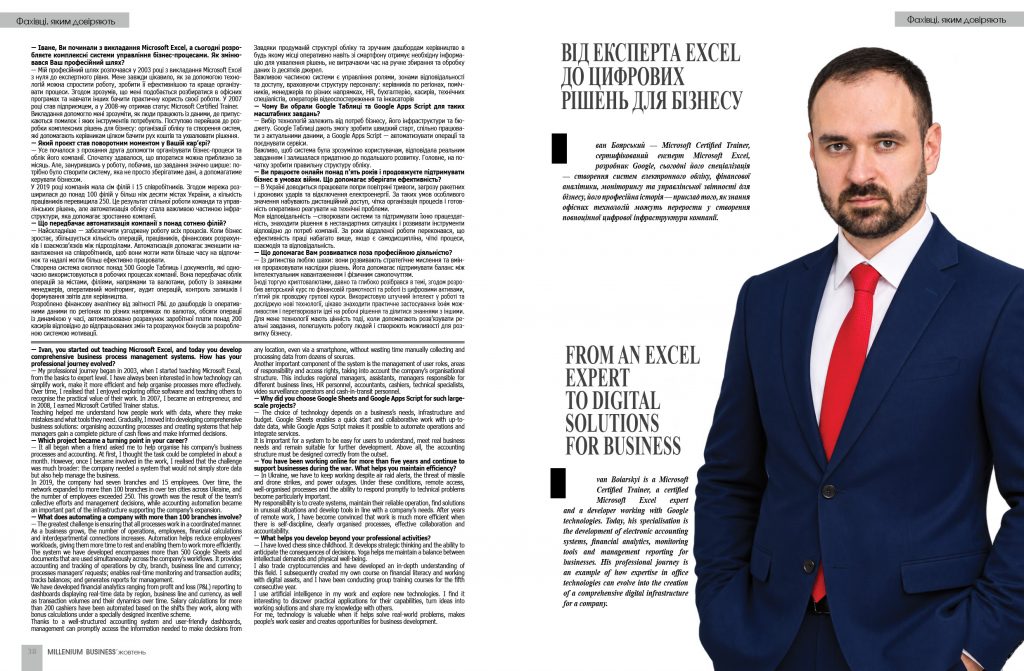
Іван Боярський — Microsoft Certified Trainer, сертифікований експерт Microsoft Excel, розробник Google, сьогодні його спеціалізація — створення систем електронного обліку, фінансової аналітики, моніторингу та управлінської звітності для бізнесу, його професійна історія — приклад того, як знання офісних технологій можуть перерости у створення повноцінної цифрової інфраструктури компанії.
— Іване, Ви починали з викладання Microsoft Excel, а сьогодні розробляєте комплексні системи управління бізнес-процесами. Як змінювався Ваш професійний шлях?
— Мій професійний шлях розпочався у 2003 році з викладання Microsoft Excel з нуля до експертного рівня. Мене завжди цікавило, як за допомогою технологій можна спростити роботу, зробити її ефективнішою та краще організувати процеси. Згодом зрозумів, що мені подобається розбиратися в офісних програмах та навчати інших бачити практичну користь своєї роботи. У 2007 році став підприємцем, а у 2008-му отримав статус Microsoft Certified Trainer.
Викладання допомогло мені зрозуміти, як люди працюють із даними, де припускаються помилок і яких інструментів потребують. Поступово перейшов до розробки комплексних рішень для бізнесу: організації обліку та створення систем, які допомагають керівникам цілком бачити рух коштів та ухвалювати рішення.
— Який проєкт став поворотним моментом у Вашій кар’єрі?
— Усе почалося з прохання друга допомогти організувати бізнес-процеси та облік його компанії. Спочатку здавалося, що впоратися можна приблизно за місяць. Але, занурившись у роботу, побачив, що завдання значно ширше: потрібно було створити систему, яка не просто зберігатиме дані, а допомагатиме керувати бізнесом.
У 2019 році компанія мала сім філій і 15 співробітників. Згодом мережа розширилася до понад 100 філій у більш ніж десяти містах України, а кількість працівників перевищила 250. Це результат спільної роботи команди та управлінських рішень, але автоматизація обліку стала важливою частиною інфраструктури, яка допомагає зростанню компанії.
— Що передбачає автоматизація компанії з понад сотнею філій?
— Найскладніше — забезпечити узгоджену роботу всіх процесів. Коли бізнес зростає, збільшується кількість операцій, працівників, фінансових розрахунків і взаємозв’язків між підрозділами. Автоматизація допомагає зменшити навантаження на співробітників, щоб вони могли мати більше часу на відпочинок та надалі могли більш ефективно працювати.
Створена система охоплює понад 500 Google Таблиць і документів, які одночасно використовуються в робочих процесах компанії. Вона передбачає облік операцій за містами, філіями, напрямами та валютами, роботу із заявками менеджерів, оперативний моніторинг, аудит операцій, контроль залишків і формування звітів для керівництва.
Розроблено фінансову аналітику від звітності P&L до дашбордів із оперативними даними по регіонах по різних напрямках по валютах, обсяги операції із динамікою у часі, автоматизовано розрахунок заробітної плати понад 200 касирів відповідно до відпрацьованих змін та розрахунок бонусів за розробленою системою мотивації.
Завдяки продуманій структурі обліку та зручним дашбордам керівництво в будь якому місці оперативно навіть зі смартфону отримує необхідну інформацію для ухвалення рішень, не витрачаючи час на ручне збирання та обробку даних із десятків джерел.
Важливою частиною системи є управління ролями, зонами відповідальності та доступу, враховуючи структуру персоналу: керівників по регіонах, помічників, менеджерів по різних напрямках, HR, бухгалтерію, касирів, технічних спеціалістів, операторів відеоспостереження та інкасаторів
— Чому Ви обрали Google Таблиці та Google Apps Script для таких масштабних завдань?
— Вибір технологій залежить від потреб бізнесу, його інфраструктури та бюджету. Google Таблиці дають змогу зробити швидкий старт, спільно працювати з актуальними даними, а Google Apps Script — автоматизувати операції та поєднувати сервіси.
Важливо, щоб система була зрозумілою користувачам, відповідала реальним завданням і залишалася придатною до подальшого розвитку. Головне, на початку зробити правильну структуру обліку.
— Ви працюєте онлайн понад п’ять років і продовжуєте підтримувати бізнес в умовах війни. Що допомагає зберігати ефективність?
— В Україні доводиться працювати попри повітряні тривоги, загрозу ракетних і дронових ударів та відключення електроенергії. За таких умов особливого значення набувають дистанційний доступ, чітка організація процесів і готовність оперативно реагувати на технічні проблеми.
Моя відповідальність —створювати системи та підтримувати їхню працездатність, знаходити рішення в нестандартних ситуаціях і розвивати інструменти відповідно до потреб компанії. За роки віддаленої роботи переконався, що ефективність праці набагато вище, якщо є самодисципліна, чіткі процеси, взаємодія та відповідальність.
— Що допомагає Вам розвиватися поза професійною діяльністю?
— Із дитинства люблю шахи: вони розвивають стратегічне мислення та вміння прораховувати наслідки рішень. Йога допомагає підтримувати баланс між інтелектуальним навантаженням і фізичним самопочуттям.
Іноді торгую криптовалютами, давно та глибоко розібрався в темі, згодом розробив авторський курс по фінансовій грамотності та роботі із цифровими активами, п’ятий рік проводжу групові курси. Використовую штучний інтелект у роботі та досліджую нові технології, цікаво знаходити практичне застосування їхнім можливостям і перетворювати ідеї на робочі рішення та ділитися знаннями з іншими.
Для мене технології мають цінність тоді, коли допомагають розв’язувати реальні завдання, полегшують роботу людей і створюють можливості для розвитку бізнесу.
FROM AN EXCEL EXPERT TO DIGITAL SOLUTIONS FOR BUSINESS
Іvan Boiarskyi is a Microsoft Certified Trainer, a certified Microsoft Excel expert and a developer working with Google technologies. Today, his specialisation is the development of electronic accounting systems, financial analytics, monitoring tools and management reporting for businesses. His professional journey is an example of how expertise in office technologies can evolve into the creation of a comprehensive digital infrastructure for a company.
— Ivan, you started out teaching Microsoft Excel, and today you develop comprehensive business process management systems. How has your professional journey evolved?
— My professional journey began in 2003, when I started teaching Microsoft Excel, from the basics to expert level. I have always been interested in how technology can simplify work, make it more efficient and help organise processes more effectively. Over time, I realised that I enjoyed exploring office software and teaching others to recognise the practical value of their work. In 2007, I became an entrepreneur, and in 2008, I earned Microsoft Certified Trainer status.
Teaching helped me understand how people work with data, where they make mistakes and what tools they need. Gradually, I moved into developing comprehensive business solutions: organising accounting processes and creating systems that help managers gain a complete picture of cash flows and make informed decisions.
— Which project became a turning point in your career?
— It all began when a friend asked me to help organise his company’s business processes and accounting. At first, I thought the task could be completed in about a month. However, once I became involved in the work, I realised that the challenge was much broader: the company needed a system that would not simply store data but also help manage the business.
In 2019, the company had seven branches and 15 employees. Over time, the network expanded to more than 100 branches in over ten cities across Ukraine, and the number of employees exceeded 250. This growth was the result of the team’s collective efforts and management decisions, while accounting automation became an important part of the infrastructure supporting the company’s expansion.
— What does automating a company with more than 100 branches involve?
— The greatest challenge is ensuring that all processes work in a coordinated manner. As a business grows, the number of operations, employees, financial calculations and interdepartmental connections increases. Automation helps reduce employees’ workloads, giving them more time to rest and enabling them to work more efficiently.
The system we have developed encompasses more than 500 Google Sheets and documents that are used simultaneously across the company’s workflows. It provides accounting and tracking of operations by city, branch, business line and currency; processes managers’ requests; enables real-time monitoring and transaction audits; tracks balances; and generates reports for management.
We have developed financial analytics ranging from profit and loss (P&L) reporting to dashboards displaying real-time data by region, business line and currency, as well as transaction volumes and their dynamics over time. Salary calculations for more than 200 cashiers have been automated based on the shifts they work, along with bonus calculations under a specially designed incentive scheme.
Thanks to a well-structured accounting system and user-friendly dashboards, management can promptly access the information needed to make decisions from any location, even via a smartphone, without wasting time manually collecting and processing data from dozens of sources.
Another important component of the system is the management of user roles, areas of responsibility and access rights, taking into account the company’s organisational structure. This includes regional managers, assistants, managers responsible for different business lines, HR personnel, accountants, cashiers, technical specialists, video surveillance operators and cash-in-transit personnel.
— Why did you choose Google Sheets and Google Apps Script for such large-scale projects?
— The choice of technology depends on a business’s needs, infrastructure and budget. Google Sheets enables a quick start and collaborative work with up-to-date data, while Google Apps Script makes it possible to automate operations and integrate services.
It is important for a system to be easy for users to understand, meet real business needs and remain suitable for further development. Above all, the accounting structure must be designed correctly from the outset.
— You have been working online for more than five years and continue to support businesses during the war. What helps you maintain efficiency?
— In Ukraine, we have to keep working despite air raid alerts, the threat of missile and drone strikes, and power outages. Under these conditions, remote access, well-organised processes and the ability to respond promptly to technical problems become particularly important.
My responsibility is to create systems, maintain their reliable operation, find solutions in unusual situations and develop tools in line with a company’s needs. After years of remote work, I have become convinced that work is much more efficient when there is self-discipline, clearly organised processes, effective collaboration and accountability.
— What helps you develop beyond your professional activities?
— I have loved chess since childhood. It develops strategic thinking and the ability to anticipate the consequences of decisions. Yoga helps me maintain a balance between intellectual demands and physical well-being.
I also trade cryptocurrencies and have developed an in-depth understanding of this field. I subsequently created my own course on financial literacy and working with digital assets, and I have been conducting group training courses for the fifth consecutive year.
I use artificial intelligence in my work and explore new technologies. I find it interesting to discover practical applications for their capabilities, turn ideas into working solutions and share my knowledge with others.
For me, technology is valuable when it helps solve real-world problems, makes people’s work easier and creates opportunities for business development.