
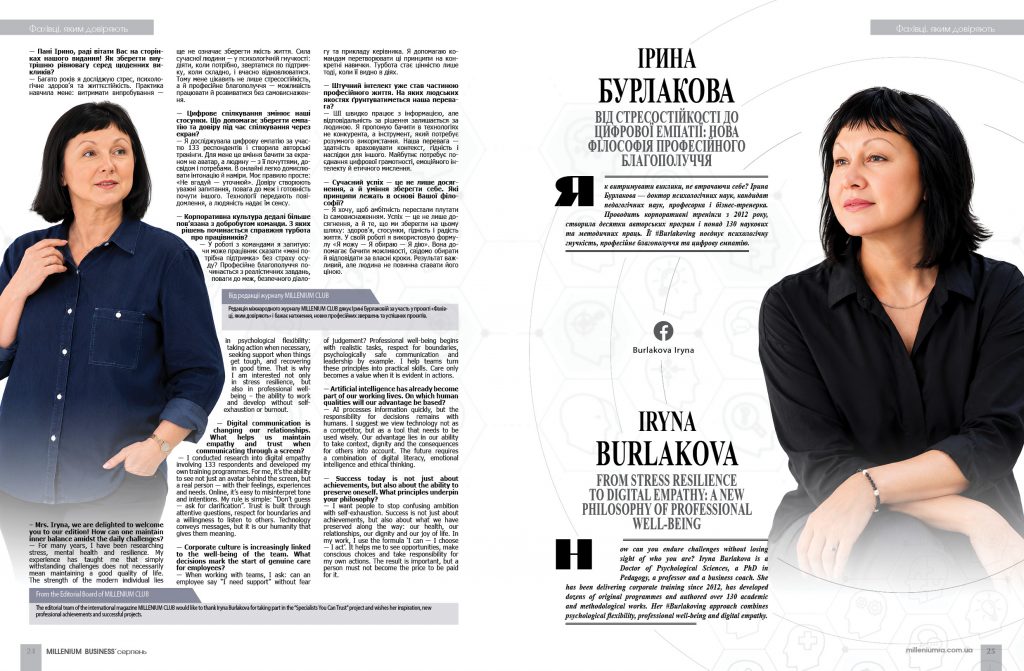
Як витримувати виклики, не втрачаючи себе? Ірина Бурлакова — доктор психологічних наук, кандидат педагогічних наук, професорка і бізнес-тренерка. Проводить корпоративні тренінги з 2012 року, створила десятки авторських програм і понад 130 наукових та методичних праць. Її #Burlakoving поєднує психологічну гнучкість, професійне благополуччя та цифрову емпатію.
— Пані Ірино, раді вітати Вас на сторінках нашого видання! Як зберегти внутрішню рівновагу серед щоденних викликів?
— Багато років я досліджую стрес, психологічне здоров’я та життєстійкість. Практика навчила мене: витримати випробування — ще не означає зберегти якість життя. Сила сучасної людини — у психологічній гнучкості: діяти, коли потрібно, звертатися по підтримку, коли складно, і вчасно відновлюватися. Тому мене цікавить не лише стресостійкість, а й професійне благополуччя — можливість працювати й розвиватися без самовиснаження.
— Цифрове спілкування змінює наші стосунки. Що допомагає зберегти емпатію та довіру під час спілкування через екран?
— Я досліджувала цифрову емпатію за участю 133 респондентів і створила авторські тренінги. Для мене це вміння бачити за екраном не аватар, а людину — з її почуттями, досвідом і потребами. В онлайні легко домислювати інтонацію й наміри. Моє правило просте: «Не вгадуй — уточнюй». Довіру створюють уважні запитання, повага до меж і готовність почути іншого. Технології передають повідомлення, а людяність надає їм сенсу.
— Корпоративна культура дедалі більше пов’язана з добробутом команди. З яких рішень починається справжня турбота про працівників?
— У роботі з командами я запитую: чи може працівник сказати «мені потрібна підтримка» без страху осуду? Професійне благополуччя починається з реалістичних завдань, поваги до меж, безпечного діалогу та прикладу керівника. Я допомагаю командам перетворювати ці принципи на конкретні навички. Турбота стає цінністю лише тоді, коли її видно в діях.
— Штучний інтелект уже став частиною професійного життя. На яких людських якостях ґрунтуватиметься наша перевага?
— ШІ швидко працює з інформацією, але відповідальність за рішення залишається за людиною. Я пропоную бачити в технологіях не конкурента, а інструмент, який потребує розумного використання. Наша перевага — здатність враховувати контекст, гідність і наслідки для іншого. Майбутнє потребує поєднання цифрової грамотності, емоційного інтелекту й етичного мислення.
— Сучасний успіх — це не лише досягнення, а й уміння зберегти себе. Які принципи лежать в основі Вашої філософії?
— Я хочу, щоб амбітність перестали плутати із самовиснаженням. Успіх — це не лише досягнення, а й те, що ми зберегли на цьому шляху: здоров’я, стосунки, гідність і радість життя. У своїй роботі я використовую формулу «Я можу — Я обираю — Я дію». Вона допомагає бачити можливості, свідомо обирати й відповідати за власні кроки. Результат важливий, але людина не повинна ставати його ціною.
Від редакції журналу MILLENIUM CLUB
Редакція міжнародного журналу MILLENIUM CLUB дякує Ірині Бурлаковій за участь у проєкті «Фахівці, яким довіряють» і бажає натхнення, нових професійних звершень та успішних проєктів.
Iryna BURLAKOVA. From Stress Resilience to Digital Empathy: A New Philosophy of Professional Well-being
Нow can you endure challenges without losing sight of who you are? Iryna Burlakova is a Doctor of Psychological Sciences, a PhD in Pedagogy, a professor and a business coach. She has been delivering corporate training since 2012, has developed dozens of original programmes and authored over 130 academic and methodological works. Her #Burlakoving approach combines psychological flexibility, professional well-being and digital empathy.
– Mrs. Iryna, we are delighted to welcome you to our edition! How can one maintain inner balance amidst the daily challenges?
— For many years, I have been researching stress, mental health and resilience. My experience has taught me that simply withstanding challenges does not necessarily mean maintaining a good quality of life. The strength of the modern individual lies in psychological flexibility: taking action when necessary, seeking support when things get tough, and recovering in good time. That is why I am interested not only in stress resilience, but also in professional well-being – the ability to work and develop without self-exhaustion or burnout.
— Digital communication is changing our relationships. What helps us maintain empathy and trust when communicating through a screen?
— I conducted research into digital empathy involving 133 respondents and developed my own training programmes. For me, it’s the ability to see not just an avatar behind the screen, but a real person — with their feelings, experiences and needs. Online, it’s easy to misinterpret tone and intentions. My rule is simple: “Don’t guess — ask for clarification”. Trust is built through attentive questions, respect for boundaries and a willingness to listen to others. Technology conveys messages, but it is our humanity that gives them meaning.
— Corporate culture is increasingly linked to the well-being of the team. What decisions mark the start of genuine care for employees?
— When working with teams, I ask: can an employee say “I need support” without fear of judgement? Professional well-being begins with realistic tasks, respect for boundaries, psychologically safe communication and leadership by example. I help teams turn these principles into practical skills. Care only becomes a value when it is evident in actions.
— Artificial intelligence has already become part of our working lives. On which human qualities will our advantage be based?
— AI processes information quickly, but the responsibility for decisions remains with humans. I suggest we view technology not as a competitor, but as a tool that needs to be used wisely. Our advantage lies in our ability to take context, dignity and the consequences for others into account. The future requires a combination of digital literacy, emotional intelligence and ethical thinking.
— Success today is not just about achievements, but also about the ability to preserve oneself. What principles underpin your philosophy?
— I want people to stop confusing ambition with self-exhaustion. Success is not just about achievements, but also about what we have preserved along the way: our health, our relationships, our dignity and our joy of life. In my work, I use the formula ‘I can — I choose — I act’. It helps me to see opportunities, make conscious choices and take responsibility for my own actions. The result is important, but a person must not become the price to be paid for it.
From the Editorial Board of MILLENIUM CLUB
The editorial team of the international magazine MILLENIUM CLUB would like to thank Iryna Burlakova for taking part in the “Specialists You Can Trust” project and wishes her inspiration, new professional achievements and successful projects.