
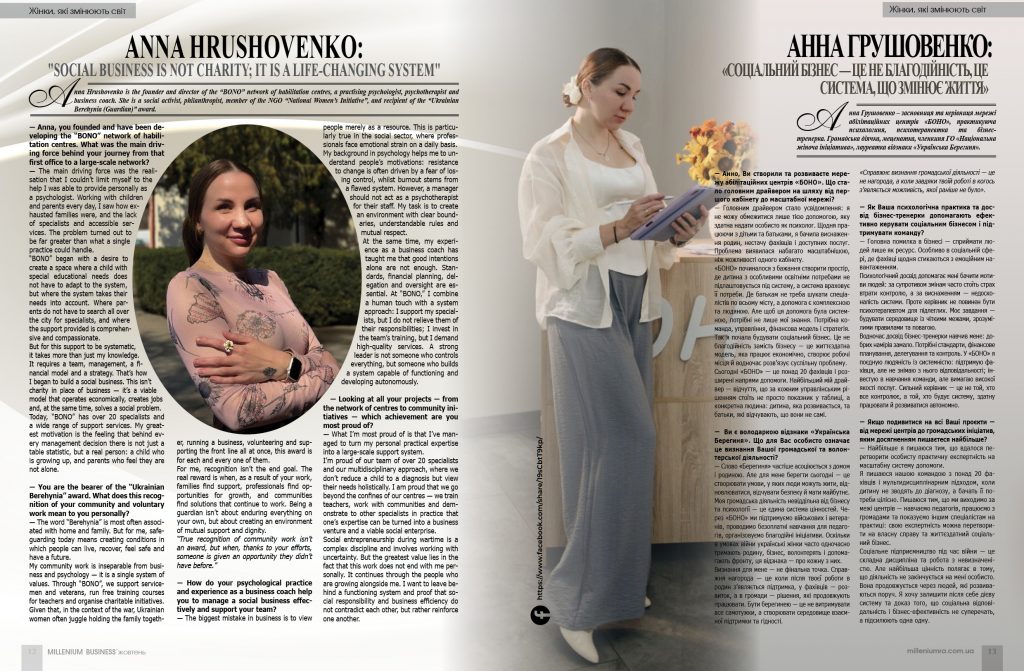
Анна Грушовенко – засновниця та керівниця мережі абілітаційних центрів «БОНО», практикуюча психологиня, психотерапевтка та бізнес-тренерка. Громадська діячка, меценатка, членкиня ГО «Національна жіноча ініціатива», лауреатка відзнаки «Українська Берегиня».
— Анно, Ви створили та розвиваєте мережу абілітаційних центрів «БОНО». Що стало головним драйвером на шляху від першого кабінету до масштабної мережі?
— Головним драйвером стало усвідомлення: я не можу обмежитися лише тією допомогою, яку здатна надати особисто як психолог. Щодня працюючи з дітьми та батьками, я бачила виснаження родин, нестачу фахівців і доступних послуг. Проблема виявилася набагато масштабнішою, ніж можливості одного кабінету.
«БОНО» починалося з бажання створити простір, де дитина з особливими освітніми потребами не підлаштовується під систему, а система враховує її потреби. Де батькам не треба шукати спеціалістів по всьому місту, а допомога є комплексною та людяною. Але щоб ця допомога була системною, потрібні не лише мої знання. Потрібна команда, управління, фінансова модель і стратегія. Так я почала будувати соціальний бізнес. Це не благодійність замість бізнесу — це життєздатна модель, яка працює економічно, створює робочі місця й водночас розв’язує суспільну проблему.
Сьогодні «БОНО» — це понад 20 фахівців і розширені напрями допомоги. Найбільший мій драйвер — відчуття, що за кожним управлінським рішенням стоїть не просто показник у таблиці, а конкретна людина: дитина, яка розвивається, та батьки, які відчувають, що вони не самі.
— Ви є володаркою відзнаки «Українська Берегиня». Що для Вас особисто означає це визнання Вашої громадської та волонтерської діяльності?
— Слово «Берегиня» частіше асоціюється з домом і родиною. Але для мене берегти сьогодні — це створювати умови, у яких люди можуть жити, відновлюватися, відчувати безпеку й мати майбутнє.
Моя громадська діяльність невіддільна від бізнесу та психології — це єдина система цінностей. Через «БОНО» ми підтримуємо військових і ветеранів, проводимо безоплатні навчання для педагогів, організовуємо благодійні ініціативи. Оскільки в умовах війни українські жінки часто одночасно тримають родину, бізнес, волонтерять і допомагають фронту, ця відзнака — про кожну з них.
Визнання для мене — не фінальна точка. Справжня нагорода — це коли після твоєї роботи в родин з’являється підтримка, у фахівців — розвиток, а в громади — рішення, які продовжують працювати. Бути берегинею — це не витримувати все самотужки, а створювати середовище взаємної підтримки та гідності.
«Справжнє визнання громадської діяльності — це не нагорода, а коли завдяки твоїй роботі в когось з’являється можливість, якої раніше не було».
— Як Ваша психологічна практика та досвід бізнес-тренерки допомагають ефективно керувати соціальним бізнесом і підтримувати команду?
— Головна помилка в бізнесі — сприймати людей лише як ресурс. Особливо в соціальній сфері, де фахівці щодня стикаються з емоційним навантаженням.
Психологічний досвід допомагає мені бачити мотиви людей: за супротивом змінам часто стоїть страх втрати контролю, а за виснаженням — недосконалість системи. Проте керівник не повинен бути психотерапевтом для підлеглих. Моє завдання — будувати середовище із чіткими межами, зрозумілими правилами та повагою.
Водночас досвід бізнес-тренерки навчив мене: добрих намірів замало. Потрібні стандарти, фінансове планування, делегування та контроль. У «БОНО» я поєдную людяність із системністю: підтримую фахівця, але не знімаю з нього відповідальності; інвестую в навчання команди, але вимагаю високої якості послуг. Сильний керівник — це не той, хто все контролює, а той, хто будує систему, здатну працювати й розвиватися автономно.
— Якщо подивитися на всі Ваші проєкти — від мережі центрів до громадських ініціатив, яким досягненням пишаєтеся найбільше?
— Найбільше я пишаюся тим, що вдалося перетворити особисту практичну експертність на масштабну систему допомоги.
Я пишаюся нашою командою з понад 20 фахівців і мультидисциплінарним підходом, коли дитину не зводять до діагнозу, а бачать її потреби цілісно. Пишаюся тим, що ми виходимо за межі центрів — навчаємо педагогів, працюємо з громадами та показуємо іншим спеціалістам на практиці: свою експертність можна перетворити на власну справу та життєздатний соціальний бізнес.
Соціальне підприємництво під час війни — це складна дисципліна та робота з невизначеністю. Але найбільша цінність полягає в тому, що діяльність не закінчується на мені особисто. Вона продовжується через людей, які розвиваються поруч. Я хочу залишити після себе дієву систему та доказ того, що соціальна відповідальність і бізнес-ефективність не суперечать, а підсилюють одна одну.
ANNA HRUSHOVENKO: “Social Business is not Charity; it is a Life-changing System”
Аnna Hrushovenko is the founder and director of the “BONO” network of habilitation centres, a practising psychologist, psychotherapist and business coach. She is a social activist, philanthropist, member of the NGO “National Women’s Initiative”, and recipient of the “Ukrainian Berehynia (Guardian)” award.
— Anna, you founded and have been developing the “BONO” network of habilitation centres. What was the main driving force behind your journey from that first office to a large-scale network?
— The main driving force was the realisation that I couldn’t limit myself to the help I was able to provide personally as a psychologist. Working with children and parents every day, I saw how exhausted families were, and the lack of specialists and accessible services. The problem turned out to be far greater than what a single practice could handle.
“BONO” began with a desire to create a space where a child with special educational needs does not have to adapt to the system, but where the system takes their needs into account. Where parents do not have to search all over the city for specialists, and where the support provided is comprehensive and compassionate.
But for this support to be systematic, it takes more than just my knowledge. It requires a team, management, a financial model and a strategy. That’s how I began to build a social business. This isn’t charity in place of business — it’s a viable model that operates economically, creates jobs and, at the same time, solves a social problem.
Today, “BONO” has over 20 specialists and a wide range of support services. My greatest motivation is the feeling that behind every management decision there is not just a table statistic, but a real person: a child who is growing up, and parents who feel they are not alone.
— You are the bearer of the “Ukrainian Berehynia” award. What does this recognition of your community and voluntary work mean to you personally?
— The word “Berehynia” is most often associated with home and family. But for me, safeguarding today means creating conditions in which people can live, recover, feel safe and have a future.
My community work is inseparable from business and psychology — it is a single system of values. Through “BONO”, we support servicemen and veterans, run free training courses for teachers and organise charitable initiatives. Given that, in the context of the war, Ukrainian women often juggle holding the family together, running a business, volunteering and supporting the front line all at once, this award is for each and every one of them.
For me, recognition isn’t the end goal. The real reward is when, as a result of your work, families find support, professionals find opportunities for growth, and communities find solutions that continue to work. Being a guardian isn’t about enduring everything on your own, but about creating an environment of mutual support and dignity.
“True recognition of community work isn’t an award, but when, thanks to your efforts, someone is given an opportunity they didn’t have before.”
— How do your psychological practice and experience as a business coach help you to manage a social business effectively and support your team?
— The biggest mistake in business is to view people merely as a resource. This is particularly true in the social sector, where professionals face emotional strain on a daily basis.
My background in psychology helps me to understand people’s motivations: resistance to change is often driven by a fear of losing control, whilst burnout stems from a flawed system. However, a manager should not act as a psychotherapist for their staff. My task is to create an environment with clear boundaries, understandable rules and mutual respect.
At the same time, my experience as a business coach has taught me that good intentions alone are not enough. Standards, financial planning, delegation and oversight are essential. At “BONO,” I combine a human touch with a system approach: I support my specialists, but I do not relieve them of their responsibilities; I invest in the team’s training, but I demand high-quality services. A strong leader is not someone who controls everything, but someone who builds a system capable of functioning and developing autonomously.
— Looking at all your projects — from the network of centres to community initiatives — which achievement are you most proud of?
— What I’m most proud of is that I’ve managed to turn my personal practical expertise into a large-scale support system.
I’m proud of our team of over 20 specialists and our multidisciplinary approach, where we don’t reduce a child to a diagnosis but view their needs holistically. I am proud that we go beyond the confines of our centres — we train teachers, work with communities and demonstrate to other specialists in practice that one’s expertise can be turned into a business venture and a viable social enterprise.
Social entrepreneurship during wartime is a complex discipline and involves working with uncertainty. But the greatest value lies in the fact that this work does not end with me personally. It continues through the people who are growing alongside me. I want to leave behind a functioning system and proof that social responsibility and business efficiency do not contradict each other, but rather reinforce one another.