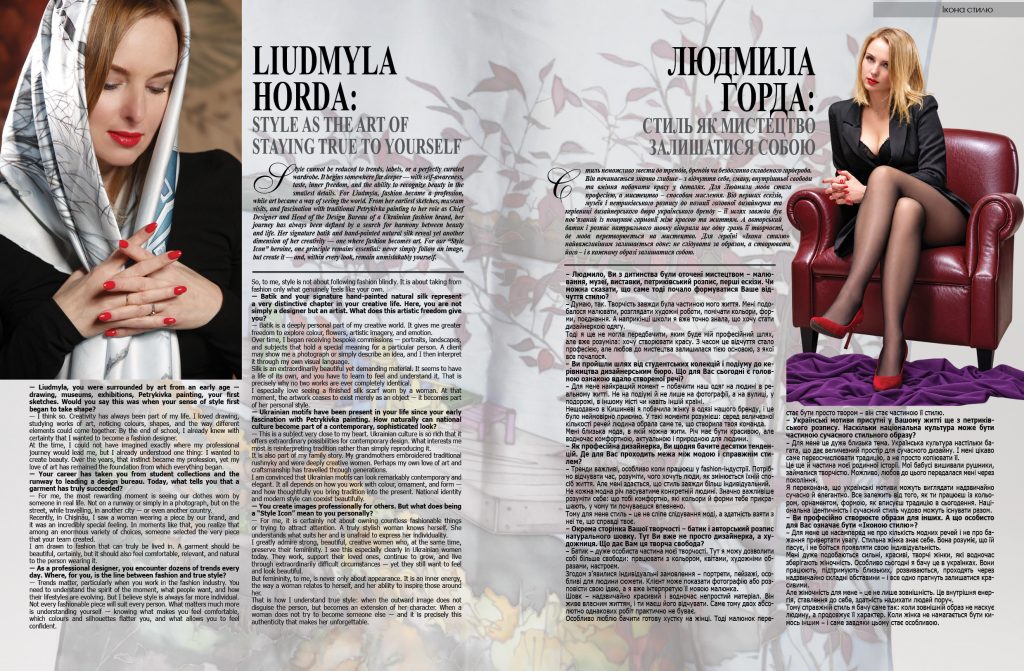
Стиль неможливо звести до трендів, брендів чи бездоганно складеного гардероба. Він починається значно глибше – з відчуття себе, смаку, внутрішньої свободи та вміння побачити красу у деталях. Для Людмили мода стала професією, а мистецтво – способом мислення. Від перших ескізів, музеїв і петриківського розпису до позиції головної дизайнерки та керівниці дизайнерського бюро українського бренду – її шлях завжди був пов’язаний із пошуком гармонії між красою та життям. А авторський батик і розпис натурального шовку відкрили ще одну грань її творчості, де мода перетворюється на мистецтво. Для героїні «Ікони стилю» найважливішим залишається одне: не слідувати за образом, а створювати його – і в кожному образі залишатися собою.
– Людмило, Ви з дитинства були оточені мистецтвом – малювання, музеї, виставки, петриківський розпис, перші ескізи. Чи можна сказати, що саме тоді почало формуватися Ваше відчуття стилю?
– Думаю, так. Творчість завжди була частиною мого життя. Мені подобалося малювати, розглядати художні роботи, помічати кольори, форми, поєднання. А наприкінці школи я вже точно знала, що хочу стати дизайнеркою одягу.
Тоді я ще не могла передбачити, яким буде мій професійний шлях, але вже розуміла: хочу створювати красу. З часом це відчуття стало професією, але любов до мистецтва залишилася тією основою, з якої все почалося.
– Ви пройшли шлях від студентських колекцій і подіуму до керівництва дизайнерським бюро. Що для Вас сьогодні є головною ознакою вдало створеної речі?
– Для мене найкращий момент – побачити наш одяг на людині в реальному житті. Не на подіумі й не лише на фотографії, а на вулиці, у подорожі, в іншому місті чи навіть іншій країні.
Нещодавно в Кишиневі я побачила жінку в одязі нашого бренду, і це було неймовірно приємно. У такі моменти розумієш: серед величезної кількості речей людина обрала саме те, що створила твоя команда.
Мені близька мода, в якій можна жити. Річ має бути красивою, але водночас комфортною, актуальною і природною для людини.
– Як професійна дизайнерка, Ви щодня бачите десятки тенденцій. Де для Вас проходить межа між модою і справжнім стилем?
– Тренди важливі, особливо коли працюєш у fashion-індустрії. Потрібно відчувати час, розуміти, чого хочуть люди, як змінюється їхній спосіб життя. Але мені здається, що стиль завжди більш індивідуальний.
Не кожна модна річ пасуватиме конкретній людині. Значно важливіше розуміти себе: що тобі комфортно, які кольори й форми тебе прикрашають, у чому ти почуваєшся впевнено.
Тому для мене стиль – це не сліпе слідування моді, а здатність взяти з неї те, що справді твоє.
– Окрема сторінка Вашої творчості – батик і авторський розпис натурального шовку. Тут Ви вже не просто дизайнерка, а художниця. Що дає Вам ця творча свобода?
– Батик – дуже особиста частина моєї творчості. Тут я можу дозволити собі більше свободи: працювати з кольором, квітами, художніми образами, настроєм.
Згодом з’явилися індивідуальні замовлення – портрети, пейзажі, особливі для людини сюжети. Клієнт може показати фотографію або розповісти свою ідею, а я вже інтерпретую її мовою малюнка.
Шовк – надзвичайно красивий і водночас непростий матеріал. Він живе власним життям, і ти маєш його відчувати. Саме тому двох абсолютно однакових робіт практично не буває.
Особливо люблю бачити готову хустку на жінці. Тоді малюнок перестає бути просто твором – він стає частиною її стилю.
– Українські мотиви присутні у Вашому житті ще з петриківського розпису. Наскільки національна культура може бути частиною сучасного стильного образу?
– Для мене це дуже близька тема. Українська культура настільки багата, що дає величезний простір для сучасного дизайну. І мені цікаво саме переосмислювати традицію, а не просто копіювати її.
Це ще й частина моєї родинної історії. Мої бабусі вишивали рушники, займалися творчістю. Можливо, любов до цього передалася мені через покоління.
Я переконана, що українські мотиви можуть виглядати надзвичайно сучасно й елегантно. Все залежить від того, як ти працюєш із кольором, орнаментом, формою, як вписуєш традицію в сьогодення. Національна ідентичність і сучасний стиль чудово можуть існувати разом.
– Ви професійно створюєте образи для інших. А що особисто для Вас означає бути «Іконою стилю»?
– Для мене це насамперед не про кількість модних речей і не про бажання привертати увагу. Стильна жінка знає себе. Вона розуміє, що їй пасує, і не боїться проявляти свою індивідуальність.
Мені дуже подобаються сильні, красиві, творчі жінки, які водночас зберігають жіночність. Особливо сьогодні я бачу це в українках. Вони працюють, підтримують близьких, розвиваються, проходять через надзвичайно складні обставини – і все одно прагнуть залишатися красивими.
Але жіночність для мене – це не лише зовнішність. Це внутрішня енергія, ставлення до себе, здатність надихати людей поруч.
Тому справжній стиль я бачу саме так: коли зовнішній образ не маскує людину, а продовжує її характер. Коли жінка не намагається бути кимось іншим – і саме завдяки цьому стає особливою.
LIUDMYLA Horda: STYLE AS THE ART OF STAYING TRUE TO YOURSELF
Style cannot be reduced to trends, labels, or a perfectly curated wardrobe. It begins somewhere far deeper — with self-awareness, taste, inner freedom, and the ability to recognize beauty in the smallest details. For Liudmyla, fashion became a profession, while art became a way of seeing the world. From her earliest sketches, museum visits, and fascination with traditional Petrykivka painting to her role as Chief Designer and Head of the Design Bureau of a Ukrainian fashion brand, her journey has always been defined by a search for harmony between beauty and life. Her signature batik and hand-painted natural silk reveal yet another dimension of her creativity — one where fashion becomes art. For our “Style Icon” heroine, one principle remains essential: never simply follow an image, but create it — and, within every look, remain unmistakably yourself.
— Liudmyla, you were surrounded by art from an early age — drawing, museums, exhibitions, Petrykivka painting, your first sketches. Would you say this was when your sense of style first began to take shape?
— I think so. Creativity has always been part of my life. I loved drawing, studying works of art, noticing colours, shapes, and the way different elements could come together. By the end of school, I already knew with certainty that I wanted to become a fashion designer.
At the time, I could not have imagined exactly where my professional journey would lead me, but I already understood one thing: I wanted to create beauty. Over the years, that instinct became my profession, yet my love of art has remained the foundation from which everything began.
— Your career has taken you from student collections and the runway to leading a design bureau. Today, what tells you that a garment has truly succeeded?
— For me, the most rewarding moment is seeing our clothes worn by someone in real life. Not on a runway or simply in a photograph, but on the street, while travelling, in another city — or even another country.
Recently, in Chișinău, I saw a woman wearing a piece by our brand, and it was an incredibly special feeling. In moments like that, you realize that among an enormous variety of choices, someone selected the very piece that your team created.
I am drawn to fashion that can truly be lived in. A garment should be beautiful, certainly, but it should also feel comfortable, relevant, and natural to the person wearing it.
— As a professional designer, you encounter dozens of trends every day. Where, for you, is the line between fashion and true style?
— Trends matter, particularly when you work in the fashion industry. You need to understand the spirit of the moment, what people want, and how their lifestyles are evolving. But I believe style is always far more individual.
Not every fashionable piece will suit every person. What matters much more is understanding yourself — knowing what makes you feel comfortable, which colours and silhouettes flatter you, and what allows you to feel confident.
So, to me, style is not about following fashion blindly. It is about taking from fashion only what genuinely feels like your own.
— Batik and your signature hand-painted natural silk represent a very distinctive chapter in your creative life. Here, you are not simply a designer but an artist. What does this artistic freedom give you?
— Batik is a deeply personal part of my creative world. It gives me greater freedom to explore colour, flowers, artistic imagery, and emotion.
Over time, I began receiving bespoke commissions — portraits, landscapes, and subjects that hold a special meaning for a particular person. A client may show me a photograph or simply describe an idea, and I then interpret it through my own visual language.
Silk is an extraordinarily beautiful yet demanding material. It seems to have a life of its own, and you have to learn to feel and understand it. That is precisely why no two works are ever completely identical.
I especially love seeing a finished silk scarf worn by a woman. At that moment, the artwork ceases to exist merely as an object — it becomes part of her personal style.
— Ukrainian motifs have been present in your life since your early fascination with Petrykivka painting. How naturally can national culture become part of a contemporary, sophisticated look?
— This is a subject very close to my heart. Ukrainian culture is so rich that it offers extraordinary possibilities for contemporary design. What interests me most is reinterpreting tradition rather than simply reproducing it.
It is also part of my family story. My grandmothers embroidered traditional rushnyky and were deeply creative women. Perhaps my own love of art and craftsmanship has travelled through generations.
I am convinced that Ukrainian motifs can look remarkably contemporary and elegant. It all depends on how you work with colour, ornament, and form — and how thoughtfully you bring tradition into the present. National identity and modern style can coexist beautifully.
— You create images professionally for others. But what does being a “Style Icon” mean to you personally?
— For me, it is certainly not about owning countless fashionable things or trying to attract attention. A truly stylish woman knows herself. She understands what suits her and is unafraid to express her individuality.
I greatly admire strong, beautiful, creative women who, at the same time, preserve their femininity. I see this especially clearly in Ukrainian women today. They work, support their loved ones, continue to grow, and live through extraordinarily difficult circumstances — yet they still want to feel and look beautiful.
But femininity, to me, is never only about appearance. It is an inner energy, the way a woman relates to herself, and her ability to inspire those around her.
That is how I understand true style: when the outward image does not disguise the person, but becomes an extension of her character. When a woman does not try to become someone else — and it is precisely this authenticity that makes her unforgettable.