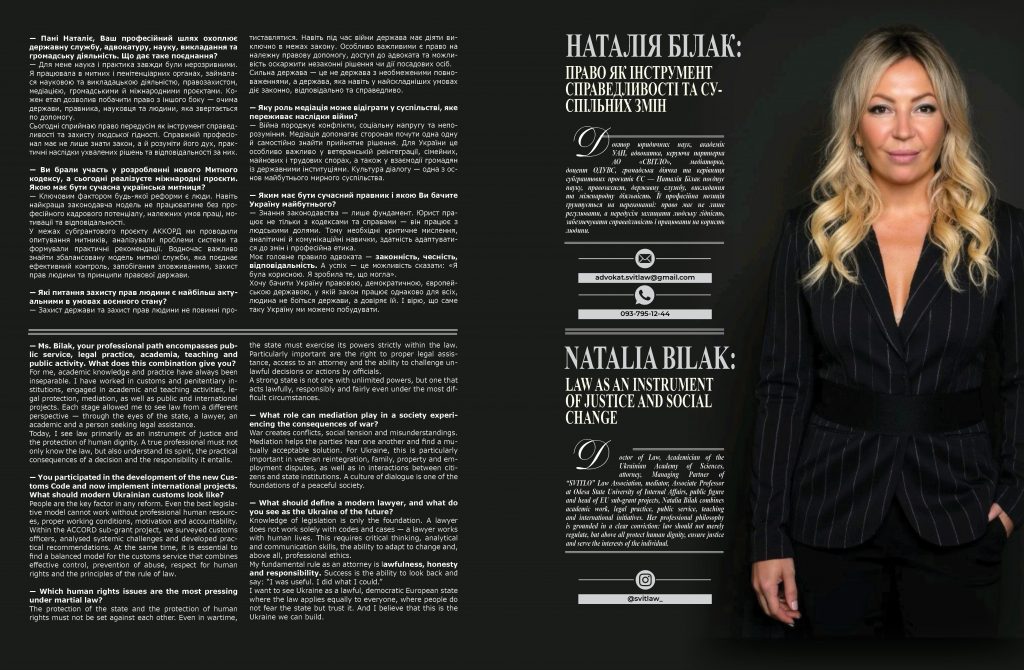
Доктор юридичних наук, академік УАН, адвокатка, керуюча партнерка АО «СВІТЛО», медіаторка, доцент ОДУВС, громадська діячка та керівниця субгрантових проєктів ЄС — Наталія Білак поєднує науку, правозахист, державну службу, викладання та міжнародну діяльність. Її професійна позиція ґрунтується на переконанні: право має не лише регулювати, а передусім захищати людську гідність, забезпечувати справедливість і працювати на користь людини.
— Пані Наталіє, Ваш професійний шлях охоплює державну службу, адвокатуру, науку, викладання та громадську діяльність. Що дає таке поєднання?
— Для мене наука і практика завжди були нерозривними. Я працювала в митних і пенітенціарних органах, займалася науковою та викладацькою діяльністю, правозахистом, медіацією, громадськими й міжнародними проєктами. Кожен етап дозволив побачити право з іншого боку — очима держави, правника, науковця та людини, яка звертається по допомогу.
Сьогодні сприймаю право передусім як інструмент справедливості та захисту людської гідності. Справжній професіонал має не лише знати закон, а й розуміти його дух, практичні наслідки ухвалених рішень та відповідальності за них.
— Ви брали участь у розробленні нового Митного кодексу, а сьогодні реалізуєте міжнародні проєкти. Якою має бути сучасна українська митниця?
— Ключовим фактором будь-якої реформи є люди. Навіть найкраща законодавча модель не працюватиме без професійного кадрового потенціалу, належних умов праці, мотивації та відповідальності.
У межах субгрантового проєкту АККОРД ми проводили опитування митників, аналізували проблеми системи та формували практичні рекомендації. Водночас важливо знайти збалансовану модель митної служби, яка поєднає ефективний контроль, запобігання зловживанням, захист прав людини та принципи правової держави.
— Які питання захисту прав людини є найбільш актуальними в умовах воєнного стану?
— Захист держави та захист прав людини не повинні протиставлятися. Навіть під час війни держава має діяти виключно в межах закону. Особливо важливими є право на належну правову допомогу, доступ до адвоката та можливість оскаржити незаконні рішення чи дії посадових осіб.
Сильна держава — це не держава з необмеженими повноваженнями, а держава, яка навіть у найскладніших умовах діє законно, відповідально та справедливо.
— Яку роль медіація може відіграти у суспільстві, яке переживає наслідки війни?
— Війна породжує конфлікти, соціальну напругу та непорозуміння. Медіація допомагає сторонам почути одна одну й самостійно знайти прийнятне рішення. Для України це особливо важливо у ветеранській реінтеграції, сімейних, майнових і трудових спорах, а також у взаємодії громадян із державними інституціями. Культура діалогу — одна з основ майбутнього мирного суспільства.
— Яким має бути сучасний правник і якою Ви бачите Україну майбутнього?
— Знання законодавства — лише фундамент. Юрист працює не тільки з кодексами та справами — він працює з людськими долями. Тому необхідні критичне мислення, аналітичні й комунікаційні навички, здатність адаптуватися до змін і професійна етика.
Моє головне правило адвоката — законність, чесність, відповідальність. А успіх — це можливість сказати: «Я була корисною. Я зробила те, що могла».
Хочу бачити Україну правовою, демократичною, європейською державою, у якій закон працює однаково для всіх, людина не боїться держави, а довіряє їй. І вірю, що саме таку Україну ми можемо побудувати.
Natalia Bilak: Law as an Instrument of Justice and Social Change
Doctor of Law, Academician of the Ukrainian Academy of Sciences, attorney, Managing Partner of “SVITLO” Law Association, mediator, Associate Professor at Odesa State University of Internal Affairs, public figure and head of EU sub-grant projects, Natalia Bilak combines academic work, legal practice, public service, teaching and international initiatives. Her professional philosophy is grounded in a clear conviction: law should not merely regulate, but above all protect human dignity, ensure justice and serve the interests of the individual.
— Ms. Bilak, your professional path encompasses public service, legal practice, academia, teaching and public activity. What does this combination give you?
For me, academic knowledge and practice have always been inseparable. I have worked in customs and penitentiary institutions, engaged in academic and teaching activities, legal protection, mediation, as well as public and international projects. Each stage allowed me to see law from a different perspective — through the eyes of the state, a lawyer, an academic and a person seeking legal assistance.
Today, I see law primarily as an instrument of justice and the protection of human dignity. A true professional must not only know the law, but also understand its spirit, the practical consequences of a decision and the responsibility it entails.
— You participated in the development of the new Customs Code and now implement international projects. What should modern Ukrainian customs look like?
People are the key factor in any reform. Even the best legislative model cannot work without professional human resources, proper working conditions, motivation and accountability.
Within the ACCORD sub-grant project, we surveyed customs officers, analysed systemic challenges and developed practical recommendations. At the same time, it is essential to find a balanced model for the customs service that combines effective control, prevention of abuse, respect for human rights and the principles of the rule of law.
— Which human rights issues are the most pressing under martial law?
The protection of the state and the protection of human rights must not be set against each other. Even in wartime, the state must exercise its powers strictly within the law. Particularly important are the right to proper legal assistance, access to an attorney and the ability to challenge unlawful decisions or actions by officials.
A strong state is not one with unlimited powers, but one that acts lawfully, responsibly and fairly even under the most difficult circumstances.
— What role can mediation play in a society experiencing the consequences of war?
War creates conflicts, social tension and misunderstandings. Mediation helps the parties hear one another and find a mutually acceptable solution. For Ukraine, this is particularly important in veteran reintegration, family, property and employment disputes, as well as in interactions between citizens and state institutions. A culture of dialogue is one of the foundations of a peaceful society.
— What should define a modern lawyer, and what do you see as the Ukraine of the future?
Knowledge of legislation is only the foundation. A lawyer does not work solely with codes and cases — a lawyer works with human lives. This requires critical thinking, analytical and communication skills, the ability to adapt to change and, above all, professional ethics.
My fundamental rule as an attorney is lawfulness, honesty and responsibility. Success is the ability to look back and say: “I was useful. I did what I could.”
I want to see Ukraine as a lawful, democratic European state where the law applies equally to everyone, where people do not fear the state but trust it. And I believe that this is the Ukraine we can build.