
Євгенія Мнишенко — адвокатка, кандидат юридичних наук, членкиня Кваліфікаційно-дисциплінарної комісії прокурорів та активна учасниця професійного діалогу щодо розвитку правосуддя в Україні. У своїй діяльності вона послідовно відстоює принципи незалежності, доброчесності, відкритості та поваги до прав людини. Ми поговорили з пані Євгенією про довіру до державних інституцій, європейські стандарти, практику ЄСПЛ, відповідальність юриста під час війни та майбутнє українського правосуддя.
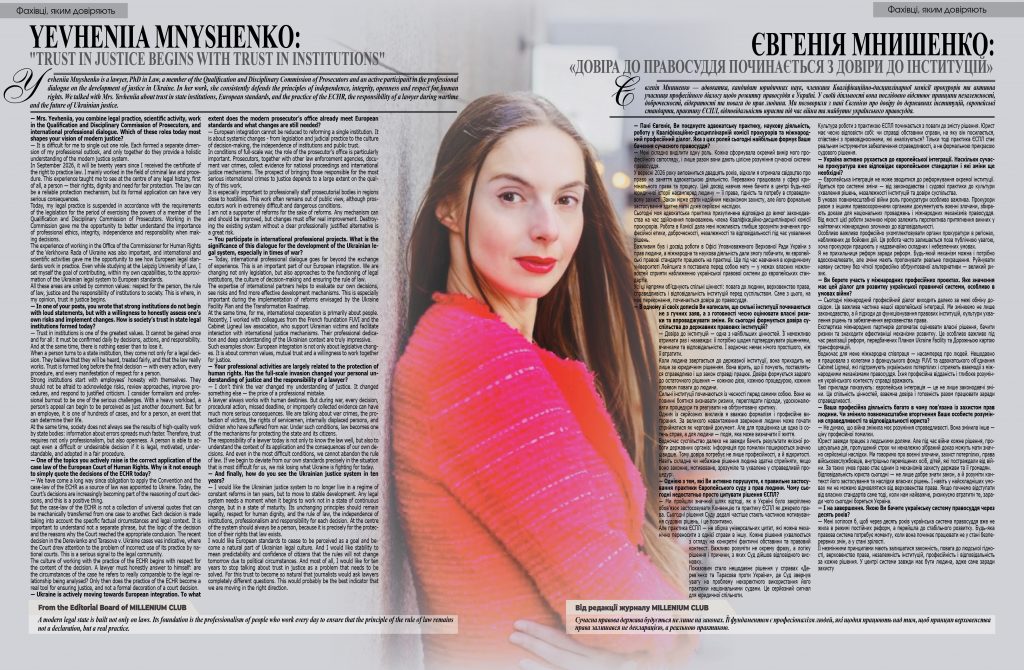
— Пані Євгеніє, Ви поєднуєте адвокатську практику, наукову діяльність, роботу у Кваліфікаційно-дисциплінарній комісії прокурорів та міжнародний професійний діалог. Яка з цих ролей сьогодні найбільше формує Ваше бачення сучасного правосуддя?
— Мені складно виділити одну роль. Кожна сформувала окремий вимір мого професійного світогляду, і лише разом вони дають цілісне розуміння сучасної системи правосуддя.
У вересні 2026 року виповниться двадцять років, відколи я отримала свідоцтво про право на заняття адвокатською діяльністю. Переважно працювала у сфері кримінального права та процесу. Цей досвід навчив мене бачити в центрі будь-якої юридичної історії насамперед людину — її права, гідність та потребу в справедливому захисті. Закон може стати надійним механізмом захисту, але його формальне застосування здатне мати дуже серйозні наслідки.
Сьогодні моя адвокатська практика призупинена відповідно до вимог законодавства на час здійснення повноважень члена Кваліфікаційно-дисциплінарної комісії прокурорів. Робота в Комісії дала мені можливість глибше зрозуміти значення професійної етики, доброчесності, незалежності та відповідальності під час ухвалення рішень.
Важливим був і досвід роботи в Офісі Уповноваженого Верховної Ради України з прав людини, а міжнародна та наукова діяльність дали змогу побачити, як європейські правові стандарти працюють на практиці. Ще під час навчання в юридичному університеті Лейпцига я поставила перед собою мету — у межах власних можливостей сприяти наближенню української правової системи до європейських стандартів.
Усі ці напрями об’єднують спільні цінності: повага до людини, верховенство права, справедливість і відповідальність інституцій перед суспільством. Саме з цього, на моє переконання, починається довіра до правосуддя.
— В одному зі своїх дописів Ви написали, що сильні інституції починаються не з гучних заяв, а з готовності чесно оцінювати власні ризики та впроваджувати зміни. Як сьогодні формується довіра суспільства до державних правових інституцій?
— Довіра до інституцій — одна з найбільших цінностей. Її неможливо отримати раз і назавжди: її потрібно щодня підтверджувати рішеннями, вчинками та відповідальністю. І водночас немає нічого простішого, ніж її втратити.
Коли людина звертається до державної інституції, вона приходить не лише за юридичним рішенням. Вона вірить, що її почують, поставляться справедливо і що закон справді працює. Довіра формується задовго до остаточного рішення — кожною дією, кожною процедурою, кожним проявом поваги до людини.
Сильні інституції починаються із чесності перед самими собою. Вони не повинні боятися визнавати ризики, переглядати підходи, удосконалювати процедури та реагувати на обґрунтовану критику.
Одним із серйозних викликів я вважаю формалізм і професійне вигорання. За великого навантаження звернення людини може почати сприйматися як черговий документ. Але для працівника це одна із сотень справ, а для людини — подія, яка може визначати її життя.
Водночас суспільство далеко не завжди бачить результати якісної роботи державних органів: інформація про помилки поширюється значно швидше. Тому довіра потребує не лише професійності, а й відкритості. Навіть складне чи небажане рішення людина здатна сприйняти, якщо воно законне, мотивоване, зрозуміле та ухвалене у справедливій процедурі.
— Однією з тем, які Ви активно порушуєте, є правильне застосування практики Європейського суду з прав людини. Чому сьогодні недостатньо просто цитувати рішення ЄСПЛ?
— Ми пройшли значний шлях відтоді, як в Україні було закріплено обов’язок застосовувати Конвенцію та практику ЄСПЛ як джерело права. Сьогодні рішення Суду дедалі частіше стають частиною мотивування судових рішень, і це позитивно.
Але практика ЄСПЛ — не збірка універсальних цитат, які можна механічно переносити з однієї справи в іншу. Кожне рішення ухвалюється з огляду на конкретні фактичні обставини та правовий контекст. Важливо розуміти не окрему фразу, а логіку рішення і причини, з яких Суд дійшов відповідного висновку.
Показовим стало нещодавнє рішення у справах «Дерев’янко та Тарасова проти України», де Суд звернув увагу на проблему некоректного використання його практики національними судами. Це серйозний сигнал для юридичної спільноти.
Культура роботи з практикою ЄСПЛ починається з поваги до змісту рішення. Юрист має чесно відповісти собі: чи справді обставини справи, на яку він посилається, співставні з правовідносинами, які аналізуються? Тільки тоді практика ЄСПЛ стає реальним інструментом забезпечення справедливості, а не формальною прикрасою судового рішення.
— Україна активно рухається до європейської інтеграції. Наскільки сучасна прокуратура вже відповідає європейським стандартам і які зміни ще необхідні?
— Європейська інтеграція не може зводитися до реформування окремої інституції. Йдеться про системні зміни — від законодавства і судової практики до культури ухвалення рішень, незалежності інституцій та довіри суспільства.
В умовах повномасштабної війни роль прокуратури особливо важлива. Прокурори разом з іншими правоохоронними органами документують воєнні злочини, збирають докази для національних проваджень і міжнародних механізмів правосуддя. Від якості цієї роботи значною мірою залежить перспектива притягнення винних у найтяжчих міжнародних злочинах до відповідальності.
Особливо важливо професійно укомплектовувати органи прокуратури в регіонах, наближених до бойових дій. Ця робота часто залишається поза публічною увагою, хоча прокурори працюють у надзвичайно складних і небезпечних умовах.
Я не прихильниця реформ заради реформ. Будь-який механізм можна і потрібно вдосконалювати, але зміни мають пропонувати реальне покращення. Руйнувати наявну систему без чіткої професійно обґрунтованої альтернативи — великий ризик.
— Ви берете участь у міжнародних професійних проєктах. Яке значення має цей діалог для розвитку української правничої системи, особливо в умовах війни?
— Сьогодні міжнародний професійний діалог виходить далеко за межі обміну досвідом. Це важлива частина нашої європейської інтеграції. Ми змінюємо не лише законодавство, а й підходи до функціонування правових інституцій, культури ухвалення рішень та забезпечення верховенства права.
Експертиза міжнародних партнерів допомагає оцінювати власні рішення, бачити ризики та знаходити ефективніші механізми розвитку. Це особливо важливо під час реалізації реформ, передбачених Планом Ukraine Facility та Дорожньою картою трансформацій.
Водночас для мене міжнародна співпраця — насамперед про людей. Нещодавно я працювала з колегами з французького фонду FUVI та адвокатського об’єднання Cabinet Ligneul, які підтримують українських потерпілих і сприяють взаємодії з міжнародними механізмами правосуддя. Їхня професійна відданість і глибоке розуміння українського контексту справді вражають.
Такі приклади показують: європейська інтеграція — це не лише законодавчі зміни. Це спільність цінностей, взаємна довіра і готовність разом працювати заради справедливості.
— Ваша професійна діяльність багато в чому пов’язана із захистом прав людини. Чи змінило повномасштабне вторгнення Ваше особисте розуміння справедливості та відповідальності юриста?
— Не думаю, що війна змінила моє розуміння справедливості. Вона змінила інше — ціну професійної помилки.
Юрист завжди працює з людськими долями. Але під час війни кожне рішення, процесуальна дія, пропущений строк чи неналежно зібраний доказ можуть мати значно серйозніші наслідки. Ми говоримо про воєнні злочини, захист потерпілих, права військовослужбовців, внутрішньо переміщених осіб, дітей, які постраждали від війни. За таких умов право стає одним із механізмів захисту держави та її громадян.
Відповідальність юриста сьогодні — не лише добре знати закон, а й розуміти контекст його застосування та наслідки власних рішень. І навіть у найскладніших умовах ми не можемо відмовлятися від верховенства права. Якщо почнемо відступати від власних стандартів саме тоді, коли нам найважче, ризикуємо втратити те, заради чого сьогодні бореться Україна.
— І на завершення. Якою Ви бачите українську систему правосуддя через десять років?
— Мені хотілося б, щоб через десять років українська система правосуддя вже не жила в режимі постійних реформ, а перейшла до стабільного розвитку. Будь-яка правова система потребує моменту, коли вона починає працювати не у стані безперервних змін, а у стані зрілості.
Її незмінними принципами мають залишатися законність, повага до людської гідності, верховенство права, незалежність інституцій, професійність і відповідальність за кожне рішення. У центрі системи завжди має бути людина, адже саме заради захисту
YEVHENIIA MNYSHENKO: “TRUST IN JUSTICE BEGINS WITH TRUST IN INSTITUTIONS”
Уevheniia Mnyshenko is a lawyer, PhD in Law, a member of the Qualification and Disciplinary Commission of Prosecutors and an active participant in the professional dialogue on the development of justice in Ukraine. In her work, she consistently defends the principles of independence, integrity, openness and respect for human rights. We talked with Mrs. Yevheniia about trust in state institutions, European standards, and the practice of the ECHR, the responsibility of a lawyer during wartime and the future of Ukrainian justice.
— Mrs. Yevheniia, you combine legal practice, scientific activity, work in the Qualification and Disciplinary Commission of Prosecutors, and international professional dialogue. Which of these roles today most shapes your vision of modern justice?
— It is difficult for me to single out one role. Each formed a separate dimension of my professional outlook, and only together do they provide a holistic understanding of the modern justice system.
In September 2026, it will be twenty years since I received the certificate of the right to practice law. I mainly worked in the field of criminal law and procedure. This experience taught me to see at the centre of any legal history, first of all, a person — their rights, dignity and need for fair protection. The law can be a reliable protection mechanism, but its formal application can have very serious consequences.
Today, my legal practice is suspended in accordance with the requirements of the legislation for the period of exercising the powers of a member of the Qualification and Disciplinary Commission of Prosecutors. Working in the Commission gave me the opportunity to better understand the importance of professional ethics, integrity, independence and responsibility when making decisions.
The experience of working in the Office of the Commissioner for Human Rights of the Verkhovna Rada of Ukraine was also important, and international and scientific activities gave me the opportunity to see how European legal standards work in practice. Even while studying at the Leipzig University of Law, I set myself the goal of contributing, within my own capabilities, to the approximation of the Ukrainian legal system to European standards.
All these areas are united by common values: respect for the person, the rule of law, justice and the responsibility of institutions to society. This is where, in my opinion, trust in justice begins.
— In one of your posts, you wrote that strong institutions do not begin with loud statements, but with a willingness to honestly assess one’s own risks and implement changes. How is society’s trust in state legal institutions formed today?
— Trust in institutions is one of the greatest values. It cannot be gained once and for all: it must be confirmed daily by decisions, actions, and responsibility. And at the same time, there is nothing easier than to lose it.
When a person turns to a state institution, they come not only for a legal decision. They believe that they will be heard, treated fairly, and that the law really works. Trust is formed long before the final decision — with every action, every procedure, and every manifestation of respect for a person.
Strong institutions start with employees’ honesty with themselves. They should not be afraid to acknowledge risks, review approaches, improve procedures, and respond to justified criticism. I consider formalism and professional burnout to be one of the serious challenges. With a heavy workload, a person’s appeal can begin to be perceived as just another document. But for an employee, it is one of hundreds of cases, and for a person, an event that can determine their life.
At the same time, society does not always see the results of high-quality work by state bodies: information about errors spreads much faster. Therefore, trust requires not only professionalism, but also openness. A person is able to accept even a difficult or undesirable decision if it is legal, motivated, understandable, and adopted in a fair procedure.
— One of the topics you actively raise is the correct application of the case law of the European Court of Human Rights. Why is it not enough to simply quote the decisions of the ECHR today?
— We have come a long way since obligation to apply the Convention and the case-law of the ECHR as a source of law was appointed to Ukraine. Today, the Court’s decisions are increasingly becoming part of the reasoning of court decisions, and this is a positive thing.
But the case-law of the ECHR is not a collection of universal quotes that can be mechanically transferred from one case to another. Each decision is made taking into account the specific factual circumstances and legal context. It is important to understand not a separate phrase, but the logic of the decision and the reasons why the Court reached the appropriate conclusion. The recent decision in the Derevianko and Tarasova v. Ukraine cases was indicative, where the Court drew attention to the problem of incorrect use of its practice by national courts. This is a serious signal to the legal community.
The culture of working with the practice of the ECHR begins with respect for the content of the decision. A lawyer must honestly answer to himself: are the circumstances of the case he refers to really comparable to the legal relationship being analysed? Only then does the practice of the ECHR become a real tool for ensuring justice, and not a formal decoration of a court decision.
— Ukraine is actively moving towards European integration. To what extent does the modern prosecutor’s office already meet European standards and what changes are still needed?
— European integration cannot be reduced to reforming a single institution. It is about systemic changes – from legislation and judicial practice to the culture of decision-making, the independence of institutions and public trust.
In conditions of full-scale war, the role of the prosecutor’s office is particularly important. Prosecutors, together with other law enforcement agencies, document war crimes, collect evidence for national proceedings and international justice mechanisms. The prospect of bringing those responsible for the most serious international crimes to justice depends to a large extent on the quality of this work.
It is especially important to professionally staff prosecutorial bodies in regions close to hostilities. This work often remains out of public view, although prosecutors work in extremely difficult and dangerous conditions.
I am not a supporter of reforms for the sake of reforms. Any mechanism can and should be improved, but changes must offer real improvement. Destroying the existing system without a clear professionally justified alternative is a great risk.
— You participate in international professional projects. What is the significance of this dialogue for the development of the Ukrainian legal system, especially in times of war?
— Today, international professional dialogue goes far beyond the exchange of experience. This is an important part of our European integration. We are changing not only legislation, but also approaches to the functioning of legal institutions, the culture of decision-making and ensuring the rule of law.
The expertise of international partners helps to evaluate our own decisions, see risks and find more effective development mechanisms. This is especially important during the implementation of reforms envisaged by the Ukraine Facility Plan and the Transformation Roadmap.
At the same time, for me, international cooperation is primarily about people. Recently, I worked with colleagues from the French foundation FUVI and the Cabinet Ligneul law association, who support Ukrainian victims and facilitate interaction with international justice mechanisms. Their professional dedication and deep understanding of the Ukrainian context are truly impressive.
Such examples show: European integration is not only about legislative changes. It is about common values, mutual trust and a willingness to work together for justice.
— Your professional activities are largely related to the protection of human rights. Has the full-scale invasion changed your personal understanding of justice and the responsibility of a lawyer?
— I don’t think the war changed my understanding of justice. It changed something else — the price of a professional mistake.
A lawyer always works with human destinies. But during war, every decision, procedural action, missed deadline, or improperly collected evidence can have much more serious consequences. We are talking about war crimes, the protection of victims, the rights of servicemen, internally displaced persons, and children who have suffered from war. Under such conditions, law becomes one of the mechanisms for protecting the state and its citizens.
The responsibility of a lawyer today is not only to know the law well, but also to understand the context of its application and the consequences of our own decisions. And even in the most difficult conditions, we cannot abandon the rule of law. If we begin to deviate from our own standards precisely in the situation that is most difficult for us, we risk losing what Ukraine is fighting for today.
— And finally, how do you see the Ukrainian justice system in ten years?
— I would like the Ukrainian justice system to no longer live in a regime of constant reforms in ten years, but to move to stable development. Any legal system needs a moment when it begins to work not in a state of continuous change, but in a state of maturity. Its unchanging principles should remain legality, respect for human dignity, and the rule of law, the independence of institutions, professionalism and responsibility for each decision. At the centre of the system should always be a person, because it is precisely for the protection of their rights that law exists.
I would like European standards to cease to be perceived as a goal and become a natural part of Ukrainian legal culture. And I would like stability to mean predictability and confidence of citizens that the rules will not change tomorrow due to political circumstances. And most of all, I would like for ten years to stop talking about trust in justice as a problem that needs to be solved. For this trust to become so natural that journalists would ask lawyers completely different questions. This would probably be the best indicator that we are moving in the right direction.