Війна змінила життя мільйонів українців, але водночас відкрила неймовірну силу людської єдності, співчуття та взаємної підтримки. Саме на цих цінностях народився проєкт «Берегиня», створений для військових, ветеранів, родин загиблих Героїв і всіх, хто переживає наслідки війни. Його співзасновниця Римма Коробкова вже багато років присвячує своє життя фізичному й емоційному відновленню людей. Сьогодні ми знову зустрічаємося з Риммою, щоб поговорити про ідею, яка перетворилася на справжню спільноту, де кожен може відчути підтримку, повернути внутрішню силу та зробити перший крок до нового життя.
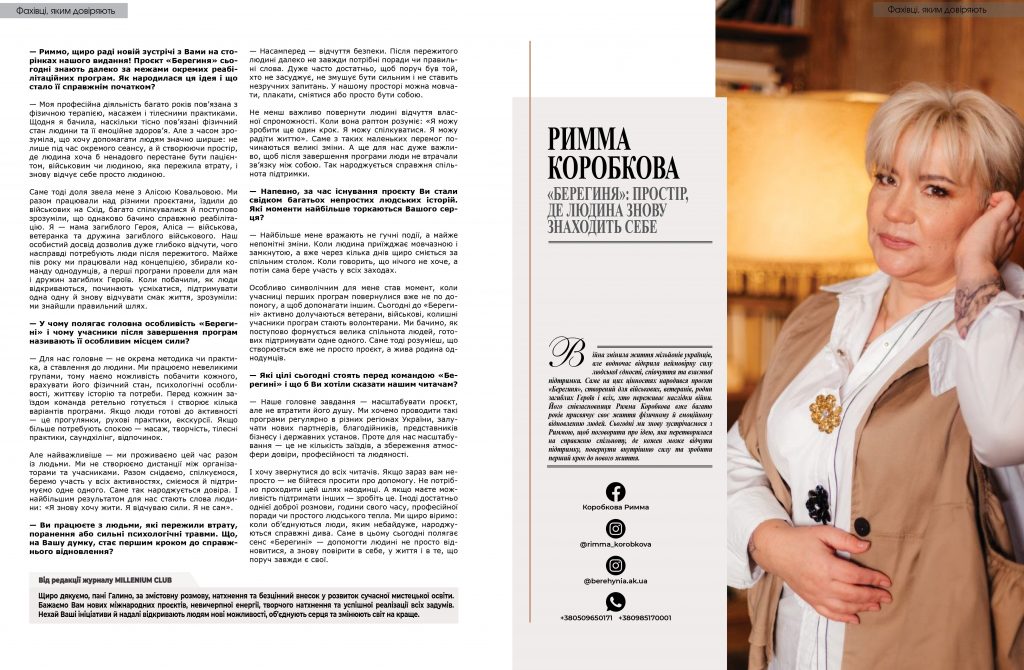
— Риммо, щиро раді новій зустрічі з Вами на сторінках нашого видання! Проєкт «Берегиня» сьогодні знають далеко за межами окремих реабілітаційних програм. Як народилася ця ідея і що стало її справжнім початком?
— Моя професійна діяльність багато років пов’язана з фізичною терапією, масажем і тілесними практиками. Щодня я бачила, наскільки тісно пов’язані фізичний стан людини та її емоційне здоров’я. Але з часом зрозуміла, що хочу допомагати людям значно ширше: не лише під час окремого сеансу, а й створюючи простір, де людина хоча б ненадовго перестане бути пацієнтом, військовим чи людиною, яка пережила втрату, і знову відчує себе просто людиною.
Саме тоді доля звела мене з Алісою Ковальовою. Ми разом працювали над різними проєктами, їздили до військових на Схід, багато спілкувалися й поступово зрозуміли, що однаково бачимо справжню реабілітацію. Я — мама загиблого Героя, Аліса — військова, ветеранка та дружина загиблого військового. Наш особистий досвід дозволив дуже глибоко відчути, чого насправді потребують люди після пережитого. Майже пів року ми працювали над концепцією, збирали команду однодумців, а перші програми провели для мам і дружин загиблих Героїв. Коли побачили, як люди відкриваються, починають усміхатися, підтримувати одна одну й знову відчувати смак життя, зрозуміли: ми знайшли правильний шлях.
— У чому полягає головна особливість «Берегині» і чому учасники після завершення програм називають її особливим місцем сили?
— Для нас головне — не окрема методика чи практика, а ставлення до людини. Ми працюємо невеликими групами, тому маємо можливість побачити кожного, врахувати його фізичний стан, психологічні особливості, життєву історію та потреби. Перед кожним заїздом команда ретельно готується і створює кілька варіантів програми. Якщо люди готові до активності — це прогулянки, рухові практики, екскурсії. Якщо більше потребують спокою — масаж, творчість, тілесні практики, саундхілінг, відпочинок.
Але найважливіше — ми проживаємо цей час разом із людьми. Ми не створюємо дистанції між організаторами та учасниками. Разом снідаємо, спілкуємося, беремо участь у всіх активностях, сміємося й підтримуємо одне одного. Саме так народжується довіра. І найбільшим результатом для нас стають слова людини: «Я знову хочу жити. Я відчуваю сили. Я не сам».
— Ви працюєте з людьми, які пережили втрату, поранення або сильні психологічні травми. Що, на Вашу думку, стає першим кроком до справжнього відновлення?
— Насамперед — відчуття безпеки. Після пережитого людині далеко не завжди потрібні поради чи правильні слова. Дуже часто достатньо, щоб поруч був той, хто не засуджує, не змушує бути сильним і не ставить незручних запитань. У нашому просторі можна мовчати, плакати, сміятися або просто бути собою.
Не менш важливо повернути людині відчуття власної спроможності. Коли вона раптом розуміє: «Я можу зробити ще один крок. Я можу спілкуватися. Я можу радіти життю». Саме з таких маленьких перемог починаються великі зміни. А ще для нас дуже важливо, щоб після завершення програми люди не втрачали зв’язку між собою. Так народжується справжня спільнота підтримки.
— Напевно, за час існування проєкту Ви стали свідком багатьох непростих людських історій. Які моменти найбільше торкаються Вашого серця?
— Найбільше мене вражають не гучні події, а майже непомітні зміни. Коли людина приїжджає мовчазною і замкнутою, а вже через кілька днів щиро сміється за спільним столом. Коли говорить, що нічого не хоче, а потім сама бере участь у всіх заходах.
Особливо символічним для мене став момент, коли учасниці перших програм повернулися вже не по допомогу, а щоб допомагати іншим. Сьогодні до «Берегині» активно долучаються ветерани, військові, колишні учасники програм стають волонтерами. Ми бачимо, як поступово формується велика спільнота людей, готових підтримувати одне одного. Саме тоді розумієш, що створюється вже не просто проєкт, а жива родина однодумців.
— Які цілі сьогодні стоять перед командою «Берегині» і що б Ви хотіли сказати нашим читачам?
— Наше головне завдання — масштабувати проєкт, але не втратити його душу. Ми хочемо проводити такі програми регулярно в різних регіонах України, залучати нових партнерів, благодійників, представників бізнесу і державних установ. Проте для нас масштабування — це не кількість заїздів, а збереження атмосфери довіри, професійності та людяності.
І хочу звернутися до всіх читачів. Якщо зараз вам непросто — не бійтеся просити про допомогу. Не потрібно проходити цей шлях наодинці. А якщо маєте можливість підтримати інших — зробіть це. Іноді достатньо однієї доброї розмови, години свого часу, професійної поради чи простого людського тепла. Ми щиро віримо: коли об’єднуються люди, яким небайдуже, народжуються справжні дива. Саме в цьому сьогодні полягає сенс «Берегині» — допомогти людині не просто відновитися, а знову повірити в себе, у життя і в те, що поруч завжди є свої.
Від редакції журналу MILLENIUM CLUB
Щиро дякуємо Риммі Коробковій за відверту, глибоку та надихаючу розмову. Бажаємо їй, команді проєкту «Берегиня» та всім її однодумцям невичерпної енергії, нових успішних ініціатив, надійних партнерів, розширення проєкту по всій Україні та ще більше історій, у яких людська підтримка повертає віру, внутрішню силу й бажання жити.
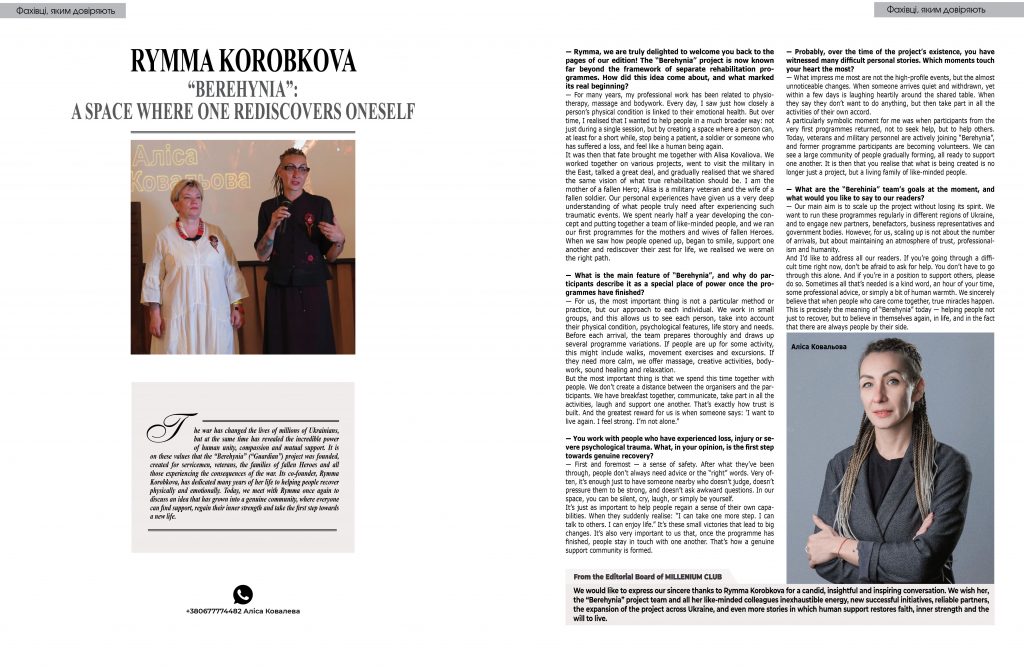
Rymma Korobkova. “Berehynia”: a space where one rediscovers oneself
The war has changed the lives of millions of Ukrainians, but at the same time has revealed the incredible power of human unity, compassion and mutual support. It is on these values that the “Berehynia” (“Guardian”) project was founded, created for servicemen, veterans, the families of fallen Heroes and all those experiencing the consequences of the war. Its co-founder, Rymma Korobkova, has dedicated many years of her life to helping people recover physically and emotionally. Today, we meet with Rymma once again to discuss an idea that has grown into a genuine community, where everyone can find support, regain their inner strength and take the first step towards a new life.
— Rymma, we are truly delighted to welcome you back to the pages of our edition! The “Berehynia” project is now known far beyond the framework of separate rehabilitation programmes. How did this idea come about, and what marked its real beginning?
— For many years, my professional work has been related to physiotherapy, massage and bodywork. Every day, I saw just how closely a person’s physical condition is linked to their emotional health. But over time, I realised that I wanted to help people in a much broader way: not just during a single session, but by creating a space where a person can, at least for a short while, stop being a patient, a soldier or someone who has suffered a loss, and feel like a human being again.
It was then that fate brought me together with Alisa Kovaliova. We worked together on various projects, went to visit the military in the East, talked a great deal, and gradually realised that we shared the same vision of what true rehabilitation should be. I am the mother of a fallen Hero; Alisa is a military veteran and the wife of a fallen soldier. Our personal experiences have given us a very deep understanding of what people truly need after experiencing such traumatic events. We spent nearly half a year developing the concept and putting together a team of like-minded people, and we ran our first programmes for the mothers and wives of fallen Heroes. When we saw how people opened up, began to smile, support one another and rediscover their zest for life, we realised we were on the right path.
— What is the main feature of “Berehynia”, and why do participants describe it as a special place of power once the programmes have finished?
— For us, the most important thing is not a particular method or practice, but our approach to each individual. We work in small groups, and this allows us to see each person, take into account their physical condition, psychological features, life story and needs. Before each arrival, the team prepares thoroughly and draws up several programme variations. If people are up for some activity, this might include walks, movement exercises and excursions. If they need more calm, we offer massage, creative activities, bodywork, sound healing and relaxation.
But the most important thing is that we spend this time together with people. We don’t create a distance between the organisers and the participants. We have breakfast together, communicate, take part in all the activities, laugh and support one another. That’s exactly how trust is built. And the greatest reward for us is when someone says: ‘I want to live again. I feel strong. I’m not alone.”
— You work with people who have experienced loss, injury or severe psychological trauma. What, in your opinion, is the first step towards genuine recovery?
— First and foremost — a sense of safety. After what they’ve been through, people don’t always need advice or the “right” words. Very often, it’s enough just to have someone nearby who doesn’t judge, doesn’t pressure them to be strong, and doesn’t ask awkward questions. In our space, you can be silent, cry, laugh, or simply be yourself.
It’s just as important to help people regain a sense of their own capabilities. When they suddenly realise: “I can take one more step. I can talk to others. I can enjoy life.” It’s these small victories that lead to big changes. It’s also very important to us that, once the programme has finished, people stay in touch with one another. That’s how a genuine support community is formed.
— Probably, over the time of the project’s existence, you have witnessed many difficult personal stories. Which moments touch your heart the most?
— What impress me most are not the high-profile events, but the almost unnoticeable changes. When someone arrives quiet and withdrawn, yet within a few days is laughing heartily around the shared table. When they say they don’t want to do anything, but then take part in all the activities of their own accord.
A particularly symbolic moment for me was when participants from the very first programmes returned, not to seek help, but to help others. Today, veterans and military personnel are actively joining “Berehynia”, and former programme participants are becoming volunteers. We can see a large community of people gradually forming, all ready to support one another. It is then that you realise that what is being created is no longer just a project, but a living family of like-minded people.
— What are the “Berehinia” team’s goals at the moment, and what would you like to say to our readers?
— Our main aim is to scale up the project without losing its spirit. We want to run these programmes regularly in different regions of Ukraine, and to engage new partners, benefactors, business representatives and government bodies. However, for us, scaling up is not about the number of arrivals, but about maintaining an atmosphere of trust, professionalism and humanity.
And I’d like to address all our readers. If you’re going through a difficult time right now, don’t be afraid to ask for help. You don’t have to go through this alone. And if you’re in a position to support others, please do so. Sometimes all that’s needed is a kind word, an hour of your time, some professional advice, or simply a bit of human warmth. We sincerely believe that when people who care come together, true miracles happen. This is precisely the meaning of “Berehynia” today — helping people not just to recover, but to believe in themselves again, in life, and in the fact that there are always people by their side.
From the Editorial Board of MILLENIUM CLUB
We would like to express our sincere thanks to Rymma Korobkova for a candid, insightful and inspiring conversation. We wish her, the “Berehynia” project team and all her like-minded colleagues inexhaustible energy, new successful initiatives, reliable partners, the expansion of the project across Ukraine, and even more stories in which human support restores faith, inner strength and the will to live.