
Психологічна реабілітація сьогодні є не лише допомогою після пережитої кризи, а й шляхом до відновлення внутрішньої опори та побудови нового життя. Фіалкора Миндру ділиться з читачами нашого міжнародного видання професійним баченням цього важливого процесу.
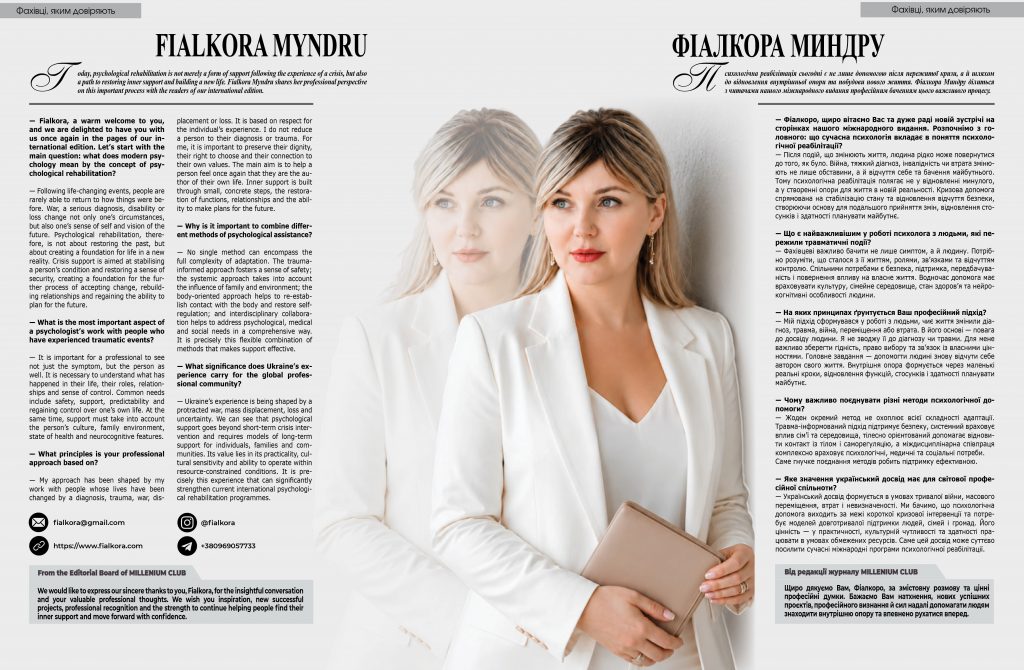
— Фіалкоро, щиро вітаємо Вас та дуже раді новій зустрічі на сторінках нашого міжнародного видання. Розпочнімо з головного: що сучасна психологія вкладає в поняття психологічної реабілітації?
— Після подій, що змінюють життя, людина рідко може повернутися до того, як було. Війна, тяжкий діагноз, інвалідність чи втрата змінюють не лише обставини, а й відчуття себе та бачення майбутнього. Тому психологічна реабілітація полягає не у відновленні минулого, а у створенні опори для життя в новій реальності. Кризова допомога спрямована на стабілізацію стану та відновлення відчуття безпеки, створюючи основу для подальшого прийняття змін, відновлення стосунків і здатності планувати майбутнє.
— Що є найважливішим у роботі психолога з людьми, які пережили травматичні події?
— Фахівцеві важливо бачити не лише симптом, а й людину. Потрібно розуміти, що сталося з її життям, ролями, зв’язками та відчуттям контролю. Спільними потребами є безпека, підтримка, передбачуваність і повернення впливу на власне життя. Водночас допомога має враховувати культуру, сімейне середовище, стан здоров’я та нейрокогнітивні особливості людини.
— На яких принципах ґрунтується Ваш професійний підхід?
— Мій підхід сформувався у роботі з людьми, чиє життя змінили діагноз, травма, війна, переміщення або втрата. В його основі — повага до досвіду людини. Я не зводжу її до діагнозу чи травми. Для мене важливо зберегти гідність, право вибору та зв’язок із власними цінностями. Головне завдання — допомогти людині знову відчути себе автором свого життя. Внутрішня опора формується через маленькі реальні кроки, відновлення функцій, стосунків і здатності планувати майбутнє.
— Чому важливо поєднувати різні методи психологічної допомоги?
— Жоден окремий метод не охоплює всієї складності адаптації. Травма-інформований підхід підтримує безпеку, системний враховує вплив сім’ї та середовища, тілесно орієнтований допомагає відновити контакт із тілом і саморегуляцію, а міждисциплінарна співпраця комплексно враховує психологічні, медичні та соціальні потреби.
Саме гнучке поєднання методів робить підтримку ефективною.
— Яке значення український досвід має для світової професійної спільноти?
— Український досвід формується в умовах тривалої війни, масового переміщення, втрат і невизначеності. Ми бачимо, що психологічна допомога виходить за межі короткої кризової інтервенції та потребує моделей довготривалої підтримки людей, сімей і громад. Його цінність — у практичності, культурній чутливості та здатності працювати в умовах обмежених ресурсів. Саме цей досвід може суттєво посилити сучасні міжнародні програми психологічної реабілітації.
Fialkora Myndru
Today, psychological rehabilitation is not merely a form of support following the experience of a crisis, but also a path to restoring inner support and building a new life. Fialkora Myndru shares her professional perspective on this important process with the readers of our international edition.
— Fialkora, a warm welcome to you, and we are delighted to have you with us once again in the pages of our international edition. Let’s start with the main question: what does modern psychology mean by the concept of psychological rehabilitation?
— Following life-changing events, people are rarely able to return to how things were before. War, a serious diagnosis, disability or loss change not only one’s circumstances, but also one’s sense of self and vision of the future. Psychological rehabilitation, therefore, is not about restoring the past, but about creating a foundation for life in a new reality. Crisis support is aimed at stabilising a person’s condition and restoring a sense of security, creating a foundation for the further process of accepting change, rebuilding relationships and regaining the ability to plan for the future.
— What is the most important aspect of a psychologist’s work with people who have experienced traumatic events?
— It is important for a professional to see not just the symptom, but the person as well. It is necessary to understand what has happened in their life, their roles, relationships and sense of control. Common needs include safety, support, predictability and regaining control over one’s own life. At the same time, support must take into account the person’s culture, family environment, state of health and neurocognitive features.
— What principles is your professional approach based on?
— My approach has been shaped by my work with people whose lives have been changed by a diagnosis, trauma, war, displacement or loss. It is based on respect for the individual’s experience. I do not reduce a person to their diagnosis or trauma. For me, it is important to preserve their dignity, their right to choose and their connection to their own values. The main aim is to help a person feel once again that they are the author of their own life. Inner support is built through small, concrete steps, the restoration of functions, relationships and the ability to make plans for the future.
— Why is it important to combine different methods of psychological assistance?
— No single method can encompass the full complexity of adaptation. The trauma-informed approach fosters a sense of safety; the systemic approach takes into account the influence of family and environment; the body-oriented approach helps to re-establish contact with the body and restore self-regulation; and interdisciplinary collaboration helps to address psychological, medical and social needs in a comprehensive way. It is precisely this flexible combination of methods that makes support effective.
— What significance does Ukraine’s experience carry for the global professional community?
— Ukraine’s experience is being shaped by a protracted war, mass displacement, loss and uncertainty. We can see that psychological support goes beyond short-term crisis intervention and requires models of long-term support for individuals, families and communities. Its value lies in its practicality, cultural sensitivity and ability to operate within resource-constrained conditions. It is precisely this experience that can significantly strengthen current international psychological rehabilitation programmes.