
Сильні державні інституції створюються не лише законами, регламентами чи організаційною структурою. Їхню стійкість забезпечують люди, які вміють мислити системно, вибудовувати ефективні процеси, об’єднувати команди та брати відповідальність у моменти, коли від їхніх рішень залежить безперервність роботи органу. Саме такі управлінці часто залишаються поза публічною увагою, хоча саме їхня щоденна робота забезпечує стабільність державних інституцій.
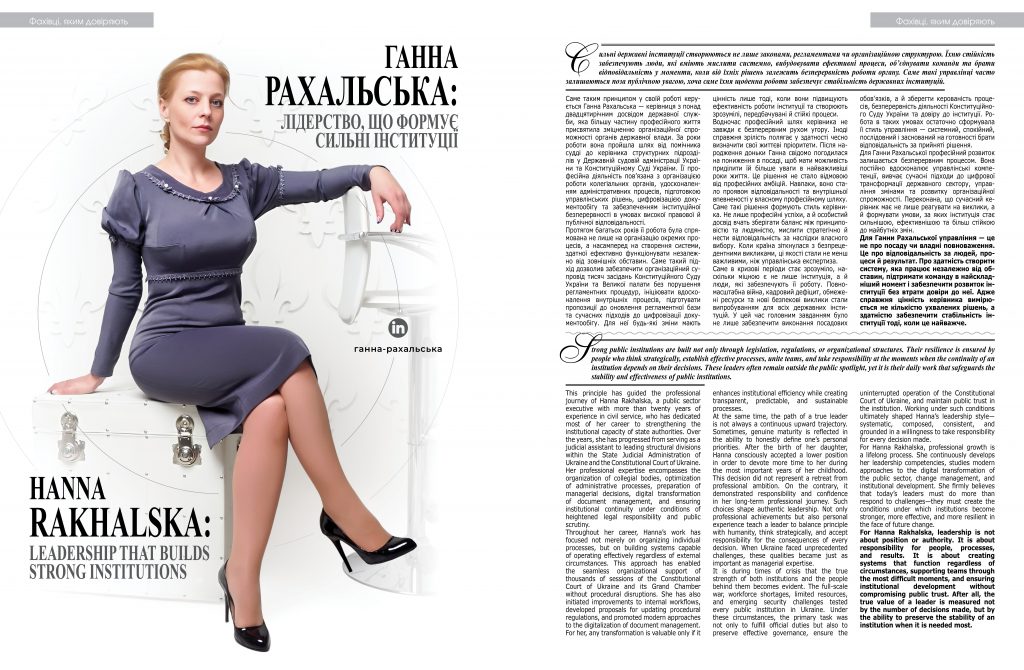
Саме таким принципом у своїй роботі керується Ганна Рахальська — керівниця з понад двадцятирічним досвідом державної служби, яка більшу частину професійного життя присвятила зміцненню організаційної спроможності органів державної влади. За роки роботи вона пройшла шлях від помічника судді до керівника структурних підрозділів у Державній судовій адміністрації України та Конституційному Суді України. Її професійна діяльність пов’язана з організацією роботи колегіальних органів, удосконаленням адміністративних процесів, підготовкою управлінських рішень, цифровізацією документообігу та забезпеченням інституційної безперервності в умовах високої правової й публічної відповідальності.
Протягом багатьох років її робота була спрямована не лише на організацію окремих процесів, а насамперед на створення системи, здатної ефективно функціонувати незалежно від зовнішніх обставин. Саме такий підхід дозволив забезпечити організаційний супровід тисяч засідань Конституційного Суду України та Великої палати без порушення регламентних процедур, ініціювати вдосконалення внутрішніх процесів, підготувати пропозиції до оновлення регламентної бази та сучасних підходів до цифровізації документообігу. Для неї будь-які зміни мають цінність лише тоді, коли вони підвищують ефективність роботи інституції та створюють зрозумілі, передбачувані й стійкі процеси.
Водночас професійний шлях керівника не завжди є безперервним рухом угору. Іноді справжня зрілість полягає у здатності чесно визначити свої життєві пріоритети. Після народження доньки Ганна свідомо погодилася на пониження в посаді, щоб мати можливість приділити їй більше уваги в найважливіші роки життя. Це рішення не стало відмовою від професійних амбіцій. Навпаки, воно стало проявом відповідальності та внутрішньої впевненості у власному професійному шляху. Саме такі рішення формують стиль керівника. Не лише професійні успіхи, а й особистий досвід вчать зберігати баланс між принциповістю та людяністю, мислити стратегічно й нести відповідальність за наслідки власного вибору. Коли країна зіткнулася з безпрецедентними викликами, ці якості стали не менш важливими, ніж управлінська експертиза.
Саме в кризові періоди стає зрозуміло, наскільки міцною є не лише інституція, а й люди, які забезпечують її роботу. Повномасштабна війна, кадровий дефіцит, обмежені ресурси та нові безпекові виклики стали випробуванням для всіх державних інституцій. У цей час головним завданням було не лише забезпечити виконання посадових обов’язків, а й зберегти керованість процесів, безперервність діяльності Конституційного Суду України та довіру до інституції. Робота в таких умовах остаточно сформувала її стиль управління — системний, спокійний, послідовний і заснований на готовності брати відповідальність за прийняті рішення.
Для Ганни Рахальської професійний розвиток залишається безперервним процесом. Вона постійно вдосконалює управлінські компетенції, вивчає сучасні підходи до цифрової трансформації державного сектору, управління змінами та розвитку організаційної спроможності. Переконана, що сучасний керівник має не лише реагувати на виклики, а й формувати умови, за яких інституція стає сильнішою, ефективнішою та більш стійкою до майбутніх змін.
Для Ганни Рахальської управління — це не про посаду чи владні повноваження. Це про відповідальність за людей, процеси й результат. Про здатність створити систему, яка працює незалежно від обставин, підтримати команду в найскладніший момент і забезпечити розвиток інституції без втрати довіри до неї. Адже справжня цінність керівника вимірюється не кількістю ухвалених рішень, а здатністю забезпечити стабільність інституції тоді, коли це найважче.
Hanna Rakhalska: Leadership that builds strong institutions
Strong public institutions are built not only through legislation, regulations, or organizational structures. Their resilience is ensured by people who think strategically, establish effective processes, unite teams, and take responsibility at the moments when the continuity of an institution depends on their decisions. These leaders often remain outside the public spotlight, yet it is their daily work that safeguards the stability and effectiveness of public institutions.
This principle has guided the professional journey of Hanna Rakhalska, a public sector executive with more than twenty years of experience in civil service, who has dedicated most of her career to strengthening the institutional capacity of state authorities. Over the years, she has progressed from serving as a judicial assistant to leading structural divisions within the State Judicial Administration of Ukraine and the Constitutional Court of Ukraine. Her professional expertise encompasses the organization of collegial bodies, optimization of administrative processes, preparation of managerial decisions, digital transformation of document management, and ensuring institutional continuity under conditions of heightened legal responsibility and public scrutiny.
Throughout her career, Hanna’s work has focused not merely on organizing individual processes, but on building systems capable of operating effectively regardless of external circumstances. This approach has enabled the seamless organizational support of thousands of sessions of the Constitutional Court of Ukraine and its Grand Chamber without procedural disruptions. She has also initiated improvements to internal workflows, developed proposals for updating procedural regulations, and promoted modern approaches to the digitalization of document management. For her, any transformation is valuable only if it enhances institutional efficiency while creating transparent, predictable, and sustainable processes.
At the same time, the path of a true leader is not always a continuous upward trajectory. Sometimes, genuine maturity is reflected in the ability to honestly define one’s personal priorities. After the birth of her daughter, Hanna consciously accepted a lower position in order to devote more time to her during the most important years of her childhood. This decision did not represent a retreat from professional ambition. On the contrary, it demonstrated responsibility and confidence in her long-term professional journey. Such choices shape authentic leadership. Not only professional achievements but also personal experience teach a leader to balance principle with humanity, think strategically, and accept responsibility for the consequences of every decision. When Ukraine faced unprecedented challenges, these qualities became just as important as managerial expertise.
It is during times of crisis that the true strength of both institutions and the people behind them becomes evident. The full-scale war, workforce shortages, limited resources, and emerging security challenges tested every public institution in Ukraine. Under these circumstances, the primary task was not only to fulfill official duties but also to preserve effective governance, ensure the uninterrupted operation of the Constitutional Court of Ukraine, and maintain public trust in the institution. Working under such conditions ultimately shaped Hanna’s leadership style—systematic, composed, consistent, and grounded in a willingness to take responsibility for every decision made.
For Hanna Rakhalska, professional growth is a lifelong process. She continuously develops her leadership competencies, studies modern approaches to the digital transformation of the public sector, change management, and institutional development. She firmly believes that today’s leaders must do more than respond to challenges—they must create the conditions under which institutions become stronger, more effective, and more resilient in the face of future change.
For Hanna Rakhalska, leadership is not about position or authority. It is about responsibility for people, processes, and results. It is about creating systems that function regardless of circumstances, supporting teams through the most difficult moments, and ensuring institutional development without compromising public trust. After all, the true value of a leader is measured not by the number of decisions made, but by the ability to preserve the stability of an institution when it is needed most.