
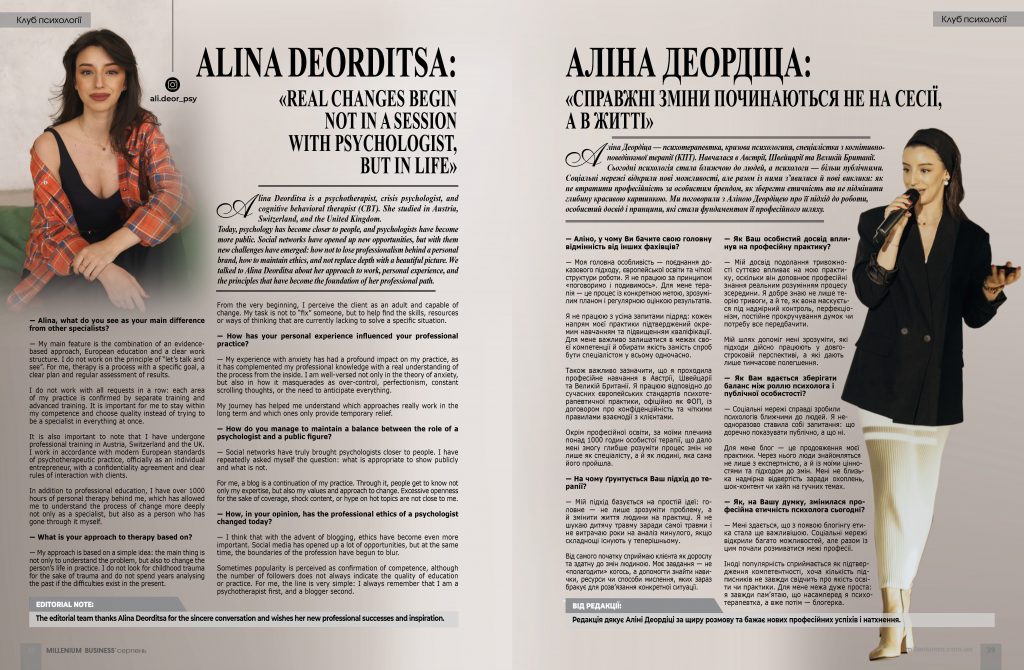
Аліна Деордіца — психотерапевтка, кризова психологиня, спеціалістка з когнітивно-поведінкової терапії (КПТ). Навчалася в Австрії, Швейцарії та Великій Британії.
Сьогодні психологія стала ближчою до людей, а психологи — більш публічними. Соціальні мережі відкрили нові можливості, але разом із ними з’явилися й нові виклики: як не втратити професійність за особистим брендом, як зберегти етичність та не підмінити глибину красивою картинкою. Ми поговорили з Аліною Деордіцею про її підхід до роботи, особистий досвід і принципи, які стали фундаментом її професійного шляху.
— Аліно, у чому Ви бачите свою головну відмінність від інших фахівців?
— Моя головна особливість — поєднання доказового підходу, європейської освіти та чіткої структури роботи. Я не працюю за принципом «поговоримо і подивимось». Для мене терапія — це процес із конкретною метою, зрозумілим планом і регулярною оцінкою результатів.
Я не працюю з усіма запитами підряд: кожен напрям моєї практики підтверджений окремим навчанням та підвищенням кваліфікації. Для мене важливо залишатися в межах своєї компетенції й обирати якість замість спроб бути спеціалістом у всьому одночасно.
Також важливо зазначити, що я проходила професійне навчання в Австрії, Швейцарії та Великій Британії. Я працюю відповідно до сучасних європейських стандартів психотерапевтичної практики, офіційно як ФОП, із договором про конфіденційність та чіткими правилами взаємодії з клієнтами.
Окрім професійної освіти, за моїми плечима понад 1000 годин особистої терапії, що дало мені змогу глибше розуміти процес змін не лише як спеціалісту, а й як людині, яка сама його пройшла.
— На чому ґрунтується Ваш підхід до терапії?
— Мій підхід базується на простій ідеї: головне — не лише зрозуміти проблему, а й змінити життя людини на практиці. Я не шукаю дитячу травму заради самої травми і не витрачаю роки на аналіз минулого, якщо складнощі існують у теперішньому.
Від самого початку сприймаю клієнта як дорослу та здатну до змін людиною. Моє завдання — не «полагодити» когось, а допомогти знайти навички, ресурси чи способи мислення, яких зараз бракує для розв’язання конкретної ситуації.
— Як Ваш особистий досвід вплинув на професійну практику?
— Мій досвід подолання тривожності суттєво впливає на мою практику, оскільки він доповнює професійні знання реальним розумінням процесу зсередини. Я добре знаю не лише теорію тривоги, а й те, як вона маскується під надмірний контроль, перфекціонізм, постійне прокручування думок чи потребу все передбачити.
Мій шлях допоміг мені зрозуміти, які підходи дійсно працюють у довгостроковій перспективі, а які дають лише тимчасове полегшення.
— Як Вам вдається зберігати баланс між роллю психолога і публічної особистості?
— Соціальні мережі справді зробили психологів ближчими до людей. Я неодноразово ставила собі запитання: що доречно показувати публічно, а що ні.
Для мене блог — це продовження моєї практики. Через нього люди знайомляться не лише з експертністю, а й із моїми цінностями та підходом до змін. Мені не близька надмірна відвертість заради охоплень, шок-контент чи хайп на гучних темах.
— Як, на Вашу думку, змінилася професійна етичність психолога сьогодні?
— Мені здається, що з появою блогінгу етика стала ще важливішою. Соціальні мережі відкрили багато можливостей, але разом із цим почали розмиватися межі професії.
Іноді популярність сприймається як підтвердження компетентності, хоча кількість підписників не завжди свідчить про якість освіти чи практики. Для мене межа дуже проста: я завжди пам’ятаю, що насамперед я психотерапевтка, а вже потім — блогерка.
Від редакції: Редакція дякує Аліні Деордіці за щиру розмову та бажає нових професійних успіхів і натхнення.
Alina Deorditsa: «Real changes begin not in a session with psychologist, but in life»
Аlina Deorditsa is a psychotherapist, crisis psychologist, and cognitive behavioral therapist (CBT). She studied in Austria, Switzerland, and the United Kingdom.
Today, psychology has become closer to people, and psychologists have become more public. Social networks have opened up new opportunities, but with them new challenges have emerged: how not to lose professionalism behind a personal brand, how to maintain ethics, and not replace depth with a beautiful picture. We talked to Alina Deorditsa about her approach to work, personal experience, and the principles that have become the foundation of her professional path.
— Alina, what do you see as your main difference from other specialists?
— My main feature is the combination of an evidence-based approach, European education and a clear work structure. I do not work on the principle of “let’s talk and see”. For me, therapy is a process with a specific goal, a clear plan and regular assessment of results.
I do not work with all requests in a row: each area of my practice is confirmed by separate training and advanced training. It is important for me to stay within my competence and choose quality instead of trying to be a specialist in everything at once.
It is also important to note that I have undergone professional training in Austria, Switzerland and the UK. I work in accordance with modern European standards of psychotherapeutic practice, officially as an individual entrepreneur, with a confidentiality agreement and clear rules of interaction with clients.
In addition to professional education, I have over 1000 hours of personal therapy behind me, which has allowed me to understand the process of change more deeply not only as a specialist, but also as a person who has gone through it myself.
— What is your approach to therapy based on?
— My approach is based on a simple idea: the main thing is not only to understand the problem, but also to change the person’s life in practice. I do not look for childhood trauma for the sake of trauma and do not spend years analysing the past if the difficulties exist in the present.
From the very beginning, I perceive the client as an adult and capable of change. My task is not to “fix” someone, but to help find the skills, resources or ways of thinking that are currently lacking to solve a specific situation.
— How has your personal experience influenced your professional practice?
— My experience with anxiety has had a profound impact on my practice, as it has complemented my professional knowledge with a real understanding of the process from the inside. I am well-versed not only in the theory of anxiety, but also in how it masquerades as over-control, perfectionism, constant scrolling thoughts, or the need to anticipate everything.
My journey has helped me understand which approaches really work in the long term and which ones only provide temporary relief.
— How do you manage to maintain a balance between the role of a psychologist and a public figure?
— Social networks have truly brought psychologists closer to people. I have repeatedly asked myself the question: what is appropriate to show publicly and what is not.
For me, a blog is a continuation of my practice. Through it, people get to know not only my expertise, but also my values and approach to change. Excessive openness for the sake of coverage, shock content, or hype on hot topics are not close to me.
— How, in your opinion, has the professional ethics of a psychologist changed today?
— I think that with the advent of blogging, ethics have become even more important. Social media has opened up a lot of opportunities, but at the same time, the boundaries of the profession have begun to blur.
Sometimes popularity is perceived as confirmation of competence, although the number of followers does not always indicate the quality of education or practice. For me, the line is very simple: I always remember that I am a psychotherapist first, and a blogger second.
Еditorial note: The editorial team thanks Alina Deorditsa for the sincere conversation and wishes her new professional successes and inspiration.