
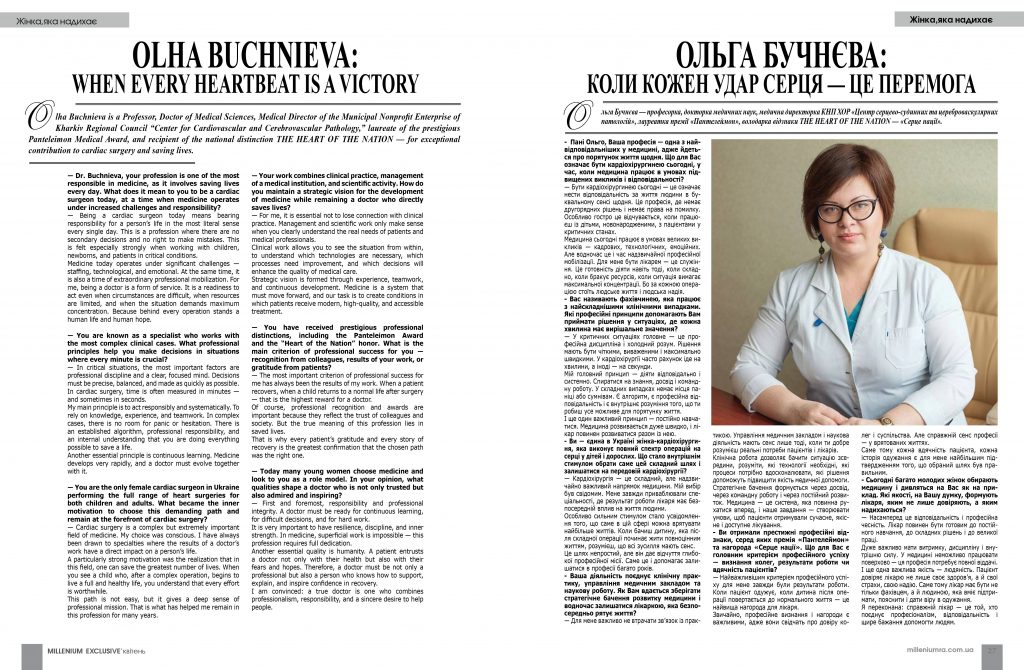
Ольга Бучнєва — професорка, докторка медичних наук, медична директорка КНП ХОР «Центр серцево-судинних та цереброваскулярних патологій», лауреатка премії «Пантелеймон», володарка відзнаки THE HEART OF THE NATION — «Серце нації».
- Пані Ольго, Ваша професія — одна з найвідповідальніших у медицині, адже йдеться про порятунок життя щодня. Що для Вас означає бути кардіохірургинею сьогодні, у час, коли медицина працює в умовах підвищених викликів і відповідальності?
— Бути кардіохірургинею сьогодні — це означає нести відповідальність за життя людини в буквальному сенсі щодня. Це професія, де немає другорядних рішень і немає права на помилку. Особливо гостро це відчувається, коли працюєш із дітьми, новонародженими, з пацієнтами у критичних станах.
Медицина сьогодні працює в умовах великих викликів — кадрових, технологічних, емоційних. Але водночас це і час надзвичайної професійної мобілізації. Для мене бути лікарем — це служіння. Це готовність діяти навіть тоді, коли складно, коли бракує ресурсів, коли ситуація вимагає максимальної концентрації. Бо за кожною операцією стоїть людське життя і людська надія. - Вас називають фахівчинею, яка працює з найскладнішими клінічними випадками. Які професійні принципи допомагають Вам приймати рішення у ситуаціях, де кожна хвилина має вирішальне значення?
— У критичних ситуаціях головне — це професійна дисципліна і холодний розум. Рішення мають бути чіткими, виваженими і максимально швидкими. У кардіохірургії часто рахунок іде на хвилини, а іноді — на секунди.
Мій головний принцип — діяти відповідально і системно. Спиратися на знання, досвід і командну роботу. У складних випадках немає місця паніці або сумнівам. Є алгоритм, є професійна відповідальність і є внутрішнє розуміння того, що ти робиш усе можливе для порятунку життя.
І ще один важливий принцип — постійно навчатися. Медицина розвивається дуже швидко, і лікар повинен розвиватися разом із нею. - Ви — єдина в Україні жінка-кардіохірургиня, яка виконує повний спектр операцій на серці у дітей і дорослих. Що стало внутрішнім стимулом обрати саме цей складний шлях і залишатися на передовій кардіохірургії?
— Кардіохірургія — це складний, але надзвичайно важливий напрямок медицини. Мій вибір був свідомим. Мене завжди приваблювали спеціальності, де результат роботи лікаря має безпосередній вплив на життя людини.
Особливо сильним стимулом стало усвідомлення того, що саме в цій сфері можна врятувати найбільше життів. Коли бачиш дитину, яка після складної операції починає жити повноцінним життям, розумієш, що всі зусилля мають сенс.
Це шлях непростий, але він дає відчуття глибокої професійної місії. Саме це і допомагає залишатися в професії багато років. - Ваша діяльність поєднує клінічну практику, управління медичним закладом та наукову роботу. Як Вам вдається зберігати стратегічне бачення розвитку медицини і водночас залишатися лікаркою, яка безпосередньо рятує життя?
— Для мене важливо не втрачати зв’язок із практикою. Управління медичним закладом і наукова діяльність мають сенс лише тоді, коли ти добре розумієш реальні потреби пацієнтів і лікарів.
Клінічна робота дозволяє бачити ситуацію зсередини, розуміти, які технології необхідні, які процеси потрібно вдосконалювати, які рішення допоможуть підвищити якість медичної допомоги.
Стратегічне бачення формується через досвід, через командну роботу і через постійний розвиток. Медицина — це система, яка повинна рухатися вперед, і наше завдання — створювати умови, щоб пацієнти отримували сучасне, якісне і доступне лікування. - Ви отримали престижні професійні відзнаки, серед яких премія «Пантелеймон» та нагорода «Серце нації». Що для Вас є головним критерієм професійного успіху — визнання колег, результати роботи чи вдячність пацієнтів?
— Найважливішим критерієм професійного успіху для мене завжди були результати роботи. Коли пацієнт одужує, коли дитина після операції повертається до нормального життя — це найвища нагорода для лікаря.
Звичайно, професійне визнання і нагороди є важливими, адже вони свідчать про довіру колег і суспільства. Але справжній сенс професії — у врятованих життях.
Саме тому кожна вдячність пацієнта, кожна історія одужання є для мене найбільшим підтвердженням того, що обраний шлях був правильним. - Сьогодні багато молодих жінок обирають медицину і дивляться на Вас як на приклад. Які якості, на Вашу думку, формують лікаря, яким не лише довіряють, а яким надихаються?
— Насамперед це відповідальність і професійна чесність. Лікар повинен бути готовим до постійного навчання, до складних рішень і до великої праці.
Дуже важливо мати витримку, дисципліну і внутрішню силу. У медицині неможливо працювати поверхово — ця професія потребує повної віддачі.
І ще одна важлива якість — людяність. Пацієнт довіряє лікарю не лише своє здоров’я, а й свої страхи, свою надію. Саме тому лікар має бути не тільки фахівцем, а й людиною, яка вміє підтримати, пояснити і дати віру в одужання.
Я переконана: справжній лікар — це той, хто поєднує професіоналізм, відповідальність і щире бажання допомогти людям.
OLHA BUCHNIEVA: WHEN EVERY HEARTBEAT IS A VICTORY
Оlha Buchnieva is a Professor, Doctor of Medical Sciences, Medical Director of the Municipal Nonprofit Enterprise of Kharkiv Regional Council “Center for Cardiovascular and Cerebrovascular Pathology,” laureate of the prestigious Panteleimon Medical Award, and recipient of the national distinction THE HEART OF THE NATION — for exceptional contribution to cardiac surgery and saving lives.
— Dr. Buchnieva, your profession is one of the most responsible in medicine, as it involves saving lives every day. What does it mean to you to be a cardiac surgeon today, at a time when medicine operates under increased challenges and responsibility?
— Being a cardiac surgeon today means bearing responsibility for a person’s life in the most literal sense every single day. This is a profession where there are no secondary decisions and no right to make mistakes. This is felt especially strongly when working with children, newborns, and patients in critical conditions.
Medicine today operates under significant challenges — staffing, technological, and emotional. At the same time, it is also a time of extraordinary professional mobilization. For me, being a doctor is a form of service. It is a readiness to act even when circumstances are difficult, when resources are limited, and when the situation demands maximum concentration. Because behind every operation stands a human life and human hope.
— You are known as a specialist who works with the most complex clinical cases. What professional principles help you make decisions in situations where every minute is crucial?
— In critical situations, the most important factors are professional discipline and a clear, focused mind. Decisions must be precise, balanced, and made as quickly as possible. In cardiac surgery, time is often measured in minutes — and sometimes in seconds.
My main principle is to act responsibly and systematically. To rely on knowledge, experience, and teamwork. In complex cases, there is no room for panic or hesitation. There is an established algorithm, professional responsibility, and an internal understanding that you are doing everything possible to save a life.
Another essential principle is continuous learning. Medicine develops very rapidly, and a doctor must evolve together with it.
— You are the only female cardiac surgeon in Ukraine performing the full range of heart surgeries for both children and adults. What became the inner motivation to choose this demanding path and remain at the forefront of cardiac surgery?
— Cardiac surgery is a complex but extremely important field of medicine. My choice was conscious. I have always been drawn to specialties where the results of a doctor’s work have a direct impact on a person’s life.
A particularly strong motivation was the realization that in this field, one can save the greatest number of lives. When you see a child who, after a complex operation, begins to live a full and healthy life, you understand that every effort is worthwhile.
This path is not easy, but it gives a deep sense of professional mission. That is what has helped me remain in this profession for many years.
— Your work combines clinical practice, management of a medical institution, and scientific activity. How do you maintain a strategic vision for the development of medicine while remaining a doctor who directly saves lives?
— For me, it is essential not to lose connection with clinical practice. Management and scientific work only make sense when you clearly understand the real needs of patients and medical professionals.
Clinical work allows you to see the situation from within, to understand which technologies are necessary, which processes need improvement, and which decisions will enhance the quality of medical care.
Strategic vision is formed through experience, teamwork, and continuous development. Medicine is a system that must move forward, and our task is to create conditions in which patients receive modern, high-quality, and accessible treatment.
— You have received prestigious professional distinctions, including the Panteleimon Award and the “Heart of the Nation” honor. What is the main criterion of professional success for you — recognition from colleagues, results of your work, or gratitude from patients?
— The most important criterion of professional success for me has always been the results of my work. When a patient recovers, when a child returns to a normal life after surgery — that is the highest reward for a doctor.
Of course, professional recognition and awards are important because they reflect the trust of colleagues and society. But the true meaning of this profession lies in saved lives.
That is why every patient’s gratitude and every story of recovery is the greatest confirmation that the chosen path was the right one.
— Today many young women choose medicine and look to you as a role model. In your opinion, what qualities shape a doctor who is not only trusted but also admired and inspiring?
— First and foremost, responsibility and professional integrity. A doctor must be ready for continuous learning, for difficult decisions, and for hard work.
It is very important to have resilience, discipline, and inner strength. In medicine, superficial work is impossible — this profession requires full dedication.
Another essential quality is humanity. A patient entrusts a doctor not only with their health but also with their fears and hopes. Therefore, a doctor must be not only a professional but also a person who knows how to support, explain, and inspire confidence in recovery.
I am convinced: a true doctor is one who combines professionalism, responsibility, and a sincere desire to help people.