
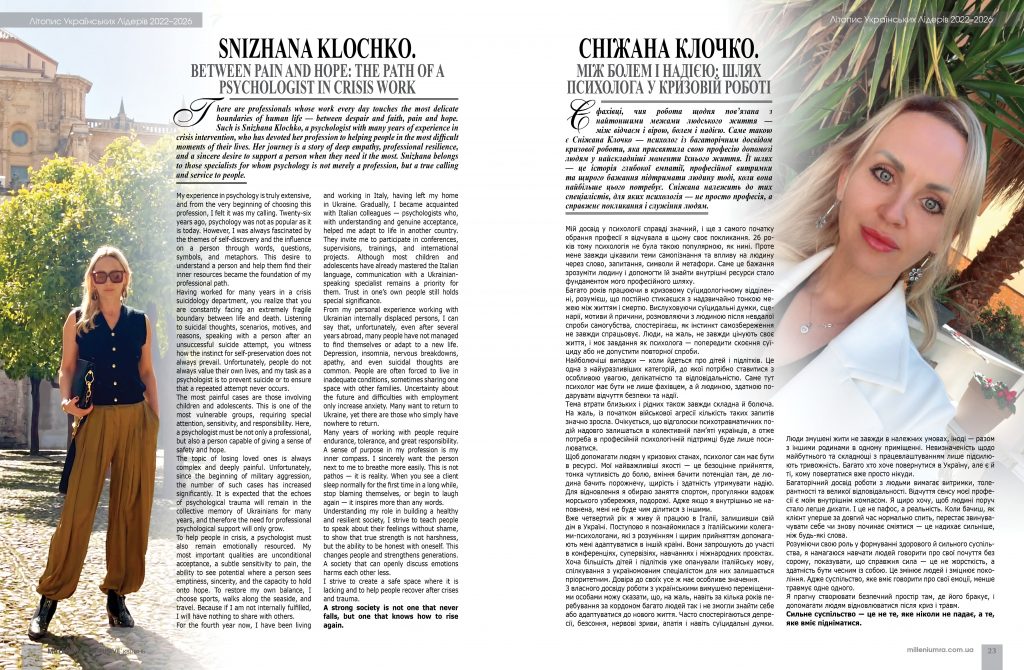
Є фахівці, чия робота щодня пов’язана з найтоншими межами людського життя — між відчаєм і вірою, болем і надією. Саме такою є Сніжана Клочко — психолог із багаторічним досвідом кризової роботи, яка присвятила свою професію допомозі людям у найскладніші моменти їхнього життя. Її шлях — це історія глибокої емпатії, професійної витримки та щирого бажання підтримати людину тоді, коли вона найбільше цього потребує. Сніжана належить до тих спеціалістів, для яких психологія — не просто професія, а справжнє покликання і служіння людям.
Мій досвід у психології справді значний, і ще з самого початку обрання професії я відчувала в цьому своє покликання. 26 років тому психологія не була такою популярною, як нині. Проте мене завжди цікавили теми самопізнання та впливу на людину через слово, запитання, символи й метафори. Саме це бажання зрозуміти людину і допомогти їй знайти внутрішні ресурси стало фундаментом мого професійного шляху.
Багато років працюючи в кризовому суїцидологічному відділенні, розумієш, що постійно стикаєшся з надзвичайно тонкою межею між життям і смертю. Вислуховуючи суїцидальні думки, сценарії, мотиви й причини, розмовляючи з людиною після невдалої спроби самогубства, спостерігаєш, як інстинкт самозбереження не завжди спрацьовує. Люди, на жаль, не завжди цінують своє життя, і моє завдання як психолога — попередити скоєння суїциду або не допустити повторної спроби.
Найболючіші випадки — коли йдеться про дітей і підлітків. Це одна з найуразливіших категорій, до якої потрібно ставитися з особливою увагою, делікатністю та відповідальністю. Саме тут психолог має бути не лише фахівцем, а й людиною, здатною подарувати відчуття безпеки та надії.
Тема втрати близьких і рідних також завжди складна й болюча. На жаль, із початком військової агресії кількість таких запитів значно зросла. Очікується, що відголоски психотравматичних подій надовго залишаться в колективній пам’яті українців, а отже потреба в професійній психологічній підтримці буде лише посилюватися.
Щоб допомагати людям у кризових станах, психолог сам має бути в ресурсі. Мої найважливіші якості — це безоцінне прийняття, тонка чутливість до болю, вміння бачити потенціал там, де людина бачить порожнечу, щирість і здатність утримувати надію. Для відновлення я обираю заняття спортом, прогулянки вздовж морського узбережжя, подорожі. Адже якщо я внутрішньо не наповнена, мені не буде чим ділитися з іншими.
Вже четвертий рік я живу й працюю в Італії, залишивши свій дім в Україні. Поступово я познайомилася з італійськими колегами-психологами, які з розумінням і щирим прийняттям допомагають мені адаптуватися в іншій країні. Вони запрошують до участі в конференціях, супервізіях, навчаннях і міжнародних проєктах. Хоча більшість дітей і підлітків уже опанували італійську мову, спілкування з україномовним спеціалістом для них залишається пріоритетним. Довіра до своїх усе ж має особливе значення.
З власного досвіду роботи з українськими вимушено переміщеними особами можу сказати, що, на жаль, навіть за кілька років перебування за кордоном багато людей так і не змогли знайти себе або адаптуватися до нового життя. Часто спостерігаються депресії, безсоння, нервові зриви, апатія і навіть суїцидальні думки. Люди змушені жити не завжди в належних умовах, іноді — разом з іншими родинами в одному приміщенні. Невизначеність щодо майбутнього та складнощі з працевлаштуванням лише підсилюють тривожність. Багато хто хоче повернутися в Україну, але є й ті, кому повертатися вже просто нікуди.
Багаторічний досвід роботи з людьми вимагає витримки, толерантності та великої відповідальності. Відчуття сенсу моєї професії є моїм внутрішнім компасом. Я щиро хочу, щоб людині поруч стало легше дихати. І це не пафос, а реальність. Коли бачиш, як клієнт уперше за довгий час нормально спить, перестає звинувачувати себе чи знову починає сміятися — це надихає сильніше, ніж будь-які слова.
Розуміючи свою роль у формуванні здорового й сильного суспільства, я намагаюся навчати людей говорити про свої почуття без сорому, показувати, що справжня сила — це не жорсткість, а здатність бути чесним із собою. Це змінює людей і зміцнює покоління. Адже суспільство, яке вміє говорити про свої емоції, менше травмує одне одного.
Я прагну створювати безпечний простір там, де його бракує, і допомагати людям відновлюватися після криз і травм.
Сильне суспільство — це не те, яке ніколи не падає, а те, яке вміє підніматися.
SNIZHANA KLOCHKO. BETWEEN PAIN AND HOPE: THE PATH OF A PSYCHOLOGIST IN CRISIS WORK
Тhere are professionals whose work every day touches the most delicate boundaries of human life — between despair and faith, pain and hope. Such is Snizhana Klochko, a psychologist with many years of experience in crisis intervention, who has devoted her profession to helping people in the most difficult moments of their lives. Her journey is a story of deep empathy, professional resilience, and a sincere desire to support a person when they need it the most. Snizhana belongs to those specialists for whom psychology is not merely a profession, but a true calling and service to people.
My experience in psychology is truly extensive, and from the very beginning of choosing this profession, I felt it was my calling. Twenty-six years ago, psychology was not as popular as it is today. However, I was always fascinated by the themes of self-discovery and the influence on a person through words, questions, symbols, and metaphors. This desire to understand a person and help them find their inner resources became the foundation of my professional path.
Having worked for many years in a crisis suicidology department, you realize that you are constantly facing an extremely fragile boundary between life and death. Listening to suicidal thoughts, scenarios, motives, and reasons, speaking with a person after an unsuccessful suicide attempt, you witness how the instinct for self-preservation does not always prevail. Unfortunately, people do not always value their own lives, and my task as a psychologist is to prevent suicide or to ensure that a repeated attempt never occurs.
The most painful cases are those involving children and adolescents. This is one of the most vulnerable groups, requiring special attention, sensitivity, and responsibility. Here, a psychologist must be not only a professional, but also a person capable of giving a sense of safety and hope.
The topic of losing loved ones is always complex and deeply painful. Unfortunately, since the beginning of military aggression, the number of such cases has increased significantly. It is expected that the echoes of psychological trauma will remain in the collective memory of Ukrainians for many years, and therefore the need for professional psychological support will only grow.
To help people in crisis, a psychologist must also remain emotionally resourced. My most important qualities are unconditional acceptance, a subtle sensitivity to pain, the ability to see potential where a person sees emptiness, sincerity, and the capacity to hold onto hope. To restore my own balance, I choose sports, walks along the seaside, and travel. Because if I am not internally fulfilled, I will have nothing to share with others.
For the fourth year now, I have been living and working in Italy, having left my home in Ukraine. Gradually, I became acquainted with Italian colleagues — psychologists who, with understanding and genuine acceptance, helped me adapt to life in another country. They invite me to participate in conferences, supervisions, trainings, and international projects. Although most children and adolescents have already mastered the Italian language, communication with a Ukrainian-speaking specialist remains a priority for them. Trust in one’s own people still holds special significance.
From my personal experience working with Ukrainian internally displaced persons, I can say that, unfortunately, even after several years abroad, many people have not managed to find themselves or adapt to a new life. Depression, insomnia, nervous breakdowns, apathy, and even suicidal thoughts are common. People are often forced to live in inadequate conditions, sometimes sharing one space with other families. Uncertainty about the future and difficulties with employment only increase anxiety. Many want to return to Ukraine, yet there are those who simply have nowhere to return.
Many years of working with people require endurance, tolerance, and great responsibility. A sense of purpose in my profession is my inner compass. I sincerely want the person next to me to breathe more easily. This is not pathos — it is reality. When you see a client sleep normally for the first time in a long while, stop blaming themselves, or begin to laugh again — it inspires more than any words.
Understanding my role in building a healthy and resilient society, I strive to teach people to speak about their feelings without shame, to show that true strength is not harshness, but the ability to be honest with oneself. This changes people and strengthens generations. A society that can openly discuss emotions harms each other less.
I strive to create a safe space where it is lacking and to help people recover after crises and trauma.
A strong society is not one that never falls, but one that knows how to rise again.