
Cиндром відкладеного життя змушує нас роками чекати «кращого моменту», відкладаючи радість, мрії та себе справжніх. У гонитві за стабільністю, безпекою й правильними рішеннями ми часто втрачаємо контакт із теперішнім і власними відчуттями. Людина ніби живе в режимі очікування, переконуючи себе, що справжнє життя почнеться пізніше — коли з’явиться більше часу, грошей або впевненості. Чому так відбувається і як повернутися в життя тут і тепер — говоримо з психологинею Мариною ФАКАС.
— Марино, вітаємо Вас, ми дуже раді цій зустрічі. Чому, на Вашу думку, люди так часто відкладають життя на потім?
— Найчастіше це пов’язано з прокрастинацією, страхом невдачі або навіть страхом успіху, а також із низькою самооцінкою. Синдром відкладеного життя — це психологічна установка, за якою теперішнє сприймається як репетиція, а справжнє життя нібито має початися пізніше, за ідеальних умов. Людина відкладає радість, дозволи на щастя і реалізацію, очікуючи уявного «потім».
— Звідки береться такий життєвий сценарій?
— Його коріння часто сягає дитинства. Нас учили: є одяг «на щодень» і «на вихід», спочатку — обов’язки, а вже потім — задоволення, на мрії ще буде час. У дорослому віці цей сценарій продовжує працювати автоматично, навіть якщо він більше не служить нам і не відповідає нашим справжнім потребам. Люди роками відкладають себе, не помічаючи, як минає життя.
— За якими ознаками можна зрозуміти, що людина живе в режимі очікування?
— Це ледь помітні сигнали: фрази «потім поїду у подорож», «схудну — тоді вдягну цю сукню», «ось закінчиться цей період — і тоді заживу». Ми ніби пишемо чернетку життя, відкладаючи чистовик. Але життя не має запасної версії — воно відбувається саме зараз, у кожному дні.
— З чого починається вихід із цього стану?
— З маленьких кроків і повернення уваги в сьогодення. Радощі без приводу — кава в улюбленій кав’ярні, гарна свічка, кілька хвилин тиші — дають мозку сигнал: «Я живу зараз». Практики вдячності, усвідомлені паузи й турбота про себе допомагають знижувати страх перед змінами.
— Що допомагає не відкладати радість у нестабільному світі?
— Фокус на власних ресурсах і практика «Що як не сьогодні?». Вона вчить цінувати кожен день, дозволяти собі маленькі радості та не чекати ідеальних умов. Важливо також навчитися просити допомоги й дозволяти собі жити, а не лише виживати.
— На що можна спертися, щоб відчути внутрішню підтримку і сміливо жити сьогодні?
— На прості фрази-нагадування: «Життя — не репетиція», «Потім — це пастка», «Я маю право жити зараз». Навіть у невизначеності ми можемо обирати бути присутніми у власному житті й помічати його цінність.
Редакція Millenium Club щиро дякує Марині Факас за глибоку й відверту розмову та бажає їй професійного зростання, внутрішньої гармонії й реалізації проєктів, що змінюють життя людей на краще.
MARYNA FAKAS: LIFE IS NOT FOR LATER: HOW TO STOP WAITING AND START LIVING
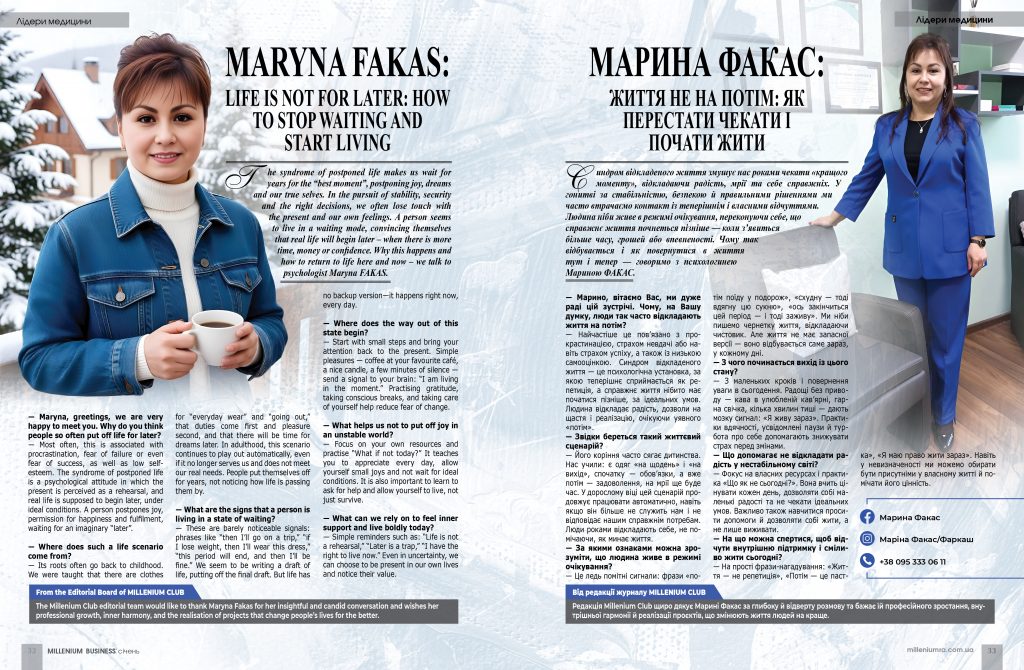
The syndrome of postponed life makes us wait for years for the “best moment”, postponing joy, dreams and our true selves. In the pursuit of stability, security and the right decisions, we often lose touch with the present and our own feelings. A person seems to live in a waiting mode, convincing themselves that real life will begin later – when there is more time, money or confidence. Why this happens and how to return to life here and now – we talk to psychologist Maryna FAKAS.
— Maryna, greetings, we are very happy to meet you. Why do you think people so often put off life for later?
— Most often, this is associated with procrastination, fear of failure or even fear of success, as well as low self-esteem. The syndrome of postponed life is a psychological attitude in which the present is perceived as a rehearsal, and real life is supposed to begin later, under ideal conditions. A person postpones joy, permission for happiness and fulfilment, waiting for an imaginary “later”.
— Where does such a life scenario come from?
— Its roots often go back to childhood. We were taught that there are clothes for “everyday wear” and “going out,” that duties come first and pleasure second, and that there will be time for dreams later. In adulthood, this scenario continues to play out automatically, even if it no longer serves us and does not meet our real needs. People put themselves off for years, not noticing how life is passing them by.
— What are the signs that a person is living in a state of waiting?
— These are barely noticeable signals: phrases like “then I’ll go on a trip,” “if I lose weight, then I’ll wear this dress,” “this period will end, and then I’ll be fine.” We seem to be writing a draft of life, putting off the final draft. But life has no backup version—it happens right now, every day.
— Where does the way out of this state begin?
— Start with small steps and bring your attention back to the present. Simple pleasures — coffee at your favourite café, a nice candle, a few minutes of silence — send a signal to your brain: “I am living in the moment.” Practising gratitude, taking conscious breaks, and taking care of yourself help reduce fear of change.
— What helps us not to put off joy in an unstable world?
— Focus on your own resources and practise “What if not today?” It teaches you to appreciate every day, allow yourself small joys and not wait for ideal conditions. It is also important to learn to ask for help and allow yourself to live, not just survive.
— What can we rely on to feel inner support and live boldly today?
— Simple reminders such as: “Life is not a rehearsal,” “Later is a trap,” “I have the right to live now.” Even in uncertainty, we can choose to be present in our own lives and notice their value.
The Millenium Club editorial team would like to thank Maryna Fakas for her insightful and candid conversation and wishes her professional growth, inner harmony, and the realisation of projects that change people’s lives for the better.