У сучасному HR, де гучні гасла ще часто замінюють реальні зміни, ім’я Вікторії СИРОТЕНКО звучить як синонім дисципліни, точності та поваги до професіоналів. Вона працює на перетині стратегії та людського розвитку, перетворюючи навички співробітників на вимірюваний ресурс, що напряму впливає на бізнес-результати. Її метод — не про магічні трансформації, а про короткі цикли, у яких кожен крок приносить відчутний ефект. Саме тому компанії довіряють Вікторії найцінніше — свої команди, свій темп і своє майбутнє. Її підхід доводить: сучасний HR — це не про пафос, а про чесні інструменти, які працюють.
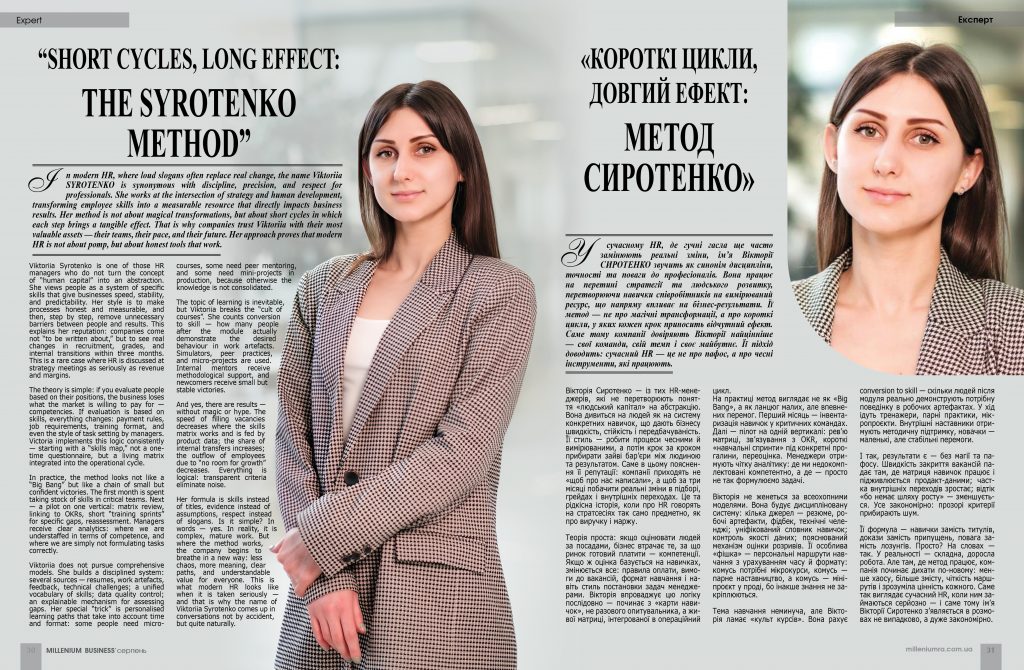
Вікторія Сиротенко — із тих HR-менеджерів, які не перетворюють поняття «людський капітал» на абстракцію. Вона дивиться на людей як на систему конкретних навичок, що дають бізнесу швидкість, стійкість і передбачуваність. Її стиль — робити процеси чесними й вимірюваними, а потім крок за кроком прибирати зайві бар’єри між людиною та результатом. Саме в цьому пояснення її репутації: компанії приходять не «щоб про нас написали», а щоб за три місяці побачити реальні зміни в підборі, грейдах і внутрішніх переходах. Це та рідкісна історія, коли про HR говорять на стратсесіях так само предметно, як про виручку і маржу.
Теорія проста: якщо оцінювати людей за посадами, бізнес втрачає те, за що ринок готовий платити — компетенції. Якщо ж оцінка базується на навичках, змінюється все: правила оплати, вимоги до вакансій, формат навчання і навіть стиль постановки задач менеджерами. Вікторія впроваджує цю логіку послідовно — починає з «карти навичок», не разового опитувальника, а живої матриці, інтегрованої в операційний цикл.
На практиці метод виглядає не як «Big Bang», а як ланцюг малих, але впевнених перемог. Перший місяць — інвентаризація навичок у критичних командах. Далі — пілот на одній вертикалі: рев’ю матриці, зв’язування з OKR, короткі «навчальні спринти» під конкретні прогалини, переоцінка. Менеджери отримують чітку аналітику: де ми недокомплектовані компетентно, а де — просто не так формулюємо задачі.
Вікторія не женеться за всеохопними моделями. Вона будує дисципліновану систему: кілька джерел — резюме, робочі артефакти, фідбек, технічні челенджі; уніфікований словник навичок; контроль якості даних; пояснюваний механізм оцінки розривів. Її особлива «фішка» — персональні маршрути навчання з урахуванням часу й формату: комусь потрібні мікрокурси, комусь — парне наставництво, а комусь — мініпроєкт у проді, бо інакше знання не закріплюються.
Тема навчання неминуча, але Вікторія ламає «культ курсів». Вона рахує conversion to skill — скільки людей після модуля реально демонструють потрібну поведінку в робочих артефактах. У хід ідуть тренажери, парні практики, мікропроєкти. Внутрішні наставники отримують методичну підтримку, новачки — маленькі, але стабільні перемоги.
І так, результати є — без магії та пафосу. Швидкість закриття вакансій падає там, де матриця навичок працює і підживлюється продакт-даними; частка внутрішніх переходів зростає; відтік «бо немає шляху росту» — зменшується. Усе закономірно: прозорі критерії прибирають шум.
Її формула — навички замість титулів, докази замість припущень, повага замість лозунгів. Просто? На словах — так. У реальності — складна, доросла робота. Але там, де метод працює, компанія починає дихати по-новому: менше хаосу, більше змісту, чіткість маршрутів і зрозуміла цінність кожного. Саме так виглядає сучасний HR, коли ним займаються серйозно — і саме тому ім’я Вікторії Сиротенко з’являється в розмовах не випадково, а дуже закономірно.
“SHORT CYCLES, LONG EFFECT:
THE SYROTENKO METHOD”
In modern HR, where loud slogans often replace real change, the name Viktoriia SYROTENKO is synonymous with discipline, precision, and respect for professionals. She works at the intersection of strategy and human development, transforming employee skills into a measurable resource that directly impacts business results. Her method is not about magical transformations, but about short cycles in which each step brings a tangible effect. That is why companies trust Viktoriia with their most valuable assets — their teams, their pace, and their future. Her approach proves that modern HR is not about pomp, but about honest tools that work.
Viktoriia Syrotenko is one of those HR managers who do not turn the concept of “human capital” into an abstraction. She views people as a system of specific skills that give businesses speed, stability, and predictability. Her style is to make processes honest and measurable, and then, step by step, remove unnecessary barriers between people and results. This explains her reputation: companies come not “to be written about,” but to see real changes in recruitment, grades, and internal transitions within three months. This is a rare case where HR is discussed at strategy meetings as seriously as revenue and margins.
The theory is simple: if you evaluate people based on their positions, the business loses what the market is willing to pay for — competencies. If evaluation is based on skills, everything changes: payment rules, job requirements, training format, and even the style of task setting by managers. Victoria implements this logic consistently — starting with a “skills map,” not a one-time questionnaire, but a living matrix integrated into the operational cycle.
In practice, the method looks not like a “Big Bang” but like a chain of small but confident victories. The first month is spent taking stock of skills in critical teams. Next — a pilot on one vertical: matrix review, linking to OKRs, short “training sprints” for specific gaps, reassessment. Managers receive clear analytics: where we are understaffed in terms of competence, and where we are simply not formulating tasks correctly.
Viktoriia does not pursue comprehensive models. She builds a disciplined system: several sources — resumes, work artefacts, feedback, technical challenges; a unified vocabulary of skills; data quality control; an explainable mechanism for assessing gaps. Her special “trick” is personalised learning paths that take into account time and format: some people need micro-courses, some need peer mentoring, and some need mini-projects in production, because otherwise the knowledge is not consolidated.
The topic of learning is inevitable, but Viktoriia breaks the “cult of courses”. She counts conversion to skill — how many people after the module actually demonstrate the desired behaviour in work artefacts. Simulators, peer practices, and micro-projects are used. Internal mentors receive methodological support, and newcomers receive small but stable victories.
And yes, there are results — without magic or hype. The speed of filling vacancies decreases where the skills matrix works and is fed by product data; the share of internal transfers increases; the outflow of employees due to “no room for growth” decreases. Everything is logical: transparent criteria eliminate noise.
Her formula is skills instead of titles, evidence instead of assumptions, respect instead of slogans. Is it simple? In words — yes. In reality, it is complex, mature work. But where the method works, the company begins to breathe in a new way: less chaos, more meaning, clear paths, and understandable value for everyone. This is what modern HR looks like when it is taken seriously — and that is why the name of Viktoriia Syrotenko comes up in conversations not by accident, but quite naturally.