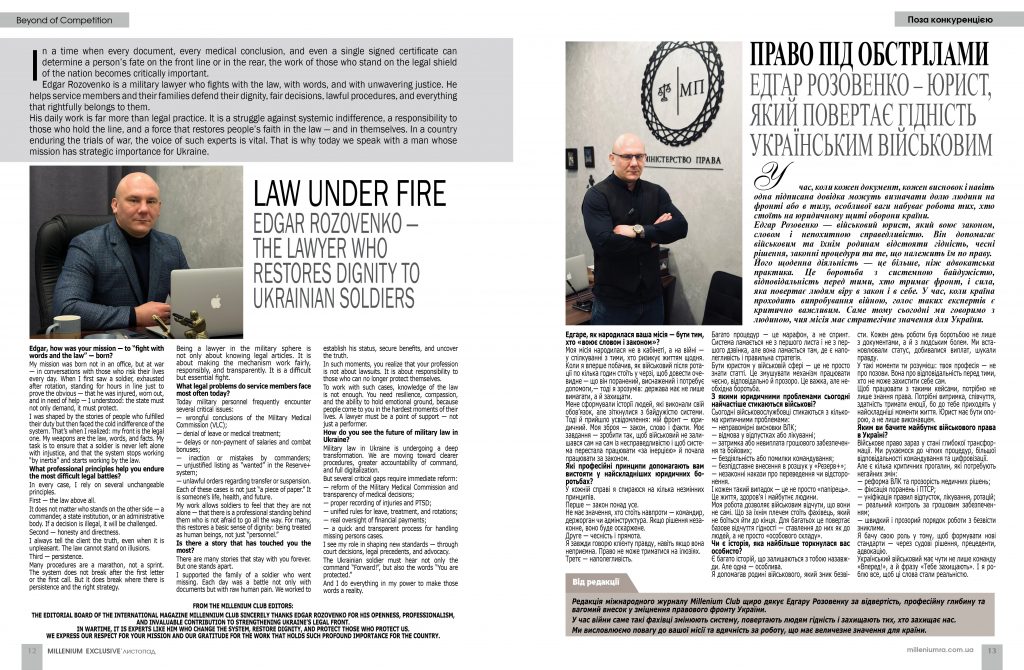
У час, коли кожен документ, кожен висновок і навіть одна підписана довідка можуть визначати долю людини на фронті або в тилу, особливої ваги набуває робота тих, хто стоїть на юридичному щиті оборони країни.
Едгар Розовенко — військовий юрист, який воює законом, словом і непохитною справедливістю. Він допомагає військовим та їхнім родинам відстояти гідність, чесні рішення, законні процедури та те, що належить їм по праву.
Його щоденна діяльність — це більше, ніж адвокатська практика. Це боротьба з системною байдужістю, відповідальність перед тими, хто тримає фронт, і сила, яка повертає людям віру в закон і в себе. У час, коли країна проходить випробування війною, голос таких експертів є критично важливим. Саме тому сьогодні ми говоримо з людиною, чия місія має стратегічне значення для України.
Едгаре, як народилася ваша місія — бути тим, хто «воює словом і законом»?
Моя місія народилася не в кабінеті, а на війні — у спілкуванні з тими, хто ризикує життям щодня. Коли я вперше побачив, як військовий після ротації по кілька годин стоїть у черзі, щоб довести очевидне — що він поранений, виснажений і потребує допомоги,— тоді я зрозумів: держава має не лише вимагати, а й захищати.
Мене сформували історії людей, які виконали свій обов’язок, але зіткнулися з байдужістю системи. Тоді й прийшло усвідомлення: мій фронт — юридичний. Моя зброя — закон, слово і факти. Моє завдання — зробити так, щоб військовий не залишався сам на сам із несправедливістю і щоб система перестала працювати «за інерцією» й почала працювати за законом.
Які професійні принципи допомагають вам вистояти у найскладніших юридичних боротьбах?
У кожній справі я спираюся на кілька незмінних принципів.
Перше — закон понад усе.
Не має значення, хто стоїть навпроти — командир, держорган чи адмінструктура. Якщо рішення незаконне, воно буде оскаржене.
Друге — чесність і прямота.
Я завжди говорю клієнту правду, навіть якщо вона неприємна. Право не може триматися на ілюзіях.
Третє — наполегливість.
Багато процедур — це марафон, а не спринт.
Система ламається не з першого листа і не з першого дзвінка, але вона ламається там, де є наполегливість і правильна стратегія.
Бути юристом у військовій сфері — це не просто знати статті. Це змушувати механізм працювати чесно, відповідально й прозоро. Це важка, але необхідна боротьба.
З якими юридичними проблемами сьогодні найчастіше стикаються військові?
Сьогодні військовослужбовці стикаються з кількома критичними проблемами:
— неправомірні висновки ВЛК;
— відмова у відпустках або лікуванні;
— затримка або невиплата грошового забезпечення та бойових;
— бездіяльність або помилки командування;
— безпідставне внесення в розшук у «Резерв+»;
— незаконні накази про переведення чи відсторонення.
І кожен такий випадок — це не просто «папірець». Це життя, здоров’я і майбутнє людини.
Моя робота дозволяє військовим відчути, що вони не самі. Що за їхнім плечем стоїть фахівець, який не боїться йти до кінця. Для багатьох це повертає базове відчуття гідності — ставлення до них як до людей, а не просто «особового складу».
Чи є історія, яка найбільше торкнулася вас особисто?
Є багато історій, що залишаються з тобою назавжди. Але одна — особлива.
Я допомагав родині військового, який зник безвісти. Кожен день роботи був боротьбою не лише з документами, а й з людським болем. Ми встановлювали статус, добивалися виплат, шукали правду.
У такі моменти ти розумієш: твоя професія — не про позови. Вона про відповідальність перед тими, хто не може захистити себе сам.
Щоб працювати з такими кейсами, потрібно не лише знання права. Потрібні витримка, співчуття, здатність тримати емоції, бо до тебе приходять у найскладніші моменти життя. Юрист має бути опорою, а не лише виконавцем.
Яким ви бачите майбутнє військового права в Україні?
Військове право зараз у стані глибокої трансформації. Ми рухаємося до чітких процедур, більшої відповідальності командування та цифровізації.
Але є кілька критичних прогалин, які потребують негайних змін:
— реформа ВЛК та прозорість медичних рішень;
— фіксація поранень і ПТСР;
— уніфікація правил відпусток, лікування, ротацій;
— реальний контроль за грошовим забезпеченням;
— швидкий і прозорий порядок роботи з безвісти зниклими.
Я бачу свою роль у тому, щоб формувати нові стандарти — через судові рішення, прецеденти, адвокацію.
Український військовий має чути не лише команду «Вперед!», а й фразу «Тебе захищають». І я роблю все, щоб ці слова стали реальністю.
Редакція міжнародного журналу Millenium Club щиро дякує Едгару Розовенку за відвертість, професійну глибину та вагомий внесок у зміцнення правового фронту України.
У час війни саме такі фахівці змінюють систему, повертають людям гідність і захищають тих, хто захищає нас.
Ми висловлюємо повагу до вашої місії та вдячність за роботу, що має величезне значення для країни.
LAW UNDER FIRE. Edgar Rozovenko —
the lawyer who restores dignity to Ukrainian soldiers
Іn a time when every document, every medical conclusion, and even a single signed certificate can determine a person’s fate on the front line or in the rear, the work of those who stand on the legal shield of the nation becomes critically important.
Edgar Rozovenko is a military lawyer who fights with the law, with words, and with unwavering justice. He helps service members and their families defend their dignity, fair decisions, lawful procedures, and everything that rightfully belongs to them.
His daily work is far more than legal practice. It is a struggle against systemic indifference, a responsibility to those who hold the line, and a force that restores people’s faith in the law — and in themselves. In a country enduring the trials of war, the voice of such experts is vital. That is why today we speak with a man whose mission has strategic importance for Ukraine.
Edgar, how was your mission — to “fight with words and the law” — born?
My mission was born not in an office, but at war — in conversations with those who risk their lives every day. When I first saw a soldier, exhausted after rotation, standing for hours in line just to prove the obvious — that he was injured, worn out, and in need of help — I understood: the state must not only demand, it must protect.
I was shaped by the stories of people who fulfilled their duty but then faced the cold indifference of the system. That’s when I realized: my front is the legal one. My weapons are the law, words, and facts. My task is to ensure that a soldier is never left alone with injustice, and that the system stops working “by inertia” and starts working by the law.
What professional principles help you endure the most difficult legal battles?
In every case, I rely on several unchangeable principles.
First — the law above all.
It does not matter who stands on the other side — a commander, a state institution, or an administrative body. If a decision is illegal, it will be challenged.
Second — honesty and directness.
I always tell the client the truth, even when it is unpleasant. The law cannot stand on illusions.
Third — persistence.
Many procedures are a marathon, not a sprint. The system does not break after the first letter or the first call. But it does break where there is persistence and the right strategy.
Being a lawyer in the military sphere is not only about knowing legal articles. It is about making the mechanism work fairly, responsibly, and transparently. It is a difficult but essential fight.
What legal problems do service members face most often today?
Today military personnel frequently encounter several critical issues:
— wrongful conclusions of the Military Medical Commission (VLC);
— denial of leave or medical treatment;
— delays or non-payment of salaries and combat bonuses;
— inaction or mistakes by commanders;
— unjustified listing as “wanted” in the Reserve+ system;
— unlawful orders regarding transfer or suspension.
Each of these cases is not just “a piece of paper.” It is someone’s life, health, and future.
My work allows soldiers to feel that they are not alone — that there is a professional standing behind them who is not afraid to go all the way. For many, this restores a basic sense of dignity: being treated as human beings, not just “personnel.”
Is there a story that has touched you the most?
There are many stories that stay with you forever. But one stands apart.
I supported the family of a soldier who went missing. Each day was a battle not only with documents but with raw human pain. We worked to establish his status, secure benefits, and uncover the truth.
In such moments, you realize that your profession is not about lawsuits. It is about responsibility to those who can no longer protect themselves.
To work with such cases, knowledge of the law is not enough. You need resilience, compassion, and the ability to hold emotional ground, because people come to you in the hardest moments of their lives. A lawyer must be a point of support — not just a performer.
How do you see the future of military law in Ukraine?
Military law in Ukraine is undergoing a deep transformation. We are moving toward clearer procedures, greater accountability of command, and full digitalization.
But several critical gaps require immediate reform:
— reform of the Military Medical Commission and transparency of medical decisions;
— proper recording of injuries and PTSD;
— unified rules for leave, treatment, and rotations;
— real oversight of financial payments;
— a quick and transparent process for handling missing persons cases.
I see my role in shaping new standards — through court decisions, legal precedents, and advocacy.
The Ukrainian soldier must hear not only the command “Forward!”, but also the words “You are protected.”
And I do everything in my power to make those words a reality.
From the MILLENIUM CLUB editors:
The editorial board of the international magazine Millennium Club sincerely thanks Edgar Rozovenko for his openness, professionalism, and invaluable contribution to strengthening Ukraine’s legal front.
In wartime, it is experts like him who change the system, restore dignity, and protect those who protect us.
We express our respect for your mission and our gratitude for the work that holds such profound importance for the country.