
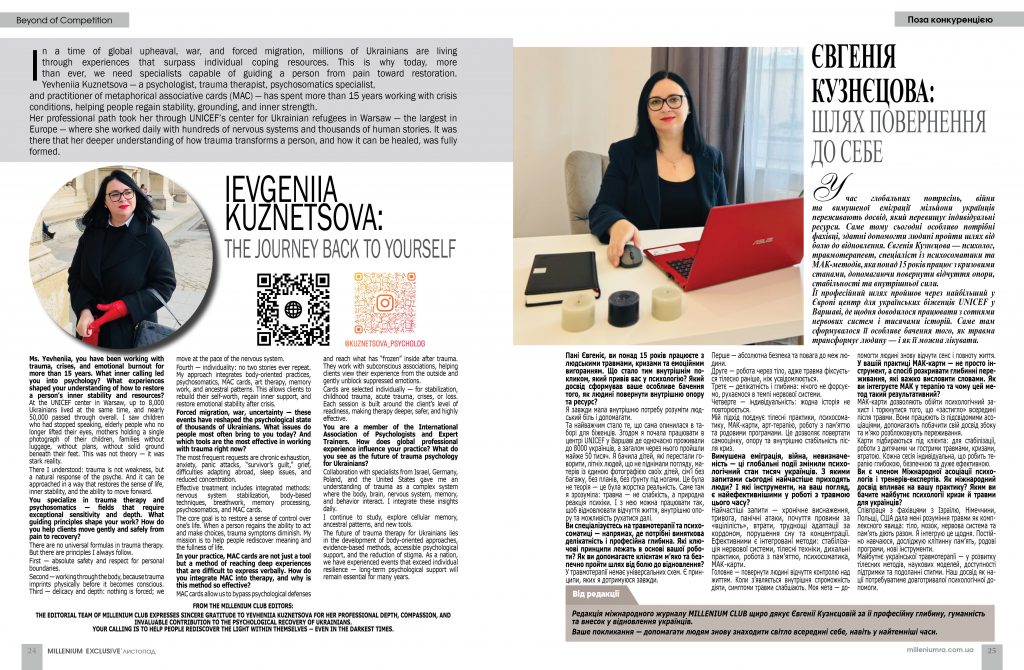
У час глобальних потрясінь, війни та вимушеної еміграції мільйони українців переживають досвід, який перевищує індивідуальні ресурси. Саме тому сьогодні особливо потрібні фахівці, здатні допомогти людині пройти шлях від болю до відновлення. Євгенія Кузнєцова — психолог, травмотерапевт, спеціаліст із психосоматики та МАК-методів, яка понад 15 років працює з кризовими станами, допомагаючи повернути відчуття опори, стабільності та внутрішньої сили.
Її професійний шлях пройшов через найбільший у Європі центр для українських біженців UNICEF у Варшаві, де щодня доводилося працювати з сотнями нервових систем і тисячами історій. Саме там сформувалося її особливе бачення того, як травма трансформує людину — і як її можна лікувати.
Пані Євгеніє, ви понад 15 років працюєте з людськими травмами, кризами та емоційним вигоранням. Що стало тим внутрішнім покликом, який привів вас у психологію? Який досвід сформував ваше особливе бачення того, як людині повернути внутрішню опору та ресурс?
Я завжди мала внутрішню потребу розуміти людський біль і допомагати.
Та найважчим стало те, що сама опинилася в таборі для біженців. Згодом я почала працювати в центрі UNICEF у Варшаві де одночасно проживали до 8000 українців, а загалом через нього пройшли майже 50 тисяч. Я бачила дітей, які перестали говорити, літніх людей, що не піднімали погляду, матерів із єдиною фотографією своїх дітей, сім’ї без багажу, без планів, без ґрунту під ногами. Це була не теорія — це була жорстка реальність. Саме там я зрозуміла: травма — не слабкість, а природна реакція психіки. І з нею можна працювати так, щоб відновлювати відчуття життя, внутрішню опору та можливість рухатися далі.
Ви спеціалізуєтесь на травмотерапії та психосоматиці — напрямах, де потрібні виняткова делікатність і професійна глибина. Які ключові принципи лежать в основі вашої роботи? Як ви допомагаєте клієнтам м’яко та безпечно пройти шлях від болю до відновлення?
У травмотерапії немає універсальних схем. Є принципи, яких я дотримуюся завжди.
Перше — абсолютна безпека та повага до меж людини.
Друге — робота через тіло, адже травма фіксується тілесно раніше, ніж усвідомлюється.
Третє — делікатність і глибина: нічого не форсуємо, рухаємося в темпі нервової системи.
Четверте — індивідуальність: жодна історія не повторюється.
Мій підхід поєднує тілесні практики, психосоматику, МАК-карти, арт-терапію, роботу з пам’яттю та родовими програмами. Це дозволяє повертати самооцінку, опору та внутрішню стабільність після криз.
Вимушена еміграція, війна, невизначеність — ці глобальні події змінили психологічний стан тисяч українців. З якими запитами сьогодні найчастіше приходять люди? І які інструменти, на ваш погляд, є найефективнішими у роботі з травмою цього часу?
Найчастіші запити — хронічне виснаження, тривога, панічні атаки, почуття провини за «вцілілість», втрати, труднощі адаптації за кордоном, порушення сну та концентрації. Ефективними є інтегровані методи: стабілізація нервової системи, тілесні техніки, дихальні практики, робота з пам’яттю, психосоматика, МАК-карти.
Головне — повернути людині відчуття контролю над життям. Коли з’являється внутрішня спроможність діяти, симптоми травми слабшають. Моя мета — допомогти людині знову відчути сенс і повноту життя.
У вашій практиці МАК-карти — не просто інструмент, а спосіб розкривати глибинні переживання, які важко висловити словами. Як ви інтегруєте МАК у терапію та чому цей метод такий результативний?
МАК-карти дозволяють обійти психологічний захист і торкнутися того, що «застигло» всередині після травми. Вони працюють із підсвідомими асоціаціями, допомагають побачити свій досвід збоку та м’яко розблоковують переживання.
Карти підбираються під клієнта: для стабілізації, роботи з дитячими чи гострими травмами, кризами, втратою. Кожна сесія індивідуальна, що робить терапію глибокою, безпечною та дуже ефективною.
Ви є членом Міжнародної асоціації психологів і тренерів-експертів. Як міжнародний досвід впливає на вашу практику? Яким ви бачите майбутнє психології кризи й травми для українців?
Співпраця з фахівцями з Ізраїлю, Німеччини, Польщі, США дала мені розуміння травми як комплексного явища: тіло, мозок, нервова система та пам’ять діють разом. Я інтегрую це щодня. Постійно навчаюся, досліджую клітинну пам’ять, родові програми, нові інструменти.
Майбутнє української травмотерапії — у розвитку тілесних методів, наукових моделей, доступності підтримки та подоланні стигми. Наш досвід як нації потребуватиме довготривалої психологічної допомоги.
Редакція міжнародного журналу MILLENIUM CLUB щиро дякує Євгенії Кузнєцовій за її професійну глибину, гуманність та внесок у відновлення українців.
Ваше покликання — допомагати людям знову знаходити світло всередині себе, навіть у найтемніші часи.
Ievgeniia Kuznetsova: The Journey Back to Yourself
Іn a time of global upheaval, war, and forced migration, millions of Ukrainians are living through experiences that surpass individual coping resources. This is why today, more than ever, we need specialists capable of guiding a person from pain toward restoration.
Yevheniia Kuznetsova — a psychologist, trauma therapist, psychosomatics specialist,
and practitioner of metaphorical associative cards (MAC) — has spent more than 15 years working with crisis conditions, helping people regain stability, grounding, and inner strength.
Her professional path took her through UNICEF’s center for Ukrainian refugees in Warsaw — the largest in Europe — where she worked daily with hundreds of nervous systems and thousands of human stories. It was there that her deeper understanding of how trauma transforms a person, and how it can be healed, was fully formed.
Ms. Yevheniia, you have been working with trauma, crises, and emotional burnout for more than 15 years. What inner calling led you into psychology? What experiences shaped your understanding of how to restore a person’s inner stability and resources?
At the UNICEF center in Warsaw, up to 8,000 Ukrainians lived at the same time, and nearly 50,000 passed through overall. I saw children who had stopped speaking, elderly people who no longer lifted their eyes, mothers holding a single photograph of their children, families without luggage, without plans, without solid ground beneath their feet. This was not theory — it was stark reality.
There I understood: trauma is not weakness, but a natural response of the psyche. And it can be approached in a way that restores the sense of life, inner stability, and the ability to move forward.
You specialize in trauma therapy and psychosomatics — fields that require exceptional sensitivity and depth. What guiding principles shape your work? How do you help clients move gently and safely from pain to recovery?
There are no universal formulas in trauma therapy. But there are principles I always follow.
First — absolute safety and respect for personal boundaries.
Second — working through the body, because trauma imprints physically before it becomes conscious.
Third — delicacy and depth: nothing is forced; we move at the pace of the nervous system.
Fourth — individuality: no two stories ever repeat.
My approach integrates body-oriented practices, psychosomatics, MAC cards, art therapy, memory work, and ancestral patterns. This allows clients to rebuild their self-worth, regain inner support, and restore emotional stability after crisis.
Forced migration, war, uncertainty — these events have reshaped the psychological state of thousands of Ukrainians. What issues do people most often bring to you today? And which tools are the most effective in working with trauma right now?
The most frequent requests are chronic exhaustion, anxiety, panic attacks, “survivor’s guilt,” grief, difficulties adapting abroad, sleep issues, and reduced concentration.
Effective treatment includes integrated methods: nervous system stabilization, body-based techniques, breathwork, memory processing, psychosomatics, and MAC cards.
The core goal is to restore a sense of control over one’s life. When a person regains the ability to act and make choices, trauma symptoms diminish. My mission is to help people rediscover meaning and the fullness of life.
In your practice, MAC cards are not just a tool but a method of reaching deep experiences that are difficult to express verbally. How do you integrate MAC into therapy, and why is this method so effective?
MAC cards allow us to bypass psychological defenses and reach what has “frozen” inside after trauma.
They work with subconscious associations, helping clients view their experience from the outside and gently unblock suppressed emotions.
Cards are selected individually — for stabilization, childhood trauma, acute trauma, crises, or loss. Each session is built around the client’s level of readiness, making therapy deeper, safer, and highly effective.
You are a member of the International Association of Psychologists and Expert Trainers. How does global professional experience influence your practice? What do you see as the future of trauma psychology for Ukrainians?
Collaboration with specialists from Israel, Germany, Poland, and the United States gave me an understanding of trauma as a complex system where the body, brain, nervous system, memory, and behavior interact. I integrate these insights daily.
I continue to study, explore cellular memory, ancestral patterns, and new tools.
The future of trauma therapy for Ukrainians lies in the development of body-oriented approaches, evidence-based methods, accessible psychological support, and the reduction of stigma. As a nation, we have experienced events that exceed individual resilience — long-term psychological support will remain essential for many years.
From the MILLENIUM CLUB editors:
The editorial team of MILLENIUM CLUB expresses sincere gratitude to Yevheniia Kuznetsova for her professional depth, compassion, and invaluable contribution to the psychological recovery of Ukrainians.
Your calling is to help people rediscover the light within themselves — even in the darkest times.