
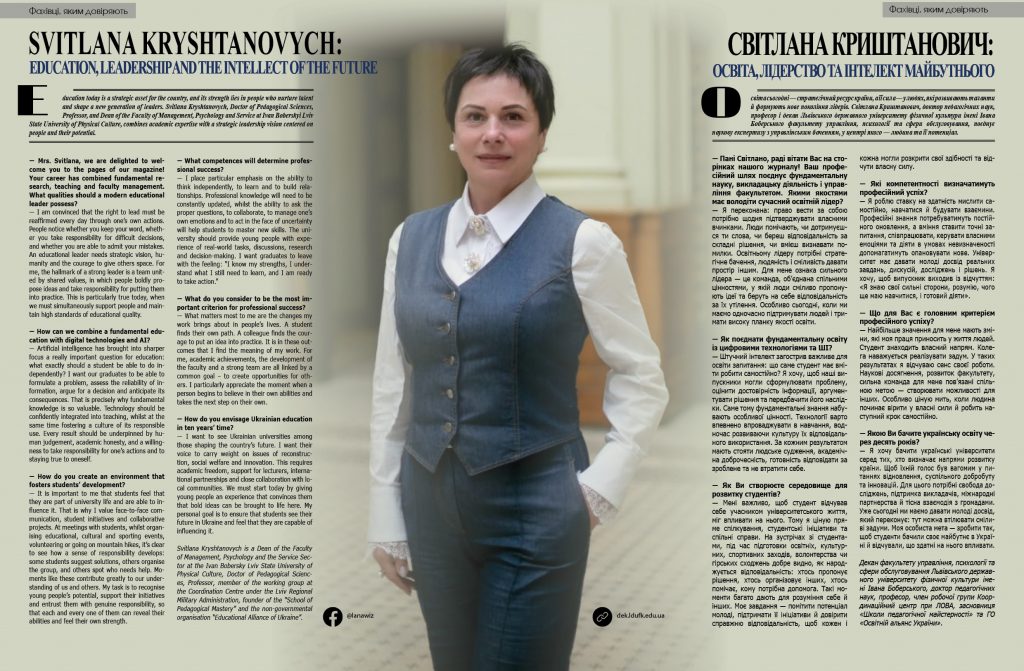
Освіта сьогодні — стратегічний ресурс країни, а її сила — у людях, які розвивають таланти й формують нове покоління лідерів. Світлана Криштанович, доктор педагогічних наук, професор і декан Львівського державного університету фізичної культури імені Івана Боберського факультету управління, психології та сфери обслуговування, поєднує наукову експертизу з управлінським баченням, у центрі якого — людина та її потенціал.
— Пані Світлано, раді вітати Вас на сторінках нашого журналу! Ваш професійний шлях поєднує фундаментальну науку, викладацьку діяльність і управління факультетом. Якими якостями має володіти сучасний освітній лідер?
— Я переконана: право вести за собою потрібно щодня підтверджувати власними вчинками. Люди помічають, чи дотримуєшся ти слова, чи береш відповідальність за складні рішення, чи вмієш визнавати помилки. Освітньому лідеру потрібні стратегічне бачення, людяність і сміливість давати простір іншим. Для мене ознака сильного лідера — це команда, об’єднана спільними цінностями, у якій люди сміливо пропонують ідеї та беруть на себе відповідальність за їх утілення. Особливо сьогодні, коли ми маємо одночасно підтримувати людей і тримати високу планку якості освіти.
— Як поєднати фундаментальну освіту із цифровими технологіями та ШІ?
— Штучний інтелект загострив важливе для освіти запитання: що саме студент має вміти робити самостійно? Я хочу, щоб наші випускники могли сформулювати проблему, оцінити достовірність інформації, аргументувати рішення та передбачити його наслідки. Саме тому фундаментальні знання набувають особливої цінності. Технології варто впевнено впроваджувати в навчання, водночас розвиваючи культуру їх відповідального використання. За кожним результатом мають стояти людське судження, академічна доброчесність, готовність відповідати за зроблене та не втратити себе.
— Як Ви створюєте середовище для розвитку студентів?
— Мені важливо, щоб студент відчував себе учасником університетського життя, міг впливати на нього. Тому я ціную пряме спілкування, студентські ініціативи та спільні справи. На зустрічах зі студентами, під час підготовки освітніх, культурних, спортивних заходів, волонтерства чи гірських сходжень добре видно, як народжується відповідальність: хтось пропонує рішення, хтось організовує інших, хтось помічає, кому потрібна допомога. Такі моменти багато дають для розуміння себе й інших. Моє завдання — помітити потенціал молоді, підтримати її ініціативи й довірити справжню відповідальність, щоб кожен і кожна могли розкрити свої здібності та відчути власну силу.
— Які компетентності визначатимуть професійний успіх?
— Я роблю ставку на здатність мислити самостійно, навчатися й будувати взаємини. Професійні знання потребуватимуть постійного оновлення, а вміння ставити точні запитання, співпрацювати, керувати власними емоціями та діяти в умовах невизначеності допомагатимуть опановувати нове. Університет має давати молоді досвід реальних завдань, дискусій, досліджень і рішень. Я хочу, щоб випускник виходив із відчуттям: «Я знаю свої сильні сторони, розумію, чого ще маю навчитися, і готовий діяти».
— Що для Вас є головним критерієм професійного успіху?
— Найбільше значення для мене мають зміни, які моя праця приносить у життя людей. Студент знаходить власний напрям. Колега наважується реалізувати задум. У таких результатах я відчуваю сенс своєї роботи. Наукові досягнення, розвиток факультету, сильна команда для мене пов’язані спільною метою — створювати можливості для інших. Особливо ціную мить, коли людина починає вірити у власні сили й робить наступний крок самостійно.
— Якою Ви бачите українську освіту через десять років?
— Я хочу бачити українські університети серед тих, хто визначає напрями розвитку країни. Щоб їхній голос був вагомим у питаннях відновлення, суспільного добробуту та інновацій. Для цього потрібні свобода досліджень, підтримка викладачів, міжнародні партнерства й тісна взаємодія з громадами. Уже сьогодні ми маємо давати молоді досвід, який переконує: тут можна втілювати сміливі задуми. Моя особиста мета — зробити так, щоб студенти бачили своє майбутнє в Україні й відчували, що здатні на нього впливати.
Декан факультету управління, психології та сфери обслуговування Львівського державного університету фізичної культури імені Івана Боберського, доктор педагогічних наук, професор, член робочої групи Координаційний центр при ЛОВА, засновниця «Школи педагогічної майстерності» та ГО «Освітній альянс України».
SVITLANA KRYSHTANOVYCH: EDUCATION, LEADERSHIP AND THE INTELLECT OF THE FUTURE
Еducation today is a strategic asset for the country, and its strength lies in people who nurture talent and shape a new generation of leaders. Svitlana Kryshtanovych, Doctor of Pedagogical Sciences, Professor, and Dean of the Faculty of Management, Psychology and Service at Ivan Boberskyi Lviv State University of Physical Culture, combines academic expertise with a strategic leadership vision centered on people and their potential.
— Mrs. Svitlana, we are delighted to welcome you to the pages of our magazine! Your career has combined fundamental research, teaching and faculty management. What qualities should a modern educational leader possess?
— I am convinced that the right to lead must be reaffirmed every day through one’s own actions. People notice whether you keep your word, whether you take responsibility for difficult decisions, and whether you are able to admit your mistakes. An educational leader needs strategic vision, humanity and the courage to give others space. For me, the hallmark of a strong leader is a team united by shared values, in which people boldly propose ideas and take responsibility for putting them into practice. This is particularly true today, when we must simultaneously support people and maintain high standards of educational quality.
— How can we combine a fundamental education with digital technologies and AI?
— Artificial intelligence has brought into sharper focus a really important question for education: what exactly should a student be able to do independently? I want our graduates to be able to formulate a problem, assess the reliability of information, argue for a decision and anticipate its consequences. That is precisely why fundamental knowledge is so valuable. Technology should be confidently integrated into teaching, whilst at the same time fostering a culture of its responsible use. Every result should be underpinned by human judgement, academic honesty, and a willingness to take responsibility for one’s actions and to staying true to oneself.
— How do you create an environment that fosters students’ development?
— It is important to me that students feel that they are part of university life and are able to influence it. That is why I value face-to-face communication, student initiatives and collaborative projects. At meetings with students, whilst organising educational, cultural and sporting events, volunteering or going on mountain hikes, it’s clear to see how a sense of responsibility develops: some students suggest solutions, others organise the group, and others spot who needs help. Moments like these contribute greatly to our understanding of us and others. My task is to recognise young people’s potential, support their initiatives and entrust them with genuine responsibility, so that each and every one of them can reveal their abilities and feel their own strength.
— What competences will determine professional success?
— I place particular emphasis on the ability to think independently, to learn and to build relationships. Professional knowledge will need to be constantly updated, whilst the ability to ask the proper questions, to collaborate, to manage one’s own emotions and to act in the face of uncertainty will help students to master new skills. The university should provide young people with experience of real-world tasks, discussions, research and decision-making. I want graduates to leave with the feeling: “I know my strengths, I understand what I still need to learn, and I am ready to take action.”
— What do you consider to be the most important criterion for professional success?
— What matters most to me are the changes my work brings about in people’s lives. A student finds their own path. A colleague finds the courage to put an idea into practice. It is in these outcomes that I find the meaning of my work. For me, academic achievements, the development of the faculty and a strong team are all linked by a common goal – to create opportunities for others. I particularly appreciate the moment when a person begins to believe in their own abilities and takes the next step on their own.
— How do you envisage Ukrainian education in ten years’ time?
— I want to see Ukrainian universities among those shaping the country’s future. I want their voice to carry weight on issues of reconstruction, social welfare and innovation. This requires academic freedom, support for lecturers, international partnerships and close collaboration with local communities. We must start today by giving young people an experience that convinces them that bold ideas can be brought to life here. My personal goal is to ensure that students see their future in Ukraine and feel that they are capable of influencing it.
Svitlana Kryshtanovych is a Dean of the Faculty of Management, Psychology and the Service Sector at the Ivan Bobersky Lviv State University of Physical Culture, Doctor of Pedagogical Sciences, Professor, member of the working group at the Coordination Centre under the Lviv Regional Military Administration, founder of the “School of Pedagogical Mastery” and the non-governmental organisation “Educational Alliance of Ukraine”.