
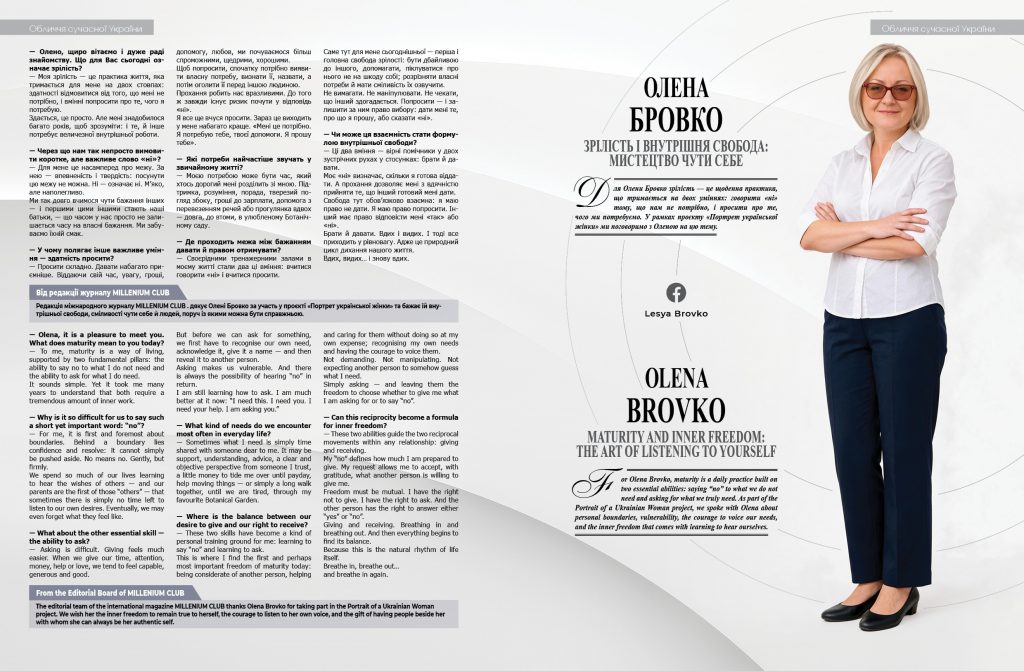
Для Олени Бровко зрілість — це щоденна практика, що тримається на двох уміннях: говорити «ні» тому, що нам не потрібно, і просити про те, чого ми потребуємо. У рамках проєкту «Портрет української жінки» ми поговоримо з Оленою на цю тему.
— Олено, щиро вітаємо і дуже раді знайомству. Що для Вас сьогодні означає зрілість?
— Моя зрілість — це практика життя, яка тримається для мене на двох стовпах: здатності відмовитися від того, що мені не потрібно, і вмінні попросити про те, чого я потребую.
Здається, це просто. Але мені знадобилося багато років, щоб зрозуміти: і те, й інше потребує величезної внутрішньої роботи.
— Через що нам так непросто вимовити коротке, але важливе слово «ні»?
— Для мене це насамперед про межу. За нею — впевненість і твердість: посунути цю межу не можна. Ні — означає ні. М’яко, але наполегливо.
Ми так довго вчимося чути бажання інших — і першими цими іншими стають наші батьки, — що часом у нас просто не залишається часу на власні бажання. Ми забуваємо їхній смак.
— У чому полягає інше важливе уміння — здатність просити?
— Просити складно. Давати набагато приємніше. Віддаючи свій час, увагу, гроші, допомогу, любов, ми почуваємося більш спроможними, щедрими, хорошими.
Щоб попросити, спочатку потрібно виявити власну потребу, визнати її, назвати, а потім оголити її перед іншою людиною.
Прохання робить нас вразливими. До того ж завжди існує ризик почути у відповідь «ні».
Я все ще вчуся просити. Зараз це виходить у мене набагато краще. «Мені це потрібно. Я потребую тебе, твоєї допомоги. Я прошу тебе».
— Які потреби найчастіше звучать у звичайному житті?
— Моєю потребою може бути час, який хтось дорогий мені розділить зі мною. Підтримка, розуміння, порада, тверезий погляд збоку, гроші до зарплати, допомога з перевезенням речей або прогулянка вдвох — довга, до втоми, в улюбленому Ботанічному саду.
— Де проходить межа між бажанням давати й правом отримувати?
— Своєрідними тренажерними залами в моєму житті стали два ці вміння: вчитися говорити «ні» і вчитися просити.
Саме тут для мене сьогоднішньої — перша і головна свобода зрілості: бути дбайливою до іншого, допомагати, піклуватися про нього не на шкоду собі; розрізняти власні потреби й мати сміливість їх озвучити.
Не вимагати. Не маніпулювати. Не чекати, що інший здогадається. Попросити — і залишити за ним право вибору: дати мені те, про що я прошу, або сказати «ні».
— Чи може ця взаємність стати формулою внутрішньої свободи?
— Ці два вміння — вірні помічники у двох зустрічних рухах у стосунках: брати й давати.
Моє «ні» визначає, скільки я готова віддати. А прохання дозволяє мені з вдячністю прийняти те, що інший готовий мені дати.
Свобода тут обов’язково взаємна: я маю право не дати. Я маю право попросити. Інший має право відповісти мені «так» або «ні».
Брати й давати. Вдих і видих. І тоді все приходить у рівновагу. Адже це природний цикл дихання нашого життя.
Вдих, видих… і знову вдих.
Від редакції журналу MILLENIUM CLUB
Редакція міжнародного журналу MILLENIUM CLUB . дякує Олені Бровко за участь у проєкті «Портрет української жінки» та бажає їй внутрішньої свободи, сміливості чути себе й людей, поруч із якими можна бути справжньою.
OLENA BROVKO. MATURITY AND INNER FREEDOM: THE ART OF LISTENING TO YOURSELF
For Olena Brovko, maturity is a daily practice built on two essential abilities: saying “no” to what we do not need and asking for what we truly need. As part of the Portrait of a Ukrainian Woman project, we spoke with Olena about personal boundaries, vulnerability, the courage to voice our needs, and the inner freedom that comes with learning to hear ourselves.
— Olena, it is a pleasure to meet you. What does maturity mean to you today?
— To me, maturity is a way of living, supported by two fundamental pillars: the ability to say no to what I do not need and the ability to ask for what I do need.
It sounds simple. Yet it took me many years to understand that both require a tremendous amount of inner work.
— Why is it so difficult for us to say such a short yet important word: “no”?
— For me, it is first and foremost about boundaries. Behind a boundary lies confidence and resolve: it cannot simply be pushed aside. No means no. Gently, but firmly.
We spend so much of our lives learning to hear the wishes of others — and our parents are the first of those “others” — that sometimes there is simply no time left to listen to our own desires. Eventually, we may even forget what they feel like.
— What about the other essential skill — the ability to ask?
— Asking is difficult. Giving feels much easier. When we give our time, attention, money, help or love, we tend to feel capable, generous and good.
But before we can ask for something, we first have to recognise our own need, acknowledge it, give it a name — and then reveal it to another person.
Asking makes us vulnerable. And there is always the possibility of hearing “no” in return.
I am still learning how to ask. I am much better at it now: “I need this. I need you. I need your help. I am asking you.”
— What kind of needs do we encounter most often in everyday life?
— Sometimes what I need is simply time shared with someone dear to me. It may be support, understanding, advice, a clear and objective perspective from someone I trust, a little money to tide me over until payday, help moving things — or simply a long walk together, until we are tired, through my favourite Botanical Garden.
— Where is the balance between our desire to give and our right to receive?
— These two skills have become a kind of personal training ground for me: learning to say “no” and learning to ask.
This is where I find the first and perhaps most important freedom of maturity today: being considerate of another person, helping and caring for them without doing so at my own expense; recognising my own needs and having the courage to voice them.
Not demanding. Not manipulating. Not expecting another person to somehow guess what I need.
Simply asking — and leaving them the freedom to choose whether to give me what I am asking for or to say “no”.
— Can this reciprocity become a formula for inner freedom?
— These two abilities guide the two reciprocal movements within any relationship: giving and receiving.
My “no” defines how much I am prepared to give. My request allows me to accept, with gratitude, what another person is willing to give me.
Freedom must be mutual. I have the right not to give. I have the right to ask. And the other person has the right to answer either “yes” or “no”.
Giving and receiving. Breathing in and breathing out. And then everything begins to find its balance.
Because this is the natural rhythm of life itself.
Breathe in, breathe out…
and breathe in again.
From the Editorial Board of MILLENIUM CLUB
The editorial team of the international magazine MILLENIUM CLUB thanks Olena Brovko for taking part in the Portrait of a Ukrainian Woman project. We wish her the inner freedom to remain true to herself, the courage to listen to her own voice, and the gift of having people beside her with whom she can always be her authentic self.