
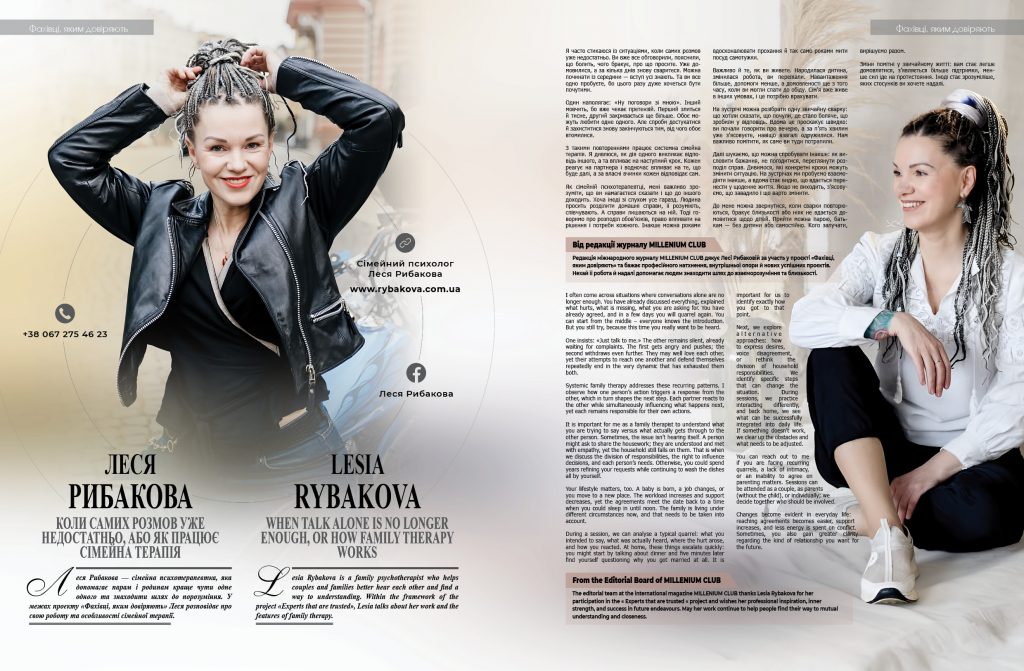
Леся Рибакова — сімейна психотерапевтка, яка допомагає парам і родинам краще чути одне одного та знаходити шлях до порозуміння. У межах проєкту «Фахівці, яким довіряють» Леся розповідає про свою роботу та особливості сімейної терапії.
Я часто стикаюся із ситуаціями, коли самих розмов уже недостатньо. Ви вже все обговорили, пояснили, що болить, чого бракує, про що просите. Уже домовилися, а за кілька днів знову сваритеся. Можна починати із середини — вступ усі знають. Та ви все одно пробуєте, бо цього разу дуже хочеться бути почутими.
Один наполягає: «Ну поговори зі мною». Інший мовчить, бо вже чекає претензій. Перший злиться й тисне, другий закривається ще більше. Обоє можуть любити одне одного. Але спроби достукатися й захиститися знову закінчуються тим, від чого обоє втомилися.
З такими повтореннями працює системна сімейна терапія. Я дивлюся, як дія одного викликає відповідь іншого, а та впливає на наступний крок. Кожен реагує на партнера і водночас впливає на те, що буде далі, а за власні вчинки кожен відповідає сам.
Як сімейній психотерапевтці, мені важливо зрозуміти, що ви намагаєтеся сказати і що до іншого доходить. Хоча іноді зі слухом усе гаразд. Людина просить розділити домашні справи, її розуміють, співчувають. А справи лишаються на ній. Тоді говоримо про розподіл обов’язків, право впливати на рішення і потреби кожного. Інакше можна роками вдосконалювати прохання й так само роками мити посуд самотужки.
Важливо й те, як ви живете. Народилася дитина, змінилася робота, ви переїхали. Навантаження більше, допомоги менше, а домовленості ще з того часу, коли ви могли спати до обіду. Сім’я вже живе в інших умовах, і це потрібно врахувати.
На зустрічі можна розібрати одну звичайну сварку: що хотіли сказати, що почули, де стало боляче, що зробили у відповідь. Вдома це проскакує швидко: ви почали говорити про вечерю, а за п’ять хвилин уже з’ясовуєте, навіщо взагалі одружилися. Нам важливо помітити, як саме ви туди потрапили.
Далі шукаємо, що можна спробувати інакше: як висловити бажання, не погодитися, переглянути розподіл справ. Дивимося, які конкретні кроки можуть змінити ситуацію. На зустрічах ми пробуємо взаємодіяти інакше, а вдома стає видно, що вдається перенести у щоденне життя. Якщо не виходить, з’ясовуємо, що завадило і що варто змінити.
До мене можна звернутися, коли сварки повторюються, бракує близькості або ніяк не вдається домовитися щодо дітей. Прийти можна парою, батькам — без дитини або самостійно. Кого залучати, вирішуємо разом.
Зміни помітні у звичайному житті: вам стає легше домовлятися, з’являється більше підтримки, менше сил іде на протистояння. Іноді стає зрозуміліше, яких стосунків ви хочете надалі.
Від редакції журналу MILLENIUM CLUB
Редакція міжнародного журналу MILLENIUM CLUB дякує Лесі Рибаковій за участь у проєкті «Фахівці, яким довіряють» та бажає професійного натхнення, внутрішньої опори й нових успішних проєктів. Нехай її робота й надалі допомагає людям знаходити шлях до взаєморозуміння та близькості.
Lesia Rybakova: When Talk Alone is no longer Enough, or How Family Therapy Works
Lesia Rybakova is a family psychotherapist who helps couples and families better hear each other and find a way to understanding. Within the framework of the project «Experts that are trusted», Lesia talks about her work and the features of family therapy.
I often come across situations where conversations alone are no longer enough. You have already discussed everything, explained what hurts, what is missing, what you are asking for. You have already agreed, and in a few days you will quarrel again. You can start from the middle – everyone knows the introduction. But you still try, because this time you really want to be heard.
One insists: «Just talk to me.» The other remains silent, already waiting for complaints. The first gets angry and pushes; the second withdraws even further. They may well love each other, yet their attempts to reach one another and defend themselves repeatedly end in the very dynamic that has exhausted them both.
Systemic family therapy addresses these recurring patterns. I observe how one person’s action triggers a response from the other, which in turn shapes the next step. Each partner reacts to the other while simultaneously influencing what happens next, yet each remains responsible for their own actions.
It is important for me as a family therapist to understand what you are trying to say versus what actually gets through to the other person. Sometimes, the issue isn’t hearing itself. A person might ask to share the housework; they are understood and met with empathy, yet the household still falls on them. That is when we discuss the division of responsibilities, the right to influence decisions, and each person’s needs. Otherwise, you could spend years refining your requests while continuing to wash the dishes all by yourself.
Your lifestyle matters, too. A baby is born, a job changes, or you move to a new place. The workload increases and support decreases, yet the agreements meet the date back to a time when you could sleep in until noon. The family is living under different circumstances now, and that needs to be taken into account.
During a session, we can analyse a typical quarrel: what you intended to say, what was actually heard, where the hurt arose, and how you reacted. At home, these things escalate quickly: you might start by talking about dinner and five minutes later find yourself questioning why you got married at all. It is important for us to identify exactly how you got to that point.
Next, we explore alternative approaches: how to express desires, voice disagreement, or rethink the division of household responsibilities. We identify specific steps that can change the situation. During sessions, we practice interacting differently, and back home, we see what can be successfully integrated into daily life. If something doesn’t work, we clear up the obstacles and what needs to be adjusted.
You can reach out to me if you are facing recurring quarrels, a lack of intimacy, or an inability to agree on parenting matters. Sessions can be attended as a couple, as parents (without the child), or individually; we decide together who should be involved.
Changes become evident in everyday life: reaching agreements becomes easier, support increases, and less energy is spent on conflict. Sometimes, you also gain greater clarity regarding the kind of relationship you want for the future.
From the Editorial Board of MILLENIUM CLUB
The editorial team at the international magazine MILLENIUM CLUB thanks Lesia Rybakova for her participation in the « Experts that are trusted « project and wishes her professional inspiration, inner strength, and success in future endeavours. May her work continue to help people find their way to mutual understanding and closeness.