
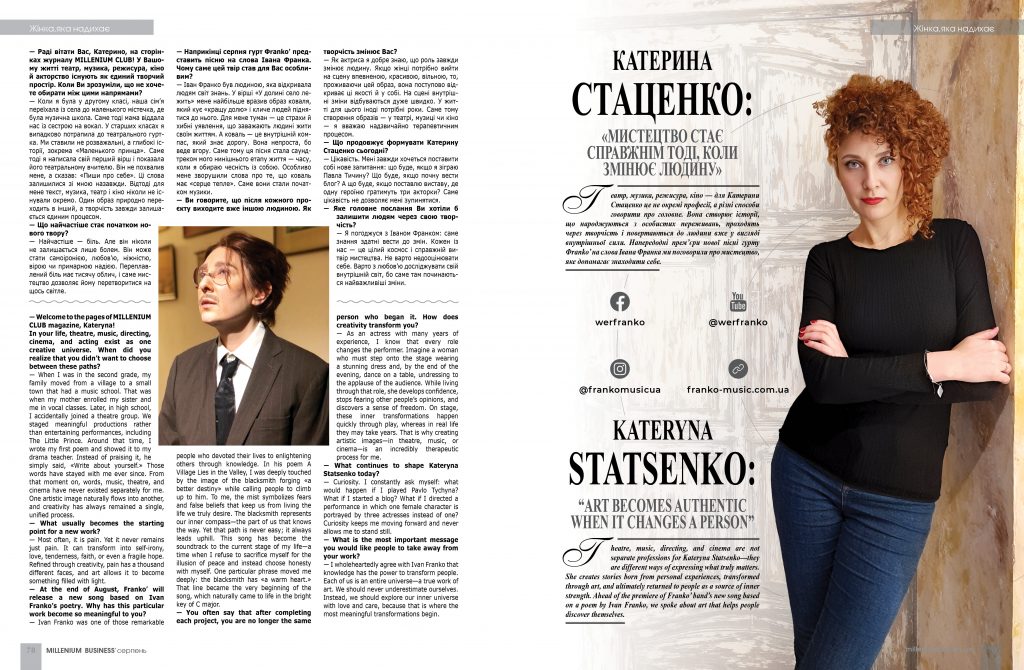
Театр, музика, режисура, кіно — для Катерини Стаценко це не окремі професії, а різні способи говорити про головне. Вона створює історії, що народжуються з особистих переживань, проходять через творчість і повертаються до людини вже у вигляді внутрішньої сили. Напередодні прем’єри нової пісні гурту Фranko’ на слова Івана Франка ми поговорили про мистецтво, яке допомагає знаходити себе.
— Раді вітати Вас, Катерино, на сторінках журналу MILLENIUM CLUB! У Вашому житті театр, музика, режисура, кіно й акторство існують як єдиний творчий простір. Коли Ви зрозуміли, що не хочете обирати між цими напрямами?
— Коли я була у другому класі, наша сім’я переїхала із села до маленького містечка, де була музична школа. Саме тоді мама віддала нас із сестрою на вокал. У старших класах я випадково потрапила до театрального гуртка. Ми ставили не розважальні, а глибокі історії, зокрема «Маленького принца». Саме тоді я написала свій перший вірш і показала його театральному вчителю. Він не похвалив мене, а сказав: «Пиши про себе». Ці слова залишилися зі мною назавжди. Відтоді для мене текст, музика, театр і кіно ніколи не існували окремо. Один образ природно переходить в інший, а творчість завжди залишається єдиним процесом.
— Що найчастіше стає початком нового твору?
— Найчастіше — біль. Але він ніколи не залишається лише болем. Він може стати самоіронією, любов’ю, ніжністю, вірою чи примарною надією. Переплавлений біль має тисячу облич, і саме мистецтво дозволяє йому перетворитися на щось світле.
— Наприкінці серпня гурт Фranko’ представить пісню на слова Івана Франка. Чому саме цей твір став для Вас особливим?
— Іван Франко був людиною, яка відкривала людям світ знань. У вірші «У долині село лежить» мене найбільше вразив образ коваля, який кує «кращу долю» і кличе людей піднятися до нього. Для мене туман — це страхи й хибні уявлення, що заважають людині жити своїм життям. А коваль — це внутрішній компас, який знає дорогу. Вона непроста, бо веде вгору. Саме тому ця пісня стала саундтреком мого нинішнього етапу життя — часу, коли я обираю чесність із собою. Особливо мене зворушили слова про те, що коваль має «серце тепле». Саме вони стали початком музики.
— Ви говорите, що після кожного проєкту виходите вже іншою людиною. Як творчість змінює Вас?
— Як актриса я добре знаю, що роль завжди змінює людину. Якщо жінці потрібно вийти на сцену впевненою, красивою, вільною, то, проживаючи цей образ, вона поступово відкриває ці якості й у собі. На сцені внутрішні зміни відбуваються дуже швидко. У житті для цього іноді потрібні роки. Саме тому створення образів — у театрі, музиці чи кіно — я вважаю надзвичайно терапевтичним процесом.
— Що продовжує формувати Катерину Стаценко сьогодні?
— Цікавість. Мені завжди хочеться поставити собі нове запитання: що буде, якщо я зіграю Павла Тичину? Що буде, якщо почну вести блог? А що буде, якщо поставлю виставу, де одну героїню гратимуть три акторки? Саме цікавість не дозволяє мені зупинятися.
— Яке головне послання Ви хотіли б залишити людям через свою творчість?
— Я погоджуся з Іваном Франком: саме знання здатні вести до змін. Кожен із нас — це цілий космос і справжній витвір мистецтва. Не варто недооцінювати себе. Варто з любов’ю досліджувати свій внутрішній світ, бо саме там починаються найважливіші зміни.
Kateryna Statsenko: “Art Becomes Authentic When It Changes a Person”
Theatre, music, directing, and cinema are not separate professions for Kateryna Statsenko—they are different ways of expressing what truly matters. She creates stories born from personal experiences, transformed through art, and ultimately returned to people as a source of inner strength. Ahead of the premiere of Franko’ band’s new song based on a poem by Ivan Franko, we spoke about art that helps people discover themselves.
— Welcome to the pages of MILLENIUM CLUB magazine, Kateryna!
In your life, theatre, music, directing, cinema, and acting exist as one creative universe. When did you realize that you didn’t want to choose between these paths?
— When I was in the second grade, my family moved from a village to a small town that had a music school. That was when my mother enrolled my sister and me in vocal classes. Later, in high school, I accidentally joined a theatre group. We staged meaningful productions rather than entertaining performances, including The Little Prince. Around that time, I wrote my first poem and showed it to my drama teacher. Instead of praising it, he simply said, «Write about yourself.» Those words have stayed with me ever since. From that moment on, words, music, theatre, and cinema have never existed separately for me. One artistic image naturally flows into another, and creativity has always remained a single, unified process.
— What usually becomes the starting point for a new work?
— Most often, it is pain. Yet it never remains just pain. It can transform into self-irony, love, tenderness, faith, or even a fragile hope. Refined through creativity, pain has a thousand different faces, and art allows it to become something filled with light.
— At the end of August, Franko’ will release a new song based on Ivan Franko’s poetry. Why has this particular work become so meaningful to you?
— Ivan Franko was one of those remarkable people who devoted their lives to enlightening others through knowledge. In his poem A Village Lies in the Valley, I was deeply touched by the image of the blacksmith forging «a better destiny» while calling people to climb up to him. To me, the mist symbolizes fears and false beliefs that keep us from living the life we truly desire. The blacksmith represents our inner compass—the part of us that knows the way. Yet that path is never easy; it always leads uphill. This song has become the soundtrack to the current stage of my life—a time when I refuse to sacrifice myself for the illusion of peace and instead choose honesty with myself. One particular phrase moved me deeply: the blacksmith has «a warm heart.» That line became the very beginning of the song, which naturally came to life in the bright key of C major.
— You often say that after completing each project, you are no longer the same person who began it. How does creativity transform you?
— As an actress with many years of experience, I know that every role changes the performer. Imagine a woman who must step onto the stage wearing a stunning dress and, by the end of the evening, dance on a table, undressing to the applause of the audience. While living through that role, she develops confidence, stops fearing other people’s opinions, and discovers a sense of freedom. On stage, these inner transformations happen quickly through play, whereas in real life they may take years. That is why creating artistic images—in theatre, music, or cinema—is an incredibly therapeutic process for me.
— What continues to shape Kateryna Statsenko today?
— Curiosity. I constantly ask myself: what would happen if I played Pavlo Tychyna? What if I started a blog? What if I directed a performance in which one female character is portrayed by three actresses instead of one? Curiosity keeps me moving forward and never allows me to stand still.
— What is the most important message you would like people to take away from your work?
— I wholeheartedly agree with Ivan Franko that knowledge has the power to transform people. Each of us is an entire universe—a true work of art. We should never underestimate ourselves. Instead, we should explore our inner universe with love and care, because that is where the most meaningful transformations begin.