
Онкохірургія — одна з тих медичних спеціальностей, де професіоналізм вимірюється не лише складністю виконаних операцій, а й умінням ухвалювати правильні рішення у критичних ситуаціях. Тут немає дрібниць, адже за кожним клінічним випадком стоїть людське життя, довіра пацієнта та відповідальність лікаря за кінцевий результат.
Хірург-онколог Олег Косьмін належить до покоління лікарів, які не зупиняються на досягнутому. Освоюючи найсучасніші методики, впроваджуючи міжнародні стандарти лікування та навчаючи молодих колег власним прикладом, він переконаний: медицина повинна постійно розвиватися, а лікар має залишатися поруч із пацієнтом не лише в операційній, а й протягом усього шляху до одужання.
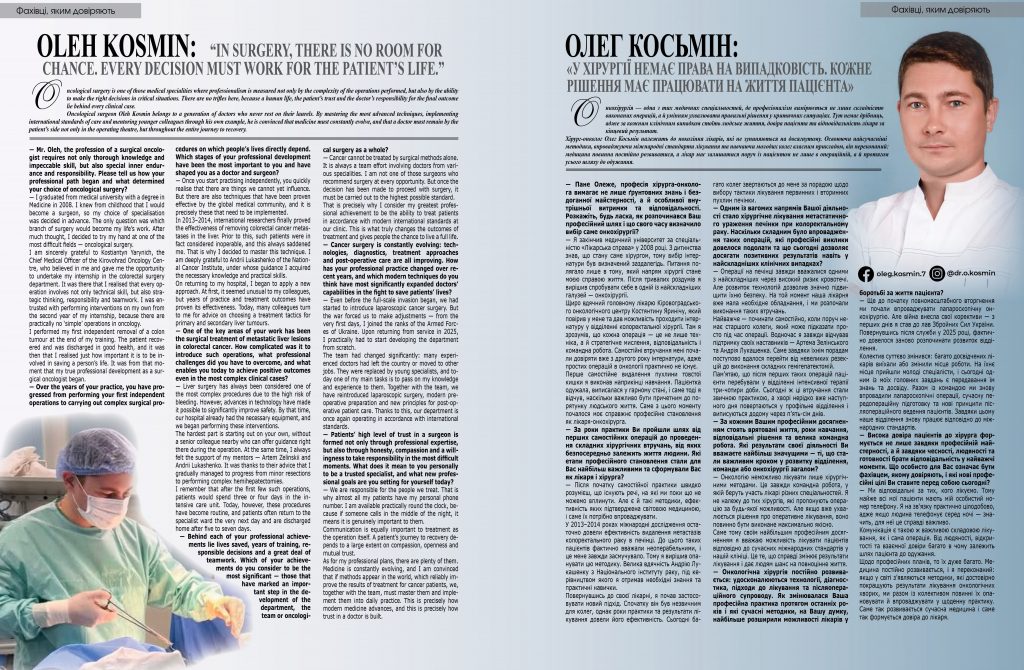
— Пане Олеже, професія хірурга-онколога вимагає не лише ґрунтовних знань і бездоганної майстерності, а й особливої внутрішньої витримки та відповідальності. Розкажіть, будь ласка, як розпочинався Ваш професійний шлях і що свого часу визначило вибір саме онкохірургії?
— Я закінчив медичний університет за спеціальністю «Лікарська справа» у 2008 році. З дитинства знав, що стану саме хірургом, тому вибір інтернатури був визначений заздалегідь. Питання полягало лише в тому, який напрям хірургії стане моєю справою життя. Після тривалих роздумів я вирішив спробувати себе в одній із найскладніших галузей — онкохірургії.
Щиро вдячний головному лікарю Кіровоградського онкологічного центру Костянтину Яринічу, який повірив у мене та дав можливість проходити інтернатуру у відділенні колоректальної хірургії. Там я зрозумів, що кожна операція — це не лише техніка, а й стратегічне мислення, відповідальність і командна робота. Самостійні втручання мені почали довіряти вже з другого року інтернатури, адже простих операцій в онкології практично не існує.
Перше самостійне видалення пухлини товстої кишки я виконав наприкінці навчання. Пацієнтка одужала, виписалася у гарному стані, і саме тоді я відчув, наскільки важливо бути причетним до порятунку людського життя. Саме з цього моменту почалося моє справжнє професійне становлення як лікаря-онкохірурга.
— За роки практики Ви пройшли шлях від перших самостійних операцій до проведення складних хірургічних втручань, від яких безпосередньо залежить життя людини. Які етапи професійного становлення стали для Вас найбільш важливими та сформували Вас як лікаря і хірурга?
— Після початку самостійної практики швидко розумієш, що існують речі, на які ми поки що не можемо вплинути. Але є й такі методики, ефективність яких підтверджена світовою медициною, і саме їх потрібно впроваджувати.
У 2013–2014 роках міжнародні дослідження остаточно довели ефективність видалення метастазів колоректального раку в печінці. До цього таких пацієнтів фактично вважали неоперабельними, і це мене завжди засмучувало. Тому я вирішив опанувати цю методику. Велика вдячність Андрію Лукашенку з Національного інституту раку, під керівництвом якого я отримав необхідні знання та практичні навички.
Повернувшись до своєї лікарні, я почав застосовувати новий підхід. Спочатку він був незвичним для колег, однак роки практики та результати лікування довели його ефективність. Сьогодні багато колег звертаються до мене за порадою щодо вибору тактики лікування первинних і вторинних пухлин печінки.
— Одним із вагомих напрямів Вашої діяльності стало хірургічне лікування метастатичного ураження печінки при колоректальному раку. Наскільки складним було впровадження таких операцій, які професійні виклики довелося подолати та що сьогодні дозволяє досягати позитивних результатів навіть у найскладніших клінічних випадках?
— Операції на печінці завжди вважалися одними з найскладніших через високий ризик кровотечі. Але розвиток технологій дозволив значно підвищити їхню безпеку. На той момент наша лікарня вже мала необхідне обладнання, і ми розпочали виконання таких втручань.
Найважче — починати самостійно, коли поруч немає старшого колеги, який може підказати просто під час операції. Водночас я завжди відчував підтримку своїх наставників — Артема Зелінського та Андрія Лукашенка. Саме завдяки їхнім порадам поступово вдалося перейти від невеликих резекцій до виконання складних гемігепатектомій.
Пам’ятаю, що після перших таких операцій пацієнти перебували у відділенні інтенсивної терапії три-чотири доби. Сьогодні ж ці втручання стали звичною практикою, а хворі нерідко вже наступного дня повертаються у профільне відділення і виписуються додому через п’ять-сім днів.
— За кожним Вашим професійним досягненням стоять врятовані життя, роки навчання, відповідальні рішення та велика командна робота. Які результати своєї діяльності Ви вважаєте найбільш значущими — ті, що стали важливим кроком у розвитку відділення, команди або онкохірургії загалом?
— Онкологію неможливо лікувати лише хірургічними методами. Це завжди командна робота, у якій беруть участь лікарі різних спеціальностей. Я не належу до тих хірургів, які пропонують операцію за будь-якої можливості. Але якщо вже ухвалюється рішення про оперативне лікування, воно повинно бути виконане максимально якісно.
Саме тому своїм найбільшим професійним досягненням я вважаю можливість лікувати пацієнтів відповідно до сучасних міжнародних стандартів у нашій клініці. Це те, що справді змінює результати лікування і дає людям шанс на повноцінне життя.
— Онкологічна хірургія постійно розвивається: удосконалюються технології, діагностика, підходи до лікування та післяопераційного супроводу. Як змінювалася Ваша професійна практика протягом останніх років і які сучасні методики, на Вашу думку, найбільше розширили можливості лікарів у боротьбі за життя пацієнта?
— Ще до початку повномасштабного вторгнення ми почали впроваджувати лапароскопічну онкохірургію. Але війна внесла свої корективи — з перших днів я став до лав Збройних Сил України. Повернувшись після служби у 2025 році, фактично довелося заново розпочинати розвиток відділення.
Колектив суттєво змінився: багато досвідчених лікарів виїхали або змінили місце роботи. На їхнє місце прийшли молоді спеціалісти, і сьогодні одним із моїх головних завдань є передавання їм знань та досвіду. Разом із командою ми знову впровадили лапароскопічні операції, сучасну передопераційну підготовку та нові принципи післяопераційного ведення пацієнтів. Завдяки цьому наше відділення знову працює відповідно до міжнародних стандартів.
— Висока довіра пацієнтів до хірурга формується не лише завдяки професійній майстерності, а й завдяки чесності, людяності та готовності брати відповідальність у найважчі моменти. Що особисто для Вас означає бути фахівцем, якому довіряють, і які нові професійні цілі Ви ставите перед собою сьогодні?
— Ми відповідальні за тих, кого лікуємо. Тому майже всі мої пацієнти мають мій особистий номер телефону. Я на зв’язку практично цілодобово, адже якщо людина телефонує серед ночі — значить, для неї це справді важливо.
Комунікація є такою ж важливою складовою лікування, як і сама операція. Від людяності, відкритості та взаємної довіри багато в чому залежить шлях пацієнта до одужання.
Щодо професійних планів, то їх дуже багато. Медицина постійно розвивається, і я переконаний: якщо у світі з’являються методики, які достовірно покращують результати лікування онкологічних хворих, ми разом із колективом повинні їх опановувати й впроваджувати у щоденну практику. Саме так розвивається сучасна медицина і саме так формується довіра до лікаря.
OLEH KOSMIN: “In surgery, there is no room for chance. Every decision must work for the patient’s life.”
Оncological surgery is one of those medical specialities where professionalism is measured not only by the complexity of the operations performed, but also by the ability to make the right decisions in critical situations. There are no trifles here, because a human life, the patient’s trust and the doctor’s responsibility for the final outcome lie behind every clinical case.
Oncological surgeon Oleh Kosmin belongs to a generation of doctors who never rest on their laurels. By mastering the most advanced techniques, implementing international standards of care and mentoring younger colleagues through his own example, he is convinced that medicine must constantly evolve, and that a doctor must remain by the patient’s side not only in the operating theatre, but throughout the entire journey to recovery.
— Mr. Oleh, the profession of a surgical oncologist requires not only thorough knowledge and impeccable skill, but also special inner endurance and responsibility. Please tell us how your professional path began and what determined your choice of oncological surgery?
— I graduated from medical university with a degree in Medicine in 2008. I knew from childhood that I would become a surgeon, so my choice of specialisation was decided in advance. The only question was which branch of surgery would become my life’s work. After much thought, I decided to try my hand at one of the most difficult fields — oncological surgery.
I am sincerely grateful to Kostiantyn Yarynich, the Chief Medical Officer of the Kirovohrad Oncology Centre, who believed in me and gave me the opportunity to undertake my internship in the colorectal surgery department. It was there that I realised that every operation involves not only technical skill, but also strategic thinking, responsibility and teamwork. I was entrusted with performing interventions on my own from the second year of my internship, because there are practically no ‘simple’ operations in oncology.
I performed my first independent removal of a colon tumour at the end of my training. The patient recovered and was discharged in good health, and it was then that I realised just how important it is to be involved in saving a person’s life. It was from that moment that my true professional development as a surgical oncologist began.
— Over the years of your practice, you have progressed from performing your first independent operations to carrying out complex surgical procedures on which people’s lives directly depend. Which stages of your professional development have been the most important to you and have shaped you as a doctor and surgeon?
— Once you start practising independently, you quickly realise that there are things we cannot yet influence. But there are also techniques that have been proven effective by the global medical community, and it is precisely these that need to be implemented.
In 2013–2014, international researchers finally proved the effectiveness of removing colorectal cancer metastases in the liver. Prior to this, such patients were in fact considered inoperable, and this always saddened me. That is why I decided to master this technique. I am deeply grateful to Andrii Lukashenko of the National Cancer Institute, under whose guidance I acquired the necessary knowledge and practical skills.
On returning to my hospital, I began to apply a new approach. At first, it seemed unusual to my colleagues, but years of practice and treatment outcomes have proven its effectiveness. Today, many colleagues turn to me for advice on choosing a treatment tactics for primary and secondary liver tumours.
— One of the key areas of your work has been the surgical treatment of metastatic liver lesions in colorectal cancer. How complicated was it to introduce such operations, what professional challenges did you have to overcome, and what enables you today to achieve positive outcomes even in the most complex clinical cases?
— Liver surgery has always been considered one of the most complex procedures due to the high risk of bleeding. However, advances in technology have made it possible to significantly improve safety. By that time, our hospital already had the necessary equipment, and we began performing these interventions.
The hardest part is starting out on your own, without a senior colleague nearby who can offer guidance right there during the operation. At the same time, I always felt the support of my mentors — Artem Zelinskii and Andrii Lukashenko. It was thanks to their advice that I gradually managed to progress from minor resections to performing complex hemihepatectomies.
I remember that after the first few such operations, patients would spend three or four days in the intensive care unit. Today, however, these procedures have become routine, and patients often return to the specialist ward the very next day and are discharged home after five to seven days.
— Behind each of your professional achievements lie lives saved, years of training, responsible decisions and a great deal of teamwork. Which of your achievements do you consider to be the most significant — those that have marked an important step in the development of the department, the team or oncological surgery as a whole?
— Cancer cannot be treated by surgical methods alone. It is always a team effort involving doctors from various specialities. I am not one of those surgeons who recommend surgery at every opportunity. But once the decision has been made to proceed with surgery, it must be carried out to the highest possible standard.
That is precisely why I consider my greatest professional achievement to be the ability to treat patients in accordance with modern international standards at our clinic. This is what truly changes the outcomes of treatment and gives people the chance to live a full life.
— Cancer surgery is constantly evolving: technologies, diagnostics, treatment approaches and post-operative care are all improving. How has your professional practice changed over recent years, and which modern techniques do you think have most significantly expanded doctors’ capabilities in the fight to save patients’ lives?
— Even before the full-scale invasion began, we had started to introduce laparoscopic cancer surgery. But the war forced us to make adjustments — from the very first days, I joined the ranks of the Armed Forces of Ukraine. Upon returning from service in 2025, I practically had to start developing the department from scratch.
The team had changed significantly: many experienced doctors had left the country or moved to other jobs. They were replaced by young specialists, and today one of my main tasks is to pass on my knowledge and experience to them. Together with the team, we have reintroduced laparoscopic surgery, modern pre-operative preparation and new principles for post-operative patient care. Thanks to this, our department is once again operating in accordance with international standards.
— Patients’ high level of trust in a surgeon is formed not only through professional expertise, but also through honesty, compassion and a willingness to take responsibility in the most difficult moments. What does it mean to you personally to be a trusted specialist, and what new professional goals are you setting for yourself today?
— We are responsible for the people we treat. That is why almost all my patients have my personal phone number. I am available practically round the clock, because if someone calls in the middle of the night, it means it is genuinely important to them.
Communication is equally important to treatment as the operation itself. A patient’s journey to recovery depends to a large extent on compassion, openness and mutual trust.
As for my professional plans, there are plenty of them. Medicine is constantly evolving, and I am convinced that if methods appear in the world, which reliably improve the results of treatment for cancer patients, we, together with the team, must master them and implement them into daily practice. This is precisely how modern medicine advances, and this is precisely how trust in a doctor is built.