
Сучасна психіатрія стрімко змінюється. Війна, масова міграція, постійний стрес і глобальні соціальні трансформації ставлять перед лікарями виклики, яких ще кілька років тому просто не існувало. У цих умовах особливої цінності набувають фахівці, які не обмежуються клінічними протоколами, а здатні побачити за діагнозом особистість, її життєву історію, родину, систему цінностей і середовище, у якому вона живе.
Понад сорок років професійного досвіду дозволили Євгенію Воронкову сформувати власний підхід до психіатрії та психотерапії. Його називають медичним траблшутером — лікарем, до якого звертаються тоді, коли стандартні алгоритми вже не дають відповіді. У розмові з журналом MILLENIUM CLUB він відверто говорить про кризу сучасної медицини, системне мислення, українську психіатрію воєнного часу та головну якість лікаря, без якої неможлива довіра.
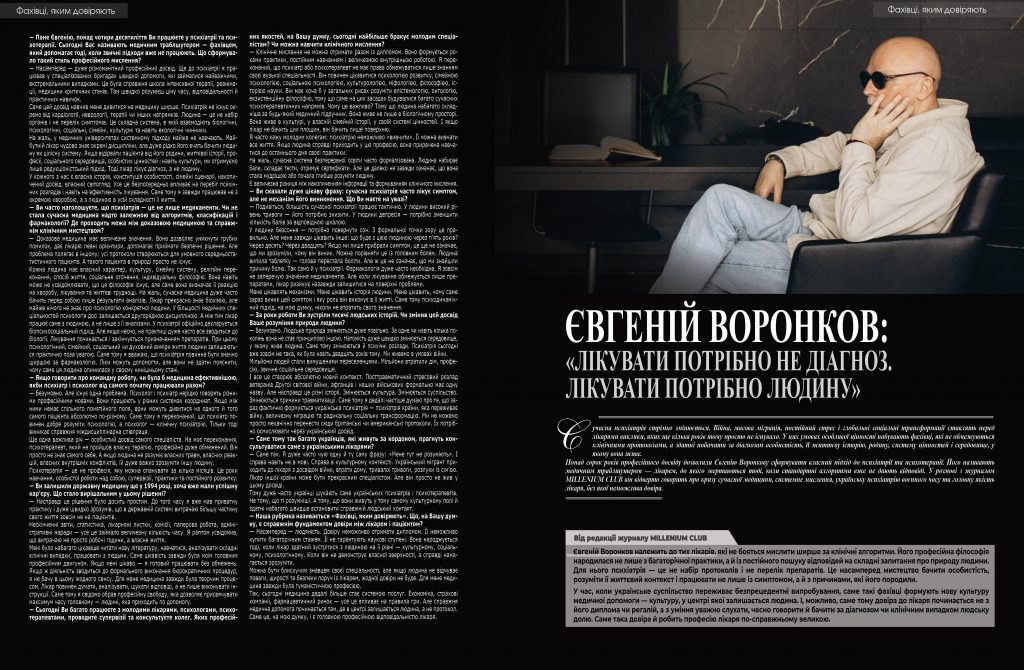
— Пане Євгенію, понад чотири десятиліття Ви працюєте у психіатрії та психотерапії. Сьогодні Вас називають медичним траблшутером — фахівцем, який допомагає тоді, коли звичні підходи вже не працюють. Що сформувало такий стиль професійного мислення?
— Насамперед — дуже різноманітний професійний досвід. Ще до психіатрії я працював у спеціалізованих бригадах швидкої допомоги, які займалися найважчими, екстремальними випадками. Це була справжня школа інтенсивної терапії, реанімації, медицини критичних станів. Там швидко розумієш ціну часу, відповідальності й практичних навичок.Саме цей досвід навчив мене дивитися на медицину ширше. Психіатрія не існує окремо від кардіології, неврології, терапії чи інших напрямків. Людина — це не набір органів і не перелік симптомів. Це складна система, в якій взаємодіють біологічні, психологічні, соціальні, сімейні, культурні та навіть екологічні чинники.На жаль, у медичних університетах системному підходу майже не навчають. Майбутній лікар чудово знає окремі дисципліни, але дуже рідко його вчать бачити людину як цілісну систему. Якщо відірвати пацієнта від його родини, життєвої історії, професії, соціального середовища, особистих цінностей і навіть культури, ми отримуємо лише редукціоністський підхід. Тоді лікар лікує діагноз, а не людину.У кожного з нас є власна історія, конституція особистості, сімейні сценарії, накопичений досвід, власний світогляд. Усе це безпосередньо впливає на перебіг психічних розладів і навіть на ефективність лікування. Саме тому я завжди працював не з окремою хворобою, а з людиною в усій складності її життя.
— Ви часто наголошуєте, що психіатрія — це не лише медикаменти. Чи не стала сучасна медицина надто залежною від алгоритмів, класифікацій і фармакології? Де проходить межа між доказовою медициною та справжнім клінічним мистецтвом?
— Доказова медицина має величезне значення. Вона дозволяє уникнути грубих помилок, дає лікарю певні орієнтири, допомагає приймати безпечні рішення. Але проблема полягає в іншому: усі протоколи створюються для умовного середньостатистичного пацієнта. А такого пацієнта в природі просто не існує.Кожна людина має власний характер, культуру, сімейну систему, релігійні переконання, спосіб життя, соціальне оточення, індивідуальну філософію. Вона навіть може не усвідомлювати, що ця філософія існує, але саме вона визначає її реакцію на хворобу, лікування та життєві труднощі. На жаль, сучасна медицина дуже часто бачить перед собою лише результати аналізів. Лікар прекрасно знає біохімію, але майже нічого не знає про психологію конкретної людини. У більшості медичних спеціальностей психологія досі залишається другорядною дисципліною. А між тим лікар працює саме з людиною, а не лише з її аналізами. У психіатрії офіційно декларується біопсихосоціальний підхід. Але якщо чесно, на практиці дуже часто все зводиться до біології. Лікування починається і закінчується призначенням препаратів. При цьому психологічний, сімейний, соціальний чи духовний виміри життя людини залишаються практично поза увагою. Саме тому я вважаю, що психіатрія повинна бути значно ширшою за фармакологію. Ліки можуть допомогти, але вони не здатні пояснити, чому саме ця людина опинилася у своєму нинішньому стані.
— Якщо говорити про командну роботу, чи була б медицина ефективнішою, якби психіатр і психолог від самого початку працювали разом?
— Безумовно. Але існує одна проблема. Психолог і психіатр нерідко говорять різними професійними мовами. Вони працюють у різних системах координат. Якщо між ними немає спільного понятійного поля, вони можуть дивитися на одного й того самого пацієнта абсолютно по-різному. Саме тому я переконаний, що психіатр повинен добре розуміти психологію, а психолог — клінічну психіатрію. Тільки тоді виникає справжня міждисциплінарна співпраця.Ще одна важлива річ — особистий досвід самого спеціаліста. На моє переконання, психотерапевт, який не пройшов власну терапію, професійно дуже обмежений. Він просто не знає самого себе. А якщо людина не розуміє власних травм, власних реакцій, власних внутрішніх конфліктів, їй дуже важко зрозуміти іншу людину.Психотерапія — це не професія, яку можна опанувати за кілька місяців. Це роки навчання, особистої роботи над собою, супервізії, практики та постійного розвитку.
— Ви залишили державну медицину ще у 1994 році, хоча вже мали успішну кар’єру. Що стало вирішальним у цьому рішенні?
— Насправді це рішення було досить простим. До того часу я вже мав приватну практику і дуже швидко зрозумів, що в державній системі витрачаю більшу частину свого життя зовсім не на пацієнтів.Нескінченні звіти, статистика, лікарняні листки, комісії, паперова робота, адміністративні наради — усе це займало величезну кількість часу. Я раптом усвідомив, що витрачаю не просто робочі години, а власне життя.Мені було набагато цікавіше читати нову літературу, навчатися, аналізувати складні клінічні випадки, працювати з людьми. Саме цікавість завжди була моїм головним професійним двигуном. Якщо мені цікаво — я готовий працювати без обмежень. Якщо ж діяльність зводиться до формального виконання бюрократичних процедур, я не бачу в цьому жодного сенсу. Для мене медицина завжди була творчим процесом. Лікар повинен думати, аналізувати, шукати відповіді, а не лише виконувати інструкції. Саме тому я свідомо обрав професійну свободу, яка дозволяє присвячувати максимум часу головному — людині, яка приходить по допомогу
.— Сьогодні Ви багато працюєте з молодими лікарями, психологами, психотерапевтами, проводите супервізії та консультуєте колег. Яких професійних якостей, на Вашу думку, сьогодні найбільше бракує молодим спеціалістам? Чи можна навчити клінічного мислення?
— Клінічне мислення не можна отримати разом із дипломом. Воно формується роками практики, постійним навчанням і величезною внутрішньою роботою. Я переконаний, що психіатр або психотерапевт не має права обмежуватися лише знанням своєї вузької спеціальності. Він повинен цікавитися психологією розвитку, сімейною психологією, соціальною психологією, культурологією, міфологією, філософією, історією науки. Він має хоча б у загальних рисах розуміти епістемологію, онтологію, екзистенційну філософію, тому що саме на цих засадах будувалися багато сучасних психотерапевтичних напрямів. Чому це важливо? Тому що людина набагато складніша за будь-який медичний підручник. Вона живе не лише в біологічному просторі. Вона живе в культурі, у власній сімейній історії, у своїй системі цінностей. І якщо лікар не бачить цих площин, він бачить лише поверхню.Я часто кажу молодим колегам: психіатрію неможливо «вивчити». Її можна вивчати все життя. Якщо людина справді приходить у цю професію, вона приречена навчатися до останнього дня своєї практики.На жаль, сучасна система безперервної освіти часто формалізована. Людина набирає бали, складає тести, отримує сертифікати. Але це далеко не завжди означає, що вона стала мудрішою або почала глибше розуміти людину.Є величезна різниця між накопиченням інформації та формуванням клінічного мислення.
— Ви сказали дуже цікаву фразу: сучасна психіатрія часто лікує симптом, але не механізм його виникнення. Що Ви маєте на увазі?
— Подивіться, більшість сучасної психіатрії працює тактично. У людини високий рівень тривоги — його потрібно знизити. У людини депресія — потрібно зменшити кількість балів за відповідною шкалою.У людини безсоння — потрібно повернути сон. З формальної точки зору це правильно. Але мене завжди цікавить інше: що буде з цією людиною через п’ять років? Через десять? Через двадцять? Якщо ми лише прибрали симптом, це ще не означає, що ми зрозуміли, чому він виник. Можна порівняти це із головним болем. Людина випила таблетку — голова перестала боліти. Але ж це не означає, що ми знайшли причину болю. Так само й у психіатрії. Фармакологія дуже часто необхідна. Я зовсім не заперечую значення медикаментів. Але коли лікування обмежується лише препаратами, лікар ризикує назавжди залишитися на поверхні проблеми.Мене цікавлять механізми. Мене цікавить історія людини. Мене цікавить, чому саме зараз виник цей симптом і яку роль він виконує в її житті. Саме тому психодинамічний підхід, на мою думку, ніколи не втратить свого значення
.— За роки роботи Ви зустріли тисячі людських історій. Чи змінив цей досвід Ваше розуміння природи людини?
— Безумовно. Людська природа змінюється дуже повільно. За одне чи навіть кілька поколінь вона не стає принципово іншою. Натомість дуже швидко змінюється середовище, у якому живе людина. Саме тому змінюються й психічні розлади. Психіатрія сьогодні вже зовсім не така, як була навіть двадцять років тому. Ми живемо в умовах війни.
Мільйони людей стали вимушеними переселенцями. Мільйони втратили дім, професію, звичне соціальне середовище.І все це створює абсолютно новий контекст. Посттравматичний стресовий розлад ветеранів Другої світової війни, афганців і наших військових формально має одну назву. Але насправді це різні історії. Змінюється культура. Змінюється суспільство. Змінюються причини травматизації. Саме тому я дедалі частіше думаю про те, що зараз фактично формується українська психіатрія — психіатрія країни, яка переживає війну, величезну міграцію та радикальну соціальну трансформацію. Ми не можемо просто механічно перенести сюди британські чи американські протоколи. Їх потрібно осмислювати через український досвід.
— Саме тому так багато українців, які живуть за кордоном, прагнуть консультуватися саме з українськими лікарями?
— Саме так. Я дуже часто чую одну й ту саму фразу: «Мене тут не розуміють». І справа навіть не в мові. Справа в культурному контексті. Український мігрант приходить до лікаря з досвідом війни, втрати дому, тривалої тривоги, розлуки із сім’єю. Лікар іншої країни може бути прекрасним спеціалістом. Але він просто не жив у цьому досвіді.Тому дуже часто українці шукають саме українських психіатрів і психотерапевтів. Не тому, що ті розумніші. А тому, що вони живуть у тому самому культурному полі й здатні набагато швидше встановити справжній людський контакт.
— Наша рубрика називається «Фахівці, яким довіряють». Що, на Вашу думку, є справжнім фундаментом довіри між лікарем і пацієнтом?
— Насамперед — людяність. Довіру неможливо отримати дипломом. Її неможливо купити багаторічним стажем. Її не гарантують наукові ступені. Вона народжується тоді, коли лікар здатний зустрітися з людиною на її рівні — культурному, соціальному, психологічному. Коли він не демонструє власної зверхності, а справді намагається зрозуміти.Можна бути блискучим знавцем своєї спеціальності, але якщо людина не відчуває поваги, щирості та безпеки поруч із лікарем, жодної довіри не буде. Для мене медицина завжди була гуманістичною професією.Так, сьогодні медицина дедалі більше стає системою послуг. Економіка, страхові компанії, фармацевтичний ринок — усе це впливає на правила гри. Але справжня медична допомога починається там, де в центрі залишається людина, а не протокол. Саме це, на мою думку, і є головною професійною відповідальністю лікаря.
Євгеній Воронков належить до тих лікарів, які не бояться мислити ширше за клінічні алгоритми. Його професійна філософія народилася не лише з багаторічної практики, а й із постійного пошуку відповідей на складні запитання про природу людини. Для нього психіатрія — це не набір протоколів і не перелік препаратів. Це насамперед мистецтво бачити особистість, розуміти її життєвий контекст і працювати не лише із симптомом, а й з причинами, які його породили.
У час, коли українське суспільство переживає безпрецедентні випробування, саме такі фахівці формують нову культуру медичної допомоги — культуру, у центрі якої залишається людина. І, можливо, саме тому довіра до лікаря починається не з його диплома чи регалій, а з уміння уважно слухати, чесно говорити й бачити за діагнозом чи клінічним випадком людську долю. Саме така довіра й робить професію лікаря по-справжньому великою.
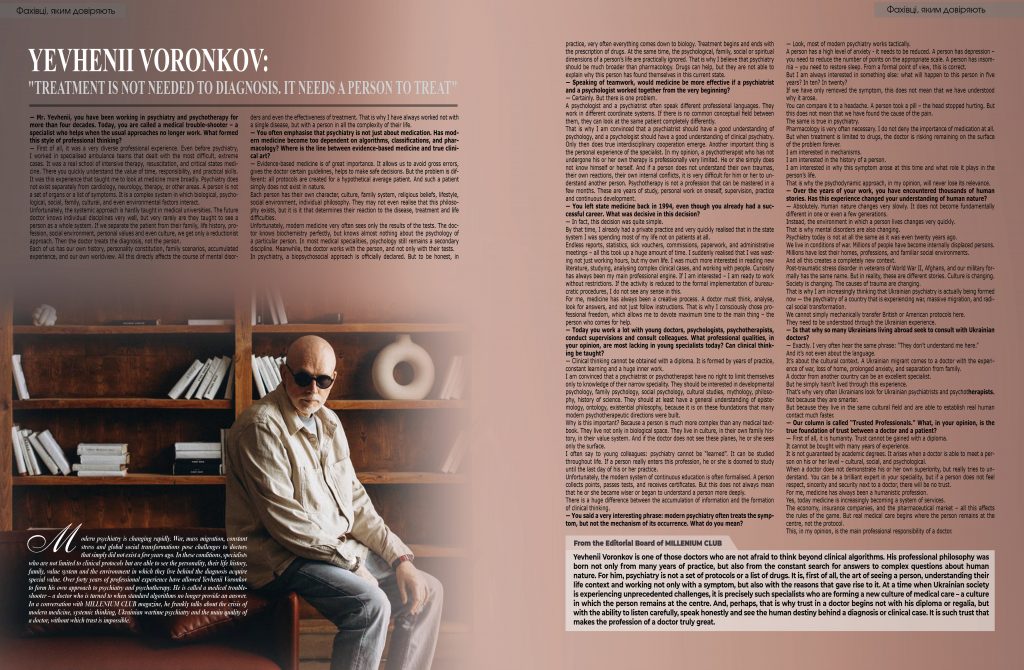
YEVHENII VORONKOV: “TREATMENT IS NOT NEEDED TO DIAGNOSIS. IT NEEDS A PERSON TO TREAT”
Мodern psychiatry is changing rapidly. War, mass migration, constant stress and global social transformations pose challenges to doctors that simply did not exist a few years ago. In these conditions, specialists who are not limited to clinical protocols but are able to see the personality, their life history, family, value system and the environment in which they live behind the diagnosis acquire special value. Over forty years of professional experience have allowed Yevhenii Voronkov to form his own approach to psychiatry and psychotherapy. He is called a medical trouble-shooter – a doctor who is turned to when standard algorithms no longer provide an answer. In a conversation with MILLENIUM CLUB magazine, he frankly talks about the crisis of modern medicine, systemic thinking, Ukrainian wartime psychiatry and the main quality of a doctor, without which trust is impossible.
— Mr. Yevhenii, you have been working in psychiatry and psychotherapy for more than four decades. Today, you are called a medical trouble-shooter – a specialist who helps when the usual approaches no longer work. What formed this style of professional thinking?
— First of all, it was a very diverse professional experience. Even before psychiatry, I worked in specialised ambulance teams that dealt with the most difficult, extreme cases. It was a real school of intensive therapy, resuscitation, and critical states medicine. There you quickly understand the value of time, responsibility, and practical skills.
It was this experience that taught me to look at medicine more broadly. Psychiatry does not exist separately from cardiology, neurology, therapy, or other areas. A person is not a set of organs or a list of symptoms. It is a complex system in which biological, psychological, social, family, cultural, and even environmental factors interact.
Unfortunately, the systemic approach is hardly taught in medical universities. The future doctor knows individual disciplines very well, but very rarely are they taught to see a person as a whole system. If we separate the patient from their family, life history, profession, social environment, personal values and even culture, we get only a reductionist approach. Then the doctor treats the diagnosis, not the person.
Each of us has our own history, personality constitution, family scenarios, accumulated experience, and our own worldview. All this directly affects the course of mental disorders and even the effectiveness of treatment. That is why I have always worked not with a single disease, but with a person in all the complexity of their life.
— You often emphasise that psychiatry is not just about medication. Has modern medicine become too dependent on algorithms, classifications, and pharmacology? Where is the line between evidence-based medicine and true clinical art?
— Evidence-based medicine is of great importance. It allows us to avoid gross errors, gives the doctor certain guidelines, helps to make safe decisions. But the problem is different: all protocols are created for a hypothetical average patient. And such a patient simply does not exist in nature.
Each person has their own character, culture, family system, religious beliefs, lifestyle, social environment, individual philosophy. They may not even realise that this philosophy exists, but it is it that determines their reaction to the disease, treatment and life difficulties.
Unfortunately, modern medicine very often sees only the results of the tests. The doctor knows biochemistry perfectly, but knows almost nothing about the psychology of a particular person. In most medical specialities, psychology still remains a secondary discipline. Meanwhile, the doctor works with the person, and not only with their tests.
In psychiatry, a biopsychosocial approach is officially declared. But to be honest, in practice, very often everything comes down to biology. Treatment begins and ends with the prescription of drugs. At the same time, the psychological, family, social or spiritual dimensions of a person’s life are practically ignored. That is why I believe that psychiatry should be much broader than pharmacology. Drugs can help, but they are not able to explain why this person has found themselves in this current state.
— Speaking of teamwork, would medicine be more effective if a psychiatrist and a psychologist worked together from the very beginning?
— Certainly. But there is one problem.
A psychologist and a psychiatrist often speak different professional languages. They work in different coordinate systems. If there is no common conceptual field between them, they can look at the same patient completely differently.
That is why I am convinced that a psychiatrist should have a good understanding of psychology, and a psychologist should have a good understanding of clinical psychiatry. Only then does true interdisciplinary cooperation emerge. Another important thing is the personal experience of the specialist. In my opinion, a psychotherapist who has not undergone his or her own therapy is professionally very limited. He or she simply does not know himself or herself. And if a person does not understand their own traumas, their own reactions, their own internal conflicts, it is very difficult for him or her to understand another person. Psychotherapy is not a profession that can be mastered in a few months. These are years of study, personal work on oneself, supervision, practice and continuous development.
— You left state medicine back in 1994, even though you already had a successful career. What was decisive in this decision?
— In fact, this decision was quite simple.
By that time, I already had a private practice and very quickly realised that in the state system I was spending most of my life not on patients at all.
Endless reports, statistics, sick vouchers, commissions, paperwork, and administrative meetings – all this took up a huge amount of time. I suddenly realised that I was wasting not just working hours, but my own life. I was much more interested in reading new literature, studying, analysing complex clinical cases, and working with people. Curiosity has always been my main professional engine. If I am interested – I am ready to work without restrictions. If the activity is reduced to the formal implementation of bureaucratic procedures, I do not see any sense in this.
For me, medicine has always been a creative process. A doctor must think, analyse, look for answers, and not just follow instructions. That is why I consciously chose professional freedom, which allows me to devote maximum time to the main thing – the person who comes for help.
— Today you work a lot with young doctors, psychologists, psychotherapists, conduct supervisions and consult colleagues. What professional qualities, in your opinion, are most lacking in young specialists today? Can clinical thinking be taught?
— Clinical thinking cannot be obtained with a diploma. It is formed by years of practice, constant learning and a huge inner work.
I am convinced that a psychiatrist or psychotherapist have no right to limit themselves only to knowledge of their narrow speciality. They should be interested in developmental psychology, family psychology, social psychology, cultural studies, mythology, philosophy, history of science. They should at least have a general understanding of epistemology, ontology, existential philosophy, because it is on these foundations that many modern psychotherapeutic directions were built.
Why is this important? Because a person is much more complex than any medical textbook. They live not only in biological space. They live in culture, in their own family history, in their value system. And if the doctor does not see these planes, he or she sees only the surface.
I often say to young colleagues: psychiatry cannot be “learned”. It can be studied throughout life. If a person really enters this profession, he or she is doomed to study until the last day of his or her practice.
Unfortunately, the modern system of continuous education is often formalised. A person collects points, passes tests, and receives certificates. But this does not always mean that he or she became wiser or began to understand a person more deeply.
There is a huge difference between the accumulation of information and the formation of clinical thinking.
— You said a very interesting phrase: modern psychiatry often treats the symptom, but not the mechanism of its occurrence. What do you mean?
— Look, most of modern psychiatry works tactically.
A person has a high level of anxiety – it needs to be reduced. A person has depression – you need to reduce the number of points on the appropriate scale. A person has insomnia – you need to restore sleep. From a formal point of view, this is correct.
But I am always interested in something else: what will happen to this person in five years? In ten? In twenty?
If we have only removed the symptom, this does not mean that we have understood why it arose.
You can compare it to a headache. A person took a pill – the head stopped hurting. But this does not mean that we have found the cause of the pain.
The same is true in psychiatry.
Pharmacology is very often necessary. I do not deny the importance of medication at all. But when treatment is limited to drugs, the doctor is risking remaining on the surface of the problem forever.
I am interested in mechanisms.
I am interested in the history of a person.
I am interested in why this symptom arose at this time and what role it plays in the person’s life.
That is why the psychodynamic approach, in my opinion, will never lose its relevance.
— Over the years of your work, you have encountered thousands of human stories. Has this experience changed your understanding of human nature?
— Absolutely. Human nature changes very slowly. It does not become fundamentally different in one or even a few generations.
Instead, the environment in which a person lives changes very quickly.
That is why mental disorders are also changing.
Psychiatry today is not at all the same as it was even twenty years ago.
We live in conditions of war. Millions of people have become internally displaced persons.
Millions have lost their homes, professions, and familiar social environments.
And all this creates a completely new context.
Post-traumatic stress disorder in veterans of World War II, Afghans, and our military formally has the same name. But in reality, these are different stories. Culture is changing. Society is changing. The causes of trauma are changing.
That is why I am increasingly thinking that Ukrainian psychiatry is actually being formed now — the psychiatry of a country that is experiencing war, massive migration, and radical social transformation.
We cannot simply mechanically transfer British or American protocols here.
They need to be understood through the Ukrainian experience.
— Is that why so many Ukrainians living abroad seek to consult with Ukrainian doctors?
— Exactly. I very often hear the same phrase: “They don’t understand me here.”
And it’s not even about the language.
It’s about the cultural context. A Ukrainian migrant comes to a doctor with the experience of war, loss of home, prolonged anxiety, and separation from family.
A doctor from another country can be an excellent specialist.
But he simply hasn’t lived through this experience.
That’s why very often Ukrainians look for Ukrainian psychiatrists and psychotherapists.
Not because they are smarter.
But because they live in the same cultural field and are able to establish real human contact much faster.
— Our column is called “Trusted Professionals.” What, in your opinion, is the true foundation of trust between a doctor and a patient?
— First of all, it is humanity. Trust cannot be gained with a diploma.
It cannot be bought with many years of experience.
It is not guaranteed by academic degrees. It arises when a doctor is able to meet a person on his or her level – cultural, social, and psychological.
When a doctor does not demonstrate his or her own superiority, but really tries to understand. You can be a brilliant expert in your speciality, but if a person does not feel respect, sincerity and security next to a doctor, there will be no trust.
For me, medicine has always been a humanistic profession.
Yes, today medicine is increasingly becoming a system of services.
The economy, insurance companies, and the pharmaceutical market – all this affects the rules of the game. But real medical care begins where the person remains at the centre, not the protocol.
This, in my opinion, is the main professional responsibility of a doctor.
From the Editorial Board of MILLENIUM CLUB
Yevhenii Voronkov is one of those doctors who are not afraid to think beyond clinical algorithms. His professional philosophy was born not only from many years of practice, but also from the constant search for answers to complex questions about human nature. For him, psychiatry is not a set of protocols or a list of drugs. It is, first of all, the art of seeing a person, understanding their life context and working not only with a symptom, but also with the reasons that gave rise to it. At a time when Ukrainian society is experiencing unprecedented challenges, it is precisely such specialists who are forming a new culture of medical care – a culture in which the person remains at the centre. And, perhaps, that is why trust in a doctor begins not with his diploma or regalia, but with the ability to listen carefully, speak honestly and see the human destiny behind a diagnosis or clinical case. It is such trust that makes the profession of a doctor truly great.