СЕРГІЙ САРАНОВ: «СИЛЬНА ЮРИДИЧНА ПОЗИЦІЯ ФОРМУЄТЬСЯ ЩЕ ДО ТОГО, ЯК ВИНИКАЄ КОНФЛІКТ»
Сьогодні бізнес працює в умовах постійних змін, а юридичні помилки дедалі частіше коштують не лише грошей, а й репутації, партнерських відносин і майбутнього компанії. Саме тому сучасний адвокат стає не просто представником у суді, а стратегічним партнером, який допомагає ухвалювати правильні рішення ще до того, як виникне проблема. Про юридичну культуру, профілактику ризиків, відповідальність бізнесу та роль людського чинника в праві ми поговорили із Сергієм Сарановим.
— Ви працюєте в юридичній сфері вже 25 років. Як за цей час змінилося Ваше власне розуміння професії адвоката?
— Коли я лише починав працювати, мені здавалося, що головне завдання адвоката — захистити клієнта тоді, коли проблема вже виникла. З роками я зрозумів, що найцінніша робота адвоката починається значно раніше.
Сьогодні я сприймаю адвоката насамперед як стратегічного радника. Наше завдання — не лише виграти суд чи знайти рішення вже наявного конфлікту, а допомогти клієнту зробити так, щоб цей конфлікт узагалі не виник. Саме в цьому, на мою думку, і полягає сучасна роль адвоката.
— На якому етапі бізнес найчастіше припускається помилок?
— Я не можу виділити якийсь один конкретний момент. Насправді це цілий ланцюг дрібних рішень.
Усе починається з довіри без належної перевірки, потім — із підписання договору без аналізу ризиків, далі — з усних домовленостей, які ніхто не фіксує, а завершується тим, що перші сигнали майбутнього конфлікту просто ігноруються. Бізнес рідко руйнується через одну помилку. Найчастіше це наслідок накопичення невеликих прорахунків, які в певний момент перетворюються на одну велику проблему.
— Чому власники бізнесу часто відкладають юридичну діагностику?
— Тому що юридичний ризик не завжди помітний одразу.
Поки все працює, здається, що додаткові перевірки — це зайві витрати. Але право працює інакше: його наслідки дуже часто проявляються із запізненням.
Людина починає думати про адвоката тоді, коли вже отримала позов, заблоковано рахунки або виник корпоративний конфлікт. Хоча більшості таких ситуацій можна було запобігти значно раніше.
— Чим відрізняється юридичне мислення підприємця, який думає стратегічно?
— Підприємець, який мислить стратегічно, сприймає юридичний супровід як інвестицію в безпеку свого бізнесу.
Він ставить питання: «Що може статися через рік? Через три? Які ризики потрібно усунути вже сьогодні?»
Людина, яка діє ситуативно, навпаки, реагує лише тоді, коли проблема вже стала очевидною. На жаль, у цей момент вибір можливих рішень завжди значно менший.
— Чому недостатньо бути правим?
— Тому що суд працює не з емоціями, а з доказами.
Я неодноразово бачив ситуації, коли людина фактично мала рацію, але не могла цього довести.
У більшості випадків клієнти недооцінюють значення правильно оформлених договорів, листування, актів виконаних робіт, платіжних документів і службових записок. Саме такі, на перший погляд, дрібниці дуже часто визначають результат судового спору.
— Наскільки важливими є повідомлення в месенджерах?
— Сьогодні величезна частина ділової комунікації відбувається саме в цифровому середовищі.
Повідомлення в месенджері, електронний лист чи переписка можуть стати важливими доказами, якщо підтверджують певні домовленості або обставини справи. Водночас потрібно розуміти, що не кожне повідомлення автоматично матиме юридичну силу. Важливими є його зміст, спосіб отримання, можливість підтвердити автора та інші процесуальні аспекти. Саме тому будь-яке ділове листування варто вести відповідально.
— Як Ви зберігаєте баланс між захистом клієнта та професійною етикою?
— Для мене цей баланс є основою професії.
Я завжди захищаю інтереси клієнта максимально ефективно, але ніколи не створюю ілюзій.
Іноді найважливіше, що може зробити адвокат, — чесно сказати клієнту, що його позиція має слабкі сторони. Це не прояв песимізму, а прояв професійної відповідальності.
Довіра починається саме з чесності.
— Чому Вас цікавлять філософія та психологія?
— Тому що будь-який юридичний конфлікт — це насамперед конфлікт між людьми.
Право дає відповідь на питання «як?», але дуже часто не пояснює «чому?».
Філософія допомагає бачити проблему ширше, а психологія — краще розуміти мотиви людей, їхню поведінку та причини конфліктів. На моє переконання, хороший адвокат повинен розуміти не лише закон, а й людину.
— Яку юридичну культуру Ви прагнете сформувати через діяльність SARANOV & PARTNERS?
— Я хотів би, щоб в Україні поступово сформувалася культура відповідального ставлення до права.
Щоб люди зверталися до адвоката не лише тоді, коли вже сталося щось погане, а й тоді, коли ще є можливість запобігти проблемі.
Для мене право — це не тільки спосіб вирішувати конфлікти. Це інструмент розвитку, захисту бізнесу, активів, репутації та впевненості в завтрашньому дні. Саме таку філософію ми закладаємо в основу роботи SARANOV & PARTNERS. Ми прагнемо бути не просто представниками в суді, а партнерами, які допомагають клієнтам ухвалювати сильні юридичні рішення ще до того, як виникне конфлікт.
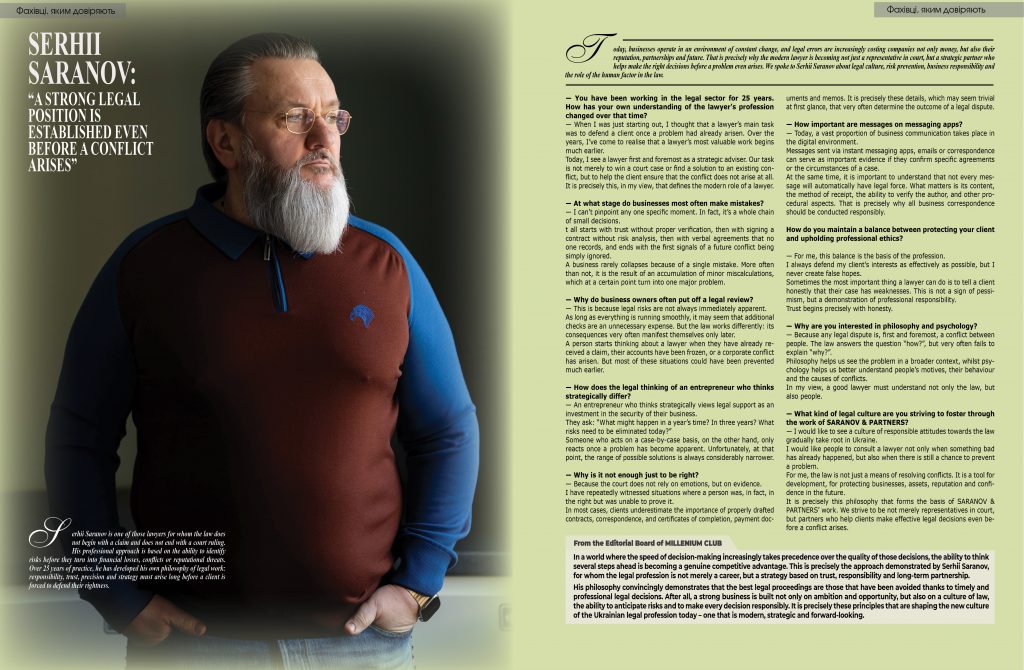
Сергій Саранов належить до тих адвокатів, для яких право не починається з позову і не закінчується рішенням суду. Його професійний підхід базується на здатності побачити ризик раніше, ніж він перетвориться на збитки, конфлікт або репутаційну загрозу. За 25 років практики він сформував власну філософію юридичної роботи: відповідальність, довіра, точність і стратегія мають з’явитися значно раніше, ніж клієнту доведеться захищати свою правоту.
Від редакції журналу MILLENIUM CLUB
У світі, де швидкість ухвалення рішень дедалі частіше переважає над їхньою якістю, справжньою конкурентною перевагою стає здатність мислити на кілька кроків уперед. Саме такий підхід демонструє Сергій Саранов, для якого адвокатура — це не лише професія, а стратегія довіри, відповідальності та довгострокового партнерства.
Його філософія переконливо доводить: найкращий судовий процес — той, якого вдалося уникнути завдяки своєчасним і професійним юридичним рішенням. Адже сильний бізнес будується не лише на амбіціях і можливостях, а й на правовій культурі, здатності передбачати ризики та відповідально ставитися до кожного рішення. Саме такі принципи сьогодні формують нову культуру української адвокатури — сучасної, стратегічної та орієнтованої на майбутнє.
SERHII SARANOV: “A STRONG LEGAL POSITION IS ESTABLISHED EVEN BEFORE A CONFLICT ARISES”
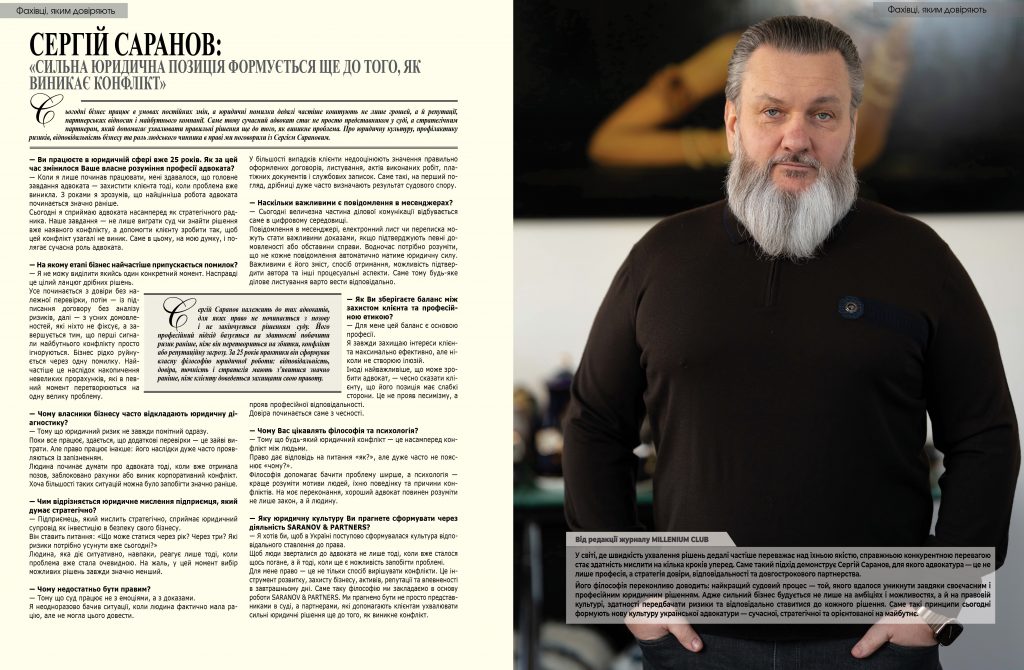
Serhii Saranov is one of those lawyers for whom the law does not begin with a claim and does not end with a court ruling. His professional approach is based on the ability to identify risks before they turn into financial losses, conflicts or reputational threats. Over 25 years of practice, he has developed his own philosophy of legal work: responsibility, trust, precision and strategy must arise long before a client is forced to defend their rightness.
Today, businesses operate in an environment of constant change, and legal errors are increasingly costing companies not only money, but also their reputation, partnerships and future. That is precisely why the modern lawyer is becoming not just a representative in court, but a strategic partner who helps make the right decisions before a problem even arises. We spoke to Serhii Saranov about legal culture, risk prevention, business responsibility and the role of the human factor in the law.
— You have been working in the legal sector for 25 years. How has your own understanding of the lawyer’s profession changed over that time?
— When I was just starting out, I thought that a lawyer’s main task was to defend a client once a problem had already arisen. Over the years, I’ve come to realise that a lawyer’s most valuable work begins much earlier.
Today, I see a lawyer first and foremost as a strategic adviser. Our task is not merely to win a court case or find a solution to an existing conflict, but to help the client ensure that the conflict does not arise at all. It is precisely this, in my view, that defines the modern role of a lawyer.
— At what stage do businesses most often make mistakes?
— I can’t pinpoint any one specific moment. In fact, it’s a whole chain of small decisions.
t all starts with trust without proper verification, then with signing a contract without risk analysis, then with verbal agreements that no one records, and ends with the first signals of a future conflict being simply ignored.
A business rarely collapses because of a single mistake. More often than not, it is the result of an accumulation of minor miscalculations, which at a certain point turn into one major problem.
— Why do business owners often put off a legal review?
— This is because legal risks are not always immediately apparent.
As long as everything is running smoothly, it may seem that additional checks are an unnecessary expense. But the law works differently: its consequences very often manifest themselves only later.
A person starts thinking about a lawyer when they have already received a claim, their accounts have been frozen, or a corporate conflict has arisen. But most of these situations could have been prevented much earlier.
— How does the legal thinking of an entrepreneur who thinks strategically differ?
— An entrepreneur who thinks strategically views legal support as an investment in the security of their business.
They ask: “What might happen in a year’s time? In three years? What risks need to be eliminated today?”
Someone who acts on a case-by-case basis, on the other hand, only reacts once a problem has become apparent. Unfortunately, at that point, the range of possible solutions is always considerably narrower.
— Why is it not enough just to be right?
— Because the court does not rely on emotions, but on evidence.
I have repeatedly witnessed situations where a person was, in fact, in the right but was unable to prove it.
In most cases, clients underestimate the importance of properly drafted contracts, correspondence, and certificates of completion, payment documents and memos. It is precisely these details, which may seem trivial at first glance, that very often determine the outcome of a legal dispute.
— How important are messages on messaging apps?
— Today, a vast proportion of business communication takes place in the digital environment.
Messages sent via instant messaging apps, emails or correspondence can serve as important evidence if they confirm specific agreements or the circumstances of a case.
At the same time, it is important to understand that not every message will automatically have legal force. What matters is its content, the method of receipt, the ability to verify the author, and other procedural aspects. That is precisely why all business correspondence should be conducted responsibly.
How do you maintain a balance between protecting your client and upholding professional ethics?
— For me, this balance is the basis of the profession.
I always defend my client’s interests as effectively as possible, but I never create false hopes.
Sometimes the most important thing a lawyer can do is to tell a client honestly that their case has weaknesses. This is not a sign of pessimism, but a demonstration of professional responsibility.
Trust begins precisely with honesty.
— Why are you interested in philosophy and psychology?
— Because any legal dispute is, first and foremost, a conflict between people. The law answers the question “how?”, but very often fails to explain “why?”.
Philosophy helps us see the problem in a broader context, whilst psychology helps us better understand people’s motives, their behaviour and the causes of conflicts.
In my view, a good lawyer must understand not only the law, but also people.
— What kind of legal culture are you striving to foster through the work of SARANOV & PARTNERS?
— I would like to see a culture of responsible attitudes towards the law gradually take root in Ukraine.
I would like people to consult a lawyer not only when something bad has already happened, but also when there is still a chance to prevent a problem.
For me, the law is not just a means of resolving conflicts. It is a tool for development, for protecting businesses, assets, reputation and confidence in the future.
It is precisely this philosophy that forms the basis of SARANOV & PARTNERS’ work. We strive to be not merely representatives in court, but partners who help clients make effective legal decisions even before a conflict arises.
From the Editorial Board of MILLENIUM CLUB
In a world where the speed of decision-making increasingly takes precedence over the quality of those decisions, the ability to think several steps ahead is becoming a genuine competitive advantage. This is precisely the approach demonstrated by Serhii Saranov, for whom the legal profession is not merely a career, but a strategy based on trust, responsibility and long-term partnership.
His philosophy convincingly demonstrates that the best legal proceedings are those that have been avoided thanks to timely and professional legal decisions. After all, a strong business is built not only on ambition and opportunity, but also on a culture of law, the ability to anticipate risks and to make every decision responsibly. It is precisely these principles that are shaping the new culture of the Ukrainian legal profession today – one that is modern, strategic and forward-looking.