
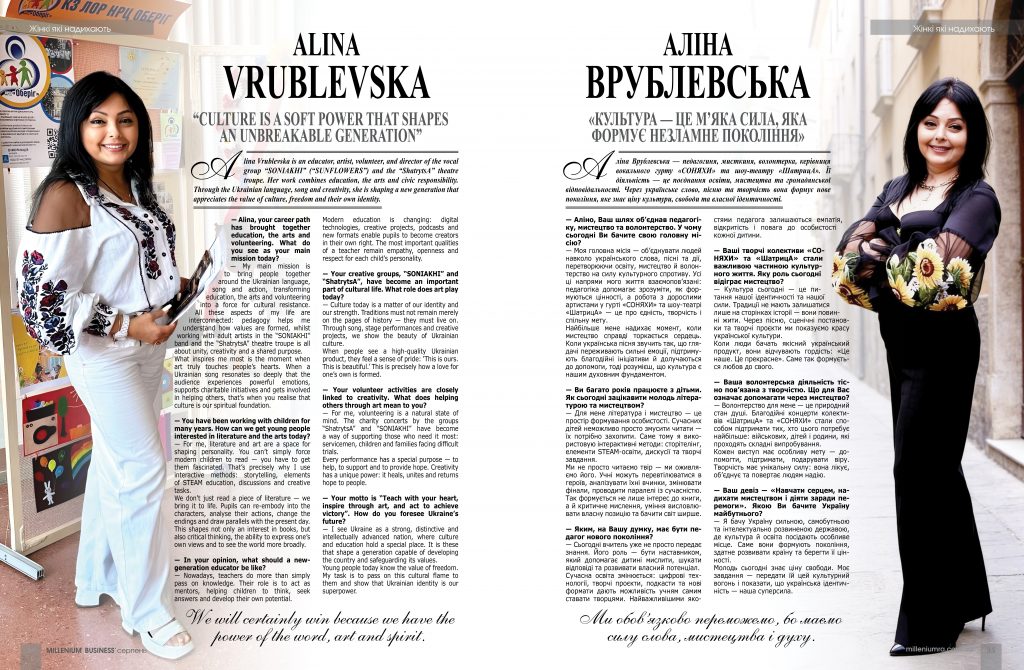
Аліна Врублевська — педагогиня, мисткиня, волонтерка, керівниця вокального гурту «СОНЯХИ» та шоу-театру «ШатрицА». Її діяльність — це поєднання освіти, мистецтва та громадянської відповідальності. Через українське слово, пісню та творчість вона формує нове покоління, яке знає ціну культури, свободи та власної ідентичності.
— Аліно, Ваш шлях об’єднав педагогіку, мистецтво та волонтерство. У чому сьогодні Ви бачите свою головну місію?
— Моя головна місія — об’єднувати людей навколо українського слова, пісні та дії, перетворюючи освіту, мистецтво й волонтерство на силу культурного спротиву. Усі ці напрями мого життя взаємопов’язані: педагогіка допомагає зрозуміти, як формуються цінності, а робота з дорослими артистами у гурті «СОНЯХИ» та шоу-театрі «ШатрицА» — це про єдність, творчість і спільну мету.
Найбільше мене надихає момент, коли мистецтво справді торкається сердець. Коли українська пісня звучить так, що глядачі переживають сильні емоції, підтримують благодійні ініціативи й долучаються до допомоги, тоді розумієш, що культура є нашим духовним фундаментом.
— Ви багато років працюєте з дітьми. Як сьогодні зацікавити молодь літературою та мистецтвом?
— Для мене література і мистецтво — це простір формування особистості. Сучасних дітей неможливо просто змусити читати — їх потрібно захопити. Саме тому я використовую інтерактивні методи: сторітелінг, елементи STEAM-освіти, дискусії та творчі завдання.
Ми не просто читаємо твір — ми оживляємо його. Учні можуть перевтілюватися в героїв, аналізувати їхні вчинки, змінювати фінали, проводити паралелі із сучасністю. Так формується не лише інтерес до книги, а й критичне мислення, уміння висловлювати власну позицію та бачити світ ширше.
— Яким, на Вашу думку, має бути педагог нового покоління?
— Сьогодні вчитель уже не просто передає знання. Його роль — бути наставником, який допомагає дитині мислити, шукати відповіді та розвивати власний потенціал.
Сучасна освіта змінюється: цифрові технології, творчі проєкти, подкасти та нові формати дають можливість учням самим ставати творцями. Найважливішими якостями педагога залишаються емпатія, відкритість і повага до особистості кожної дитини.
— Ваші творчі колективи «СОНЯХИ» та «ШатрицА» стали важливою частиною культурного життя. Яку роль сьогодні відіграє мистецтво?
— Культура сьогодні — це питання нашої ідентичності та нашої сили. Традиції не мають залишатися лише на сторінках історії — вони повинні жити. Через пісню, сценічні постановки та творчі проєкти ми показуємо красу української культури.
Коли люди бачать якісний український продукт, вони відчувають гордість: «Це наше. Це прекрасне». Саме так формується любов до свого.
— Ваша волонтерська діяльність тісно пов’язана з творчістю. Що для Вас означає допомагати через мистецтво?
— Волонтерство для мене — це природний стан душі. Благодійні концерти колективів «ШатрицА» та «СОНЯХИ» стали способом підтримати тих, хто цього потребує найбільше: військових, дітей і родини, які проходять складні випробування.
Кожен виступ має особливу мету — допомогти, підтримати, подарувати віру. Творчість має унікальну силу: вона лікує, об’єднує та повертає людям надію.
— Ваш девіз — «Навчати серцем, надихати мистецтвом і діяти заради перемоги». Якою Ви бачите Україну майбутнього?
— Я бачу Україну сильною, самобутньою та інтелектуально розвиненою державою, де культура й освіта посідають особливе місце. Саме вони формують покоління, здатне розвивати країну та берегти її цінності.
Молодь сьогодні знає ціну свободи. Моє завдання — передати їй цей культурний вогонь і показати, що українська ідентичність — наша суперсила.
Alina VRUBLEVSKA: “Culture is a soft power that shapes an unbreakable generation”
Аlina Vrublevska is an educator, artist, volunteer, and director of the vocal group “SONIAKHI” (“SUNFLOWERS”) and the “ShatrytsA” theatre troupe. Her work combines education, the arts and civic responsibility. Through the Ukrainian language, song and creativity, she is shaping a new generation that appreciates the value of culture, freedom and their own identity.
— Alina, your career path has brought together education, the arts and volunteering. What do you see as your main mission today?
— My main mission is to bring people together around the Ukrainian language, song and action, transforming education, the arts and volunteering into a force for cultural resistance. All these aspects of my life are interconnected: pedagogy helps me understand how values are formed, whilst working with adult artists in the “SONIAKHI” band and the “ShatrytsA” theatre troupe is all about unity, creativity and a shared purpose.
What inspires me most is the moment when art truly touches people’s hearts. When a Ukrainian song resonates so deeply that the audience experiences powerful emotions, supports charitable initiatives and gets involved in helping others, that’s when you realise that culture is our spiritual foundation.
— You have been working with children for many years. How can we get young people interested in literature and the arts today?
— For me, literature and art are a space for shaping personality. You can’t simply force modern children to read — you have to get them fascinated. That’s precisely why I use interactive methods: storytelling, elements of STEAM education, discussions and creative tasks.
We don’t just read a piece of literature — we bring it to life. Pupils can re-embody into the characters, analyse their actions, change the endings and draw parallels with the present day. This shapes not only an interest in books, but also critical thinking, the ability to express one’s own views and to see the world more broadly.
— In your opinion, what should a new-generation educator be like?
— Nowadays, teachers do more than simply pass on knowledge. Their role is to act as mentors, helping children to think, seek answers and develop their own potential.
Modern education is changing: digital technologies, creative projects, podcasts and new formats enable pupils to become creators in their own right. The most important qualities of a teacher remain empathy, openness and respect for each child’s personality.
— Your creative groups, “SONIAKHI” and “ShatrytsA”, have become an important part of cultural life. What role does art play today?
— Culture today is a matter of our identity and our strength. Traditions must not remain merely on the pages of history — they must live on. Through song, stage performances and creative projects, we show the beauty of Ukrainian culture.
When people see a high-quality Ukrainian product, they feel a sense of pride: ‘This is ours. This is beautiful.’ This is precisely how a love for one’s own is formed.
— Your volunteer activities are closely linked to creativity. What does helping others through art mean to you?
— For me, volunteering is a natural state of mind. The charity concerts by the groups “ShatrytsA” and “SONIAKHI” have become a way of supporting those who need it most: servicemen, children and families facing difficult trials.
Every performance has a special purpose — to help, to support and to provide hope. Creativity has a unique power: it heals, unites and returns hope to people.
— Your motto is “Teach with your heart, inspire through art, and act to achieve victory”. How do you foresee Ukraine’s future?
— I see Ukraine as a strong, distinctive and intellectually advanced nation, where culture and education hold a special place. It is these that shape a generation capable of developing the country and safeguarding its values.
Young people today know the value of freedom. My task is to pass on this cultural flame to them and show that Ukrainian identity is our superpower.