
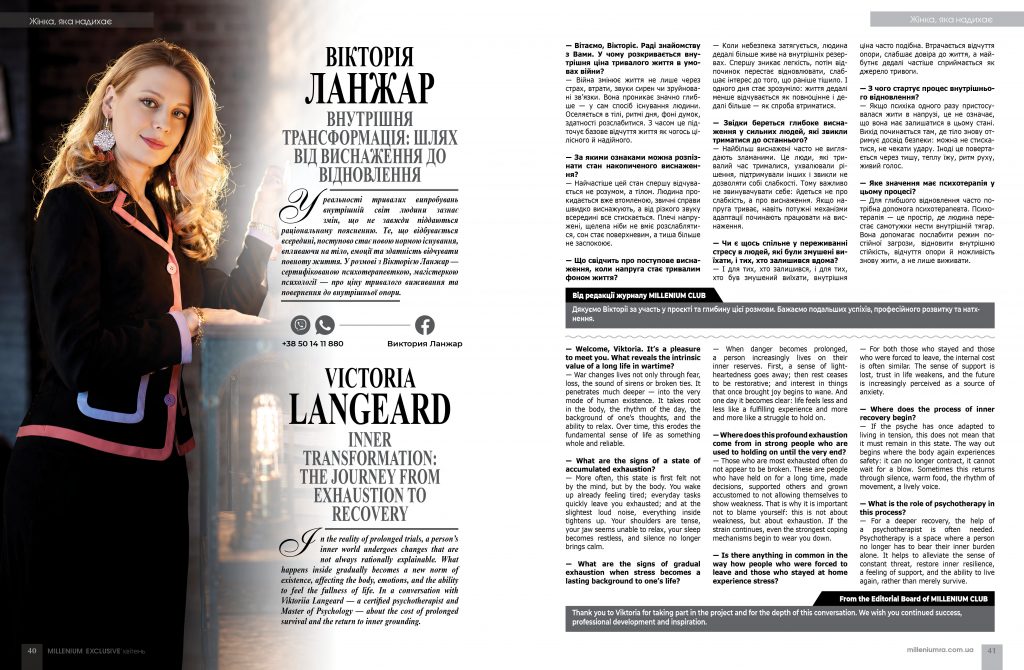
У реальності тривалих випробувань внутрішній світ людини зазнає змін, що не завжди піддаються раціональному поясненню. Те, що відбувається всередині, поступово стає новою нормою існування, впливаючи на тіло, емоції та здатність відчувати повноту життя. У розмові з Вікторією Ланжар — сертифікованою психотерапевткою, магістеркою психології — про ціну тривалого виживання та повернення до внутрішньої опори.
— Вітаємо, Вікторіє. Раді знайомству з Вами. У чому розкривається внутрішня ціна тривалого життя в умовах війни?
— Війна змінює життя не лише через страх, втрати, звуки сирен чи зруйновані зв’язки. Вона проникає значно глибше — у сам спосіб існування людини. Оселяється в тілі, ритмі дня, фоні думок, здатності розслабитися. З часом це підточує базове відчуття життя як чогось цілісного й надійного.
— За якими ознаками можна розпізнати стан накопиченого виснаження?
— Найчастіше цей стан спершу відчувається не розумом, а тілом. Людина прокидається вже втомленою, звичні справи швидко виснажують, а від різкого звуку всередині все стискається. Плечі напружені, щелепа ніби не вміє розслаблятися, сон стає поверхневим, а тиша більше не заспокоює.
— Що свідчить про поступове виснаження, коли напруга стає тривалим фоном життя?
— Коли небезпека затягується, людина дедалі більше живе на внутрішніх резервах. Спершу зникає легкість, потім відпочинок перестає відновлювати, слабшає інтерес до того, що раніше тішило. І одного дня стає зрозуміло: життя дедалі менше відчувається як повноцінне і дедалі більше — як спроба втриматися.
— Звідки береться глибоке виснаження у сильних людей, які звикли триматися до останнього?
— Найбільш виснажені часто не виглядають зламаними. Це люди, які тривалий час трималися, ухвалювали рішення, підтримували інших і звикли не дозволяти собі слабкості. Тому важливо не звинувачувати себе: йдеться не про слабкість, а про виснаження. Якщо напруга триває, навіть потужні механізми адаптації починають працювати на виснаження.
— Чи є щось спільне у переживанні стресу в людей, які були змушені виїхати, і тих, хто залишився вдома?
— І для тих, хто залишився, і для тих, хто був змушений виїхати, внутрішня ціна часто подібна. Втрачається відчуття опори, слабшає довіра до життя, а майбутнє дедалі частіше сприймається як джерело тривоги.
— З чого стартує процес внутрішнього відновлення?
— Якщо психіка одного разу пристосувалася жити в напрузі, це не означає, що вона має залишатися в цьому стані. Вихід починається там, де тіло знову отримує досвід безпеки: можна не стискатися, не чекати удару. Іноді це повертається через тишу, теплу їжу, ритм руху, живий голос.
— Яке значення має психотерапія у цьому процесі?
— Для глибшого відновлення часто потрібна допомога психотерапевта. Психотерапія — це простір, де людина перестає самотужки нести внутрішній тягар. Вона допомагає послабити режим постійної загрози, відновити внутрішню стійкість, відчуття опори й можливість знову жити, а не лише виживати.
Від редакції журналу MILLENIUM CLUB: Дякуємо Вікторії за участь у проєкті та глибину цієї розмови. Бажаємо подальших успіхів, професійного розвитку та натхнення.
Victoria Langeard Inner transformation: the journey from exhaustion to recovery
Іn the reality of prolonged trials, a person’s inner world undergoes changes that are not always rationally explainable. What happens inside gradually becomes a new norm of existence, affecting the body, emotions, and the ability to feel the fullness of life. In a conversation with Viktoriia Langeard — a certified psychotherapist and Master of Psychology — about the cost of prolonged survival and the return to inner grounding.
— Welcome, Viktoria. It’s a pleasure to meet you. What reveals the intrinsic value of a long life in wartime?
— War changes lives not only through fear, loss, the sound of sirens or broken ties. It penetrates much deeper — into the very mode of human existence. It takes root in the body, the rhythm of the day, the background of one’s thoughts, and the ability to relax. Over time, this erodes the fundamental sense of life as something whole and reliable.
— What are the signs of a state of accumulated exhaustion?
— More often, this state is first felt not by the mind, but by the body. You wake up already feeling tired; everyday tasks quickly leave you exhausted; and at the slightest loud noise, everything inside tightens up. Your shoulders are tense, your jaw seems unable to relax, your sleep becomes restless, and silence no longer brings calm.
— What are the signs of gradual exhaustion when stress becomes a lasting background to one’s life?
— When danger becomes prolonged, a person increasingly lives on their inner reserves. First, a sense of light-heartedness goes away; then rest ceases to be restorative; and interest in things that once brought joy begins to wane. And one day it becomes clear: life feels less and less like a fulfilling experience and more and more like a struggle to hold on.
— Where does this profound exhaustion come from in strong people who are used to holding on until the very end?
— Those who are most exhausted often do not appear to be broken. These are people who have held on for a long time, made decisions, supported others and grown accustomed to not allowing themselves to show weakness. That is why it is important not to blame yourself: this is not about weakness, but about exhaustion. If the strain continues, even the strongest coping mechanisms begin to wear you down.
— Is there anything in common in the way how people who were forced to leave and those who stayed at home experience stress?
— For both those who stayed and those who were forced to leave, the internal cost is often similar. The sense of support is lost, trust in life weakens, and the future is increasingly perceived as a source of anxiety.
— Where does the process of inner recovery begin?
— If the psyche has once adapted to living in tension, this does not mean that it must remain in this state. The way out begins where the body again experiences safety: it can no longer contract, it cannot wait for a blow. Sometimes this returns through silence, warm food, the rhythm of movement, a lively voice.
— What is the role of psychotherapy in this process?
— For a deeper recovery, the help of a psychotherapist is often needed. Psychotherapy is a space where a person no longer has to bear their inner burden alone. It helps to alleviate the sense of constant threat, restore inner resilience, a feeling of support, and the ability to live again, rather than merely survive.
From the Editorial Board of MILLENIUM CLUB: Thank you to Viktoria for taking part in the project and for the depth of this conversation. We wish you continued success, professional development and inspiration.