
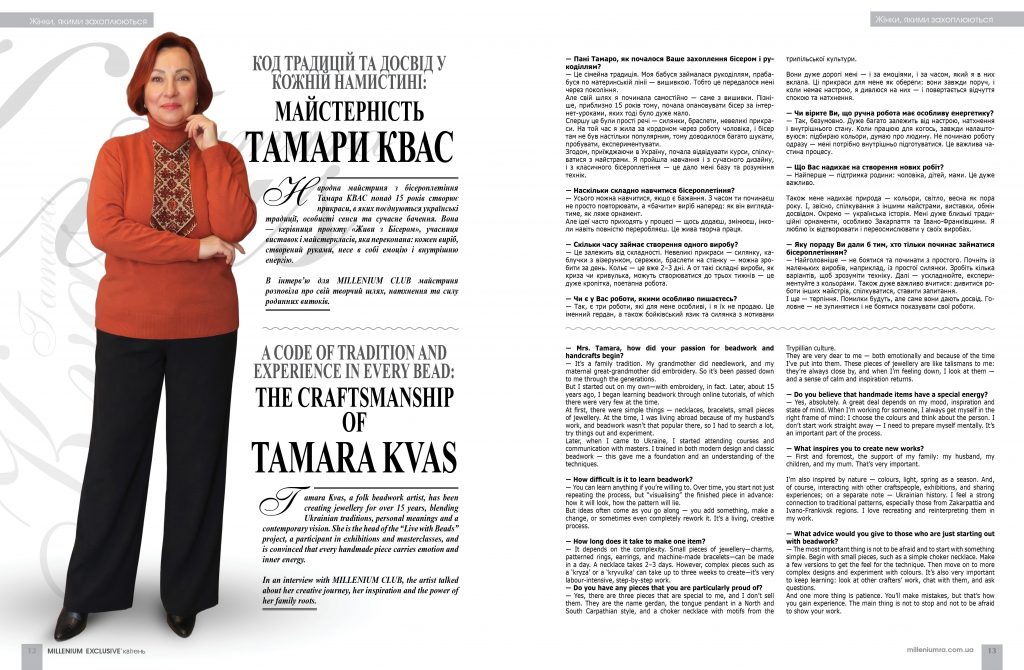
Народна майстриня з бісероплетіння Тамара КВАС понад 15 років створює прикраси, в яких поєднуються українські традиції, особисті сенси та сучасне бачення. Вона — керівниця проєкту «Живи з Бісером», учасниця виставок і майстеркласів, яка переконана: кожен виріб, створений руками, несе в собі емоцію і внутрішню енергію.
В інтерв’ю для MILLENIUM CLUB майстриня розповіла про свій творчий шлях, натхнення та силу родинних витоків.
— Пані Тамаро, як почалося Ваше захоплення бісером і рукоділлям?
— Це сімейна традиція. Моя бабуся займалася рукоділлям, прабабуся по материнській лінії — вишивкою. Тобто це передалося мені через покоління.
Але свій шлях я починала самостійно — саме з вишивки. Пізніше, приблизно 15 років тому, почала опановувати бісер за інтернет-уроками, яких тоді було дуже мало.
Спершу це були прості речі — силянки, браслети, невеликі прикраси. На той час я жила за кордоном через роботу чоловіка, і бісер там не був настільки популярним, тому доводилося багато шукати, пробувати, експериментувати.
Згодом, приїжджаючи в Україну, почала відвідувати курси, спілкуватися з майстрами. Я пройшла навчання і з сучасного дизайну, і з класичного бісероплетіння — це дало мені базу та розуміння технік.
— Наскільки складно навчитися бісероплетіння?
— Усього можна навчитися, якщо є бажання. З часом ти починаєш не просто повторювати, а «бачити» виріб наперед: як він виглядатиме, як ляже орнамент.
Але ідеї часто приходять у процесі — щось додаєш, змінюєш, інколи навіть повністю переробляєш. Це жива творча праця.
— Скільки часу займає створення одного виробу?
— Це залежить від складності. Невеликі прикраси — силянку, каблучки з візерунком, сережки, браслети на станку — можна зробити за день. Кольє — це вже 2–3 дні. А от такі складні вироби, як криза чи кривулька, можуть створюватися до трьох тижнів — це дуже кропітка, поетапна робота.
— Чи є у Вас роботи, якими особливо пишаєтесь?
— Так, є три роботи, які для мене особливі, і я їх не продаю. Це іменний гердан, а також бойківський язик та силянка з мотивами трипільської культури.
Вони дуже дорогі мені — і за емоціями, і за часом, який я в них вклала. Ці прикраси для мене як обереги: вони завжди поруч, і коли немає настрою, я дивлюся на них — і повертається відчуття спокою та натхнення.
— Чи вірите Ви, що ручна робота має особливу енергетику?
— Так, безумовно. Дуже багато залежить від настрою, натхнення і внутрішнього стану. Коли працюю для когось, завжди налаштовуюся: підбираю кольори, думаю про людину. Не починаю роботу одразу — мені потрібно внутрішньо підготуватися. Це важлива частина процесу.
— Що Вас надихає на створення нових робіт?
— Найперше — підтримка родини: чоловіка, дітей, мами. Це дуже важливо.
Також мене надихає природа — кольори, світло, весна як пора року. І, звісно, спілкування з іншими майстрами, виставки, обмін досвідом. Окремо — українська історія. Мені дуже близькі традиційні орнаменти, особливо Закарпаття та Івано-Франківщини. Я люблю їх відтворювати і переосмислювати у своїх виробах.
— Яку пораду Ви дали б тим, хто тільки починає займатися бісероплетінням?
— Найголовніше — не боятися та починати з простого. Почніть із маленьких виробів, наприклад, із простої силянки. Зробіть кілька варіантів, щоб зрозуміти техніку. Далі — ускладнюйте, експериментуйте з кольорами. Також дуже важливо вчитися: дивитися роботи інших майстрів, спілкуватися, ставити запитання.
І ще — терпіння. Помилки будуть, але саме вони дають досвід. Головне — не зупинятися і не боятися показувати свої роботи.
A CODE OF TRADITION AND EXPERIENCE IN EVERY BEAD: THE CRAFTSMANSHIP OF TAMARA KVAS
Тamara Kvas, a folk beadwork artist, has been creating jewellery for over 15 years, blending Ukrainian traditions, personal meanings and a contemporary vision. She is the head of the “Live with Beads” project, a participant in exhibitions and masterclasses, and is convinced that every handmade piece carries emotion and inner energy.
In an interview with MILLENIUM CLUB, the artist talked about her creative journey, her inspiration and the power of her family roots.
— Mrs. Tamara, how did your passion for beadwork and handcrafts begin?
— It’s a family tradition. My grandmother did needlework, and my maternal great-grandmother did embroidery. So it’s been passed down to me through the generations.
But I started out on my own—with embroidery, in fact. Later, about 15 years ago, I began learning beadwork through online tutorials, of which there were very few at the time.
At first, there were simple things — necklaces, bracelets, small pieces of jewellery. At the time, I was living abroad because of my husband’s work, and beadwork wasn’t that popular there, so I had to search a lot, try things out and experiment.
Later, when I came to Ukraine, I started attending courses and communication with masters. I trained in both modern design and classic beadwork — this gave me a foundation and an understanding of the techniques.
— How difficult is it to learn beadwork?
— You can learn anything if you’re willing to. Over time, you start not just repeating the process, but “visualising” the finished piece in advance: how it will look, how the pattern will lie.
But ideas often come as you go along — you add something, make a change, or sometimes even completely rework it. It’s a living, creative process.
— How long does it take to make one item?
— It depends on the complexity. Small pieces of jewellery—charms, patterned rings, earrings, and machine-made bracelets—can be made in a day. A necklace takes 2–3 days. However, complex pieces such as a ‘kryza’ or a ‘kryvulka’ can take up to three weeks to create—it’s very labour-intensive, step-by-step work.
— Do you have any pieces that you are particularly proud of?
— Yes, there are three pieces that are special to me, and I don’t sell them. They are the name gerdan, the tongue pendant in a North and South Carpathian style, and a choker necklace with motifs from the Trypillian culture.
They are very dear to me — both emotionally and because of the time I’ve put into them. These pieces of jewellery are like talismans to me: they’re always close by, and when I’m feeling down, I look at them — and a sense of calm and inspiration returns.
— Do you believe that handmade items have a special energy?
— Yes, absolutely. A great deal depends on my mood, inspiration and state of mind. When I’m working for someone, I always get myself in the right frame of mind: I choose the colours and think about the person. I don’t start work straight away — I need to prepare myself mentally. It’s an important part of the process.
— What inspires you to create new works?
— First and foremost, the support of my family: my husband, my children, and my mum. That’s very important.
I’m also inspired by nature — colours, light, spring as a season. And, of course, interacting with other craftspeople, exhibitions, and sharing experiences; on a separate note — Ukrainian history. I feel a strong connection to traditional patterns, especially those from Zakarpattia and Ivano-Frankivsk regions. I love recreating and reinterpreting them in my work.
— What advice would you give to those who are just starting out with beadwork?
— The most important thing is not to be afraid and to start with something simple. Begin with small pieces, such as a simple choker necklace. Make a few versions to get the feel for the technique. Then move on to more complex designs and experiment with colours. It’s also very important to keep learning: look at other crafters’ work, chat with them, and ask questions.
And one more thing is patience. You’ll make mistakes, but that’s how you gain experience. The main thing is not to stop and not to be afraid to show your work.