
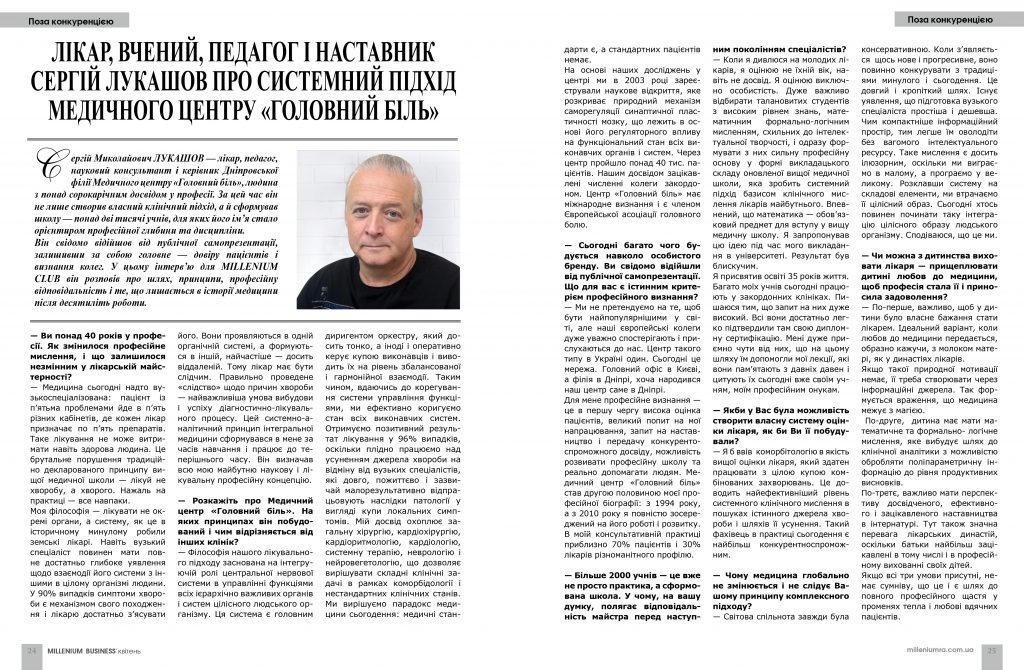
Сергій Миколайович ЛУКАШОВ — лікар, педагог, науковий консультант і керівник Дніпровської філії Медичного центру «Головний біль», людина з понад сорокарічним досвідом у професії. За цей час він не лише створив власний клінічний підхід, а й сформував школу — понад дві тисячі учнів, для яких його ім’я стало орієнтиром професійної глибини та дисципліни.
Він свідомо відійшов від публічної самопрезентації, залишивши за собою головне — довіру пацієнтів і визнання колег. У цьому інтерв’ю для MILLENIUM CLUB він розповів про шлях, принципи, професійну відповідальність і те, що лишається в історії медицини після десятиліть роботи.
— Ви понад 40 років у професії. Як змінилося професійне мислення, і що залишилося незмінним у лікарській майстерності?
— Медицина сьогодні надто вузькоспеціалізована: пацієнт із п’ятьма проблемами йде в п’ять різних кабінетів, де кожен лікар призначає по п’ять препаратів. Таке лікування не може витримати навіть здорова людина. Це брутальне порушення традиційно декларованого принципу вищої медичної школи — лікуй не хворобу, а хворого. Нажаль на практиці — все навпаки.
Моя філософія — лікувати не окремі органи, а систему, як це в історичному минулому робили земські лікарі. Навіть вузький спеціаліст повинен мати повне достатньо глибоке уявлення щодо взаємодії його системи з іншими в цілому організмі людини. У 90% випадків симптоми хвороби є механізмом свого походження і лікарю достатньо з’ясувати його. Вони проявляються в одній органічній системі, а формуються в іншій, найчастіше — досить віддаленій. Тому лікар має бути слідчим. Правильно проведене «слідство» щодо причин хвороби — найважливіша умова вибудови і успіху діагностично-лікувального процесу. Цей системно-аналітичний принцип інтегральної медицини сформувався в мене за часів навчання і працює до теперішнього часу. Він визначав всю мою майбутню наукову і лікувальну професійну концепцію.
— Розкажіть про Медичний центр «Головний біль». На яких принципах він побудований і чим відрізняється від інших клінік?
— Філософія нашого лікувального підходу заснована на інтегруючій ролі центральної нервової системи в управлінні функціями всіх ієрархічно важливих органів і систем цілісного людського організму. Ця система є головним диригентом оркестру, який досить тонко, а іноді і оперативно керує купою виконавців і виводить їх на рівень збалансованої і гармонійної взаємодії. Таким чином, вдаючись до корегування системи управління функціями, ми ефективно коригуємо стан всіх виконавчих систем. Отримуємо позитивний результат лікування у 96% випадків, оскільки плідно працюємо над усуненням джерела хвороби на відміну від вузьких спеціалістів, які довго, пожиттєво і зазвичай малорезультативно відпрацьовують наслідки патології у вигляді купи локальних симптомів. Мій досвід охоплює загальну хірургію, кардіохірургію, кардіоритмологію, кардіологію, системну терапію, неврологію і нейровегетологію, що дозволяє вирішувати складні клінічні задачі в рамках коморбідології і нестандартних клінічних станів. Ми вирішуємо парадокс медицини сьогодення: медичні стандарти є, а стандартних пацієнтів немає.
На основі наших досліджень у центрі ми в 2003 році зареєстрували наукове відкриття, яке розкриває природний механізм саморегуляції синаптичної пластичності мозку, що лежить в основі його регуляторного впливу на функціональний стан всіх виконавчих органів і систем. Через центр пройшло понад 40 тис. пацієнтів. Нашим досвідом зацікавлені численні колеги закордоном. Центр «Головний біль» має міжнародне визнання і є членом Європейської асоціації головного болю.
— Сьогодні багато чого будується навколо особистого бренду. Ви свідомо відійшли від публічної самопрезентації. Що для вас є істинним критерієм професійного визнання?
— Ми не претендуємо на те, щоб бути найпопулярнішими у світі, але наші європейські колеги дуже уважно спостерігають і прислухаються до нас. Центр такого типу в Україні один. Сьогодні це мережа. Головний офіс в Києві, а філія в Дніпрі, хоча народився наш центр саме в Дніпрі.
Для мене професійне визнання — це в першу чергу висока оцінка пацієнтів, великий попит на мої напрацювання, запит на наставництво і передачу конкурентоспроможного досвіду, можливість розвивати професійну школу та реально допомагати людям. Медичний центр «Головний біль» став другою половиною моєї професійної біографії: з 1994 року, а з 2010 року я повністю зосереджений на його роботі і розвитку. В моїй консультативній практиці приблизно 70% пацієнтів і 30% лікарів різноманітного профілю.
— Більше 2000 учнів — це вже не просто практика, а сформована школа. У чому, на вашу думку, полягає відповідальність майстра перед наступним поколінням спеціалістів?
— Коли я дивлюся на молодих лікарів, я оцінюю не їхній вік, навіть не досвід. Я оцінюю виключно особистість. Дуже важливо відбирати талановитих студентів з високим рівнем знань, математичним формально-логічним мисленням, схильних до інтелектуальної творчості, і одразу формувати з них сильну професійну основу у формі викладацького складу оновленої вищої медичної школи, яка зробить системний підхід базисом клінічного мислення лікарів майбутнього. Впевнений, що математика — обов’язковий предмет для вступу у вищу медичну школу. Я запропонував цю ідею під час мого викладання в університеті. Результат був блискучим.
Я присвятив освіті 35 років життя. Багато моїх учнів сьогодні працюють у закордонних клініках. Пишаюся тим, що запит на них дуже високий. Всі вони достатньо легко підтвердили там свою дипломну сертифікацію. Мені дуже приємно чути від них, що на цьому шляху їм допомогли мої лекції, які вони пам’ятають з давніх давен і цитують їх сьогодні вже своїм учням, моїм професійним онукам.
— Якби у Вас була можливість створити власну систему оцінки лікаря, як би Ви її побудували?
— Я б ввів коморбітологію в якість вищої оцінки лікаря, який здатен працювати з цілою купою комбінованих захворювань. Це доводить найефективніший рівень системного клінічного мислення в пошуках істинного джерела хвороби і шляхів її усунення. Такий фахівець в практиці сьогодення є найбільш конкурентноспроможним.
— Чому медицина глобально не змінюється і не слідує Вашому принципу комплексного підходу?
— Світова спільнота завжди була консервативною. Коли з’являється щось нове і прогресивне, воно повинно конкурувати з традиціями минулого і сьогодення. Це довгий і кропіткий шлях. Існує уявлення, що підготовка вузького спеціаліста простіша і дешевша. Чим компактніше інформаційний простір, тим легше їм оволодіти без вагомого інтелектуального ресурсу. Таке мислення є досить ілюзорним, оскільки ми виграємо в малому, а програємо у великому. Розклавши систему на складові елементи, ми втрачаємо її цілісний образ. Сьогодні хтось повинен починати таку інтеграцію цілісного образу людського організму. Сподіваюся, що це ми.
— Чи можна з дитинства виховати лікаря — прищеплювати дитині любов до медицини, щоб професія стала її і приносила задоволення?
— По-перше, важливо, щоб у дитини було власне бажання стати лікарем. Ідеальний варіант, коли любов до медицини передається, образно кажучи, з молоком матері, як у династіях лікарів.
Якщо такої природної мотивації немає, її треба створювати через інформаційні джерела. Так формується враження, що медицина межує з магією.
По-друге, дитина має мати математичне та формально- логічне мислення, яке вибудує шлях до клінічної аналітики з можливістю обробляти поліпараметричну інформацію до рівня продуктивних висновків.
По-третє, важливо мати перспективу досвідченого, ефективного і зацікавленого наставництва в інтернатурі. Тут також значна перевага лікарських династій, оскільки батьки найбільш зацікавлені в тому числі і в професійному вихованні своїх дітей.
Якщо всі три умови присутні, немає сумніву, що це і є шлях до повного професійного щастя у променях тепла і любові вдячних пацієнтів.
Doctor, Scientist, Educator and Mentor Serhii Lukashov on the Systemic Approach of the Medical Center “Headache”
Serhii Mykolaiovych LUKASHOV is a physician, educator, scientific consultant, and Head of the Dnipro branch of the Medical Center “Headache,” a professional with more than forty years of experience in the field. Over this time, he has not only developed his own clinical approach but has also established a professional school — more than two thousand students for whom his name has become a benchmark of professional depth and discipline.
He consciously stepped away from public self-promotion, leaving behind what matters most — the trust of his patients and the recognition of his colleagues. In this interview for MILLENIUM CLUB, he speaks about his professional journey, core principles, responsibility in medicine, and what remains in the history of healthcare after decades of dedicated work.
— You have been in the profession for more than 40 years. How has professional thinking changed, and what has remained unchanged in medical mastery?
— Medicine today has become excessively specialized: a patient with five problems goes to five different offices, where each doctor prescribes five medications. Such treatment can hardly be tolerated even by a healthy person. This is a грубe violation of the traditionally declared principle of classical medical education — treat the patient, not the disease. Unfortunately, in practice, the opposite often happens.
My philosophy is to treat not individual organs, but the system as a whole, much like the historical tradition of community physicians once did. Even a narrow specialist must have a sufficiently deep understanding of how their specific system interacts with others within the human body. In 90% of cases, the symptoms of a disease are mechanisms of its origin, and it is the physician’s task to identify that mechanism. Symptoms may manifest in one organ system while being formed in another, often quite distant one. Therefore, a doctor must be an investigator. A properly conducted “investigation” into the causes of disease is the most important condition for building an effective diagnostic and treatment process. This systemic analytical principle of integral medicine was formed during my years of study and continues to guide my scientific and clinical philosophy to this day.
— Tell us about the Medical Center “Headache.” What principles is it built upon, and how does it differ from other clinics?
— The philosophy of our treatment approach is based on the integrating role of the central nervous system in managing the functions of all hierarchically important organs and systems of the human body. This system acts as the chief conductor of an orchestra, skillfully coordinating numerous performers and bringing them into balanced and harmonious interaction.
By adjusting the regulatory system that controls bodily functions, we can effectively influence the condition of all functional systems. As a result, we achieve positive treatment outcomes in approximately 96% of cases because we focus on eliminating the source of the disease rather than merely managing its consequences in the form of multiple local symptoms — a practice often seen in highly specialized medicine.
My professional experience includes general surgery, cardiac surgery, cardiac rhythmology, cardiology, systemic therapy, neurology, and neurovegetology, which allows us to address complex clinical challenges in the field of comorbidity and non-standard clinical conditions.
We solve a paradox of modern medicine: medical standards exist, but standard patients do not.
Based on our research, in 2003 our center registered a scientific discovery that reveals the natural mechanism of self-regulation of synaptic plasticity in the brain — the mechanism underlying its regulatory influence on the functional state of all organs and systems. More than 40,000 patients have been treated at our center. Our experience has attracted significant interest from colleagues abroad. The “Headache” Medical Center has received international recognition and is a member of the European Headache Federation.
— Today, much attention is focused on personal branding. You consciously stepped away from public self-presentation. What do you consider the true criterion of professional recognition?
— We do not strive to be the most popular in the world, but our European colleagues observe and listen to us very carefully. There is only one center of this type in Ukraine. Today, it has grown into a network. The main office is located in Kyiv, with a branch in Dnipro, although the center itself was originally founded in Dnipro.
For me, professional recognition is, first and foremost, the high appreciation of patients, strong demand for my professional developments, requests for mentorship and knowledge transfer, and the opportunity to build a professional school and genuinely help people. The Medical Center “Headache” has become the second half of my professional biography: I have been working with it since 1994, and since 2010 I have been fully focused on its development. In my consulting practice, approximately 70% of clients are patients and 30% are physicians from various medical specialties.
— More than 2,000 students represent not just experience, but an established professional school. In your opinion, what responsibility does a master bear toward the next generation of specialists?
— When I look at young doctors, I evaluate not their age, and not even their experience. I evaluate their personality. It is extremely important to select talented students with a high level of knowledge, mathematical and formal-logical thinking, and a natural inclination toward intellectual creativity, and then immediately build a strong professional foundation for them within the faculty of a renewed medical education system. This system should make the systemic approach the basis of clinical thinking for future physicians.
I am convinced that mathematics should be a mandatory subject for admission to medical school. I proposed this idea during my teaching years at the university, and the results were excellent.
I devoted 35 years of my life to education. Many of my students now work in clinics abroad. I am proud that the demand for them is very high. They have successfully confirmed their professional certification internationally. It is especially rewarding to hear from them that my lectures, which they remember from many years ago, helped them on their professional journey — and that today they quote those lectures to their own students, my professional grandchildren.
— If you had the opportunity to create your own system for evaluating physicians, how would you design it?
— I would introduce comorbidity medicine as the highest criterion for evaluating a physician — the ability to work effectively with multiple combined diseases. This demonstrates the highest level of systemic clinical thinking in identifying the true source of illness and determining the most effective path to treatment. Such a specialist is the most competitive professional in modern medical practice.
— Why does medicine globally change so slowly and not fully follow the principle of a comprehensive systemic approach?
— The global professional community has always been conservative. Whenever something new and progressive appears, it must compete with established traditions of the past and present. This is a long and demanding process. There is a widespread belief that training a narrow specialist is simpler and less expensive. The more compact the information field, the easier it is to master without significant intellectual effort.
However, this thinking is somewhat illusory: we gain in the small but lose in the larger picture. By dividing the system into separate elements, we lose its holistic image. Today, someone must begin integrating the complete picture of the human organism. I hope that we will be the ones to do so.
— Is it possible to cultivate a future doctor from childhood — to instill a love for medicine so that the profession becomes a true calling and brings satisfaction?
— First, it is important that a child genuinely wants to become a doctor. The ideal situation is when love for medicine is passed down, figuratively speaking, with a mother’s milk, as in medical families.
If such natural motivation is absent, it can be developed through information and inspiration. This helps create the impression that medicine borders on something almost magical.
Second, a child should possess mathematical and formal-logical thinking, which builds the path toward clinical analytics and the ability to process complex multi-parameter information into meaningful conclusions.
Third, it is essential to have the guidance of an experienced, effective, and dedicated mentor during internship training. Here again, medical families often have an advantage, as parents are deeply invested in the professional development of their children.
If all three conditions are present, there is no doubt that this is the path to true professional fulfillment — in the warmth and gratitude of thankful patients.