
Людмила МОРОККО — директорка Дніпровської гімназії №6, педагогиня з багаторічним досвідом управління та розвитку освітнього закладу.
Сьогодні під її керівництвом гімназія поєднує сучасні освітні підходи, інклюзивну модель навчання, волонтерську діяльність і глибоко збережені шкільні традиції.
В інтерв’ю для MILLENIUM CLUB Людмила Морокко розповіла про свій професійний внесок, формування колективу та принципи лідерства.
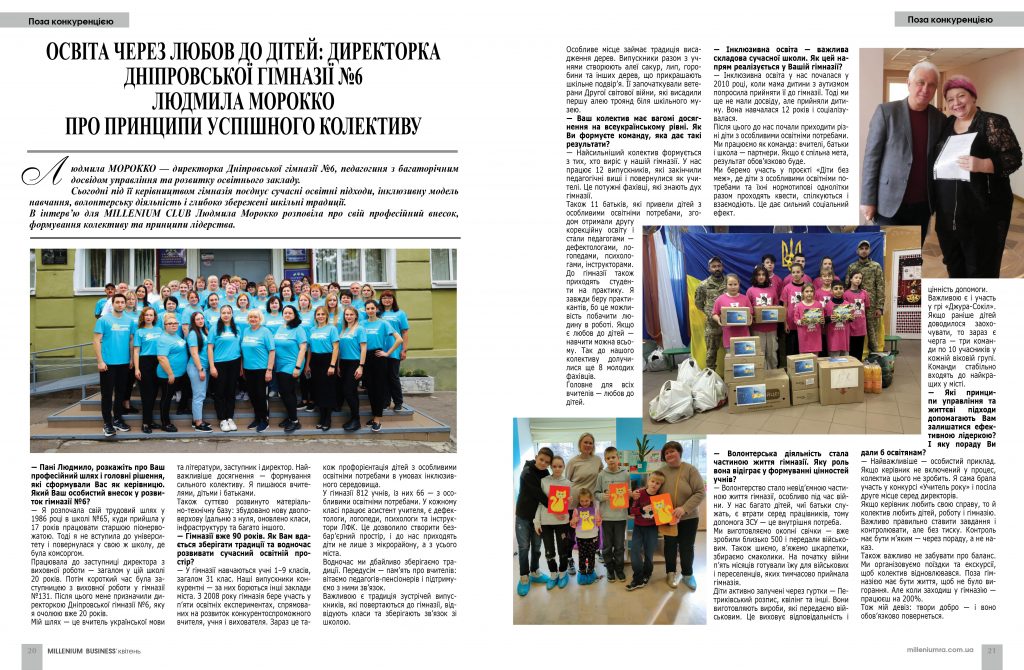
— Пані Людмило, розкажіть про Ваш професійний шлях і головні рішення, які сформували Вас як керівницю. Який Ваш особистий внесок у розвиток гімназії №6?
— Я розпочала свій трудовий шлях у 1986 році в школі №65, куди прийшла у 17 років працювати старшою піонервожатою. Тоді я не вступила до університету і повернулася у свою ж школу, де була комсоргом.
Працювала до заступниці директора з виховної роботи — загалом у цій школі 20 років. Потім короткий час була заступницею з виховної роботи у гімназії №131. Після цього мене призначили директоркою Дніпровської гімназії №6, яку я очолюю вже 20 років.
Мій шлях — це вчитель української мови та літератури, заступник і директор. Найважливіше досягнення — формування сильного колективу. Я пишаюся вчителями, дітьми і батьками.
Також суттєво розвинуто матеріально-технічну базу: збудовано нову двоповерхову їдальню з нуля, оновлено класи, інфраструктуру та багато іншого.
— Гімназії вже 90 років. Як Вам вдається зберігати традиції та водночас розвивати сучасний освітній простір?
— У гімназії навчаються учні 1–9 класів, загалом 31 клас. Наші випускники конкурентні — за них борються інші заклади міста. З 2008 року гімназія бере участь у п’яти освітніх експериментах, спрямованих на розвиток конкурентоспроможного вчителя, учня і вихователя. Зараз це також профорієнтація дітей з особливими освітніми потребами в умовах інклюзивного середовища.
У гімназії 812 учнів, із них 66 — з особливими освітніми потребами. У кожному класі працює асистент учителя, є дефектологи, логопеди, психологи та інструктори ЛФК. Це дозволило створити безбар’єрний простір, і до нас приходять діти не лише з мікрорайону, а з усього міста.
Водночас ми дбайливо зберігаємо традиції. Передусім — пам’ять про вчителів: вітаємо педагогів-пенсіонерів і підтримуємо з ними зв’язок.
Важливою є традиція зустрічей випускників, які повертаються до гімназії, відвідують класи та зберігають зв’язок зі школою.
Особливе місце займає традиція висадження дерев. Випускники разом з учнями створюють алеї сакур, лип, горобини та інших дерев, що прикрашають шкільне подвір’я. Її започаткували ветерани Другої світової війни, які висадили першу алею троянд біля шкільного музею.
— Ваш колектив має вагомі досягнення на всеукраїнському рівні. Як Ви формуєте команду, яка дає такі результати?
— Найсильніший колектив формується з тих, хто виріс у нашій гімназії. У нас працює 12 випускників, які закінчили педагогічні виші і повернулися як учителі. Це потужні фахівці, які знають дух гімназії.
Також 11 батьків, які привели дітей з особливими освітніми потребами, згодом отримали другу корекційну освіту і стали педагогами — дефектологами, логопедами, психологами, інструкторами.
До гімназії також приходять студенти на практику. Я завжди беру практикантів, бо це можливість побачити людину в роботі. Якщо є любов до дітей — навчити можна всьому. Так до нашого колективу долучилися ще 8 молодих фахівців.
Головне для всіх вчителів — любов до дітей.
— Інклюзивна освіта — важлива складова сучасної школи. Як цей напрям реалізується у Вашій гімназії?
— Інклюзивна освіта у нас почалася у 2010 році, коли мама дитини з аутизмом попросила прийняти її до гімназії. Тоді ми ще не мали досвіду, але прийняли дитину. Вона навчалася 12 років і соціалізувалася.
Після цього до нас почали приходити різні діти з особливими освітніми потребами. Ми працюємо як команда: вчителі, батьки і школа — партнери. Якщо є спільна мета, результат обов’язково буде.
Ми беремо участь у проєкті «Діти без меж», де діти з особливими освітніми потребами та їхні нормотипові однолітки разом проходять квести, спілкуються і взаємодіють. Це дає сильний соціальний ефект.
— Волонтерська діяльність стала частиною життя гімназії. Яку роль вона відіграє у формуванні цінностей учнів?
— Волонтерство стало невід’ємною частиною життя гімназії, особливо під час війни. У нас багато дітей, чиї батьки служать, є втрати серед працівників, тому допомога ЗСУ — це внутрішня потреба.
Ми виготовляємо окопні свічки — вже зробили близько 500 і передали військовим. Також шиємо, в’яжемо шкарпетки, збираємо смаколики. На початку війни п’ять місяців готували їжу для військових і переселенців, яких тимчасово приймала гімназія.
Діти активно залучені через гуртки — Петриківський розпис, квілінг та інші. Вони виготовляють вироби, які передаємо військовим. Це виховує відповідальність і цінність допомоги.
Важливою є і участь у грі «Джура-Сокіл». Якщо раніше дітей доводилося заохочувати, то зараз є черга — три команди по 10 учасників у кожній віковій групі. Команди стабільно входять до найкращих у місті.
— Які принципи управління та життєві підходи допомагають Вам залишатися ефективною лідеркою? І яку пораду Ви дали б освітянам?
— Найважливіше — особистий приклад. Якщо керівник не включений у процес, колектиа цього не зробить. Я сама брала участь у конкурсі «Учитель року» і посіла друге місце серед директорів.
Якщо керівник любить свою справу, то й колектив любить дітей, роботу і гімназію. Важливо правильно ставити завдання і контролювати, але без тиску. Контроль має бути м’яким — через пораду, а не наказ.
Також важливо не забувати про баланс. Ми організовуємо поїздки та екскурсії, щоб колектив відновлювався. Поза гімназією має бути життя, щоб не було вигорання. Але коли заходиш у гімназію — працюєш на 200%.
Тож мій девіз: твори добро — і воно обов’язково повернеться.
Education Through Love for Children: Principal of Dnipro Gymnasium No. 6 Liudmyla Morokko
on the Principles of a Successful Team
Liudmyla MOROKKO is the Principal of Dnipro Gymnasium No. 6, an educator with many years of experience in managing and developing an educational institution. Today, under her leadership, the gymnasium combines modern educational approaches, an inclusive learning model, volunteer initiatives, and carefully preserved school traditions.
In an interview for MILLENIUM CLUB, Liudmyla Morokko spoke about her professional contribution, team building, and the principles of effective leadership.
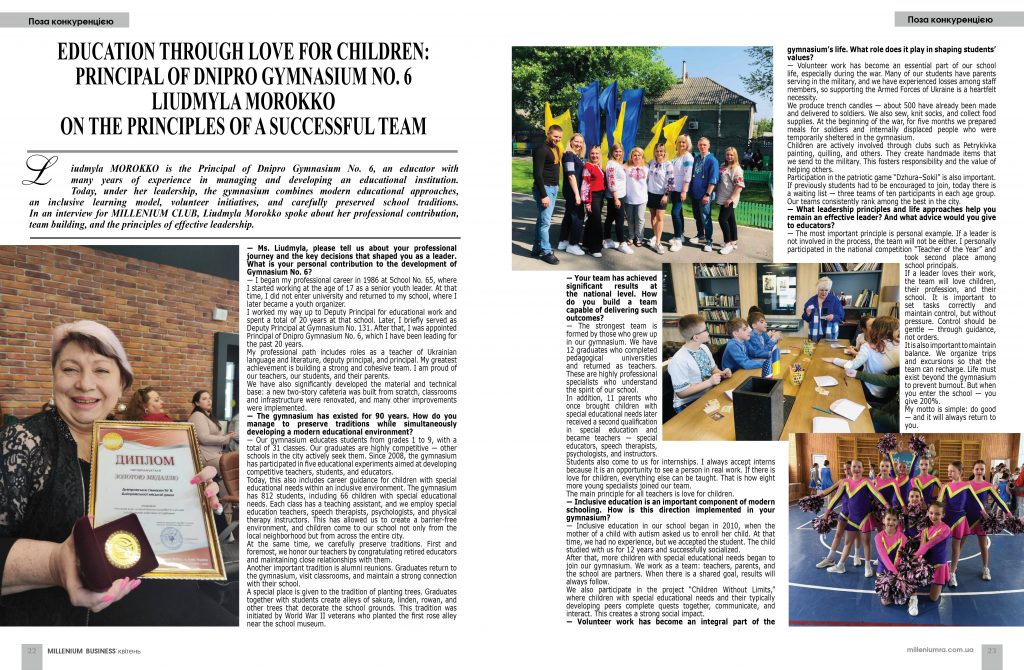
— Ms. Liudmyla, please tell us about your professional journey and the key decisions that shaped you as a leader. What is your personal contribution to the development of Gymnasium No. 6?
— I began my professional career in 1986 at School No. 65, where I started working at the age of 17 as a senior youth leader. At that time, I did not enter university and returned to my school, where I later became a youth organizer.
I worked my way up to Deputy Principal for educational work and spent a total of 20 years at that school. Later, I briefly served as Deputy Principal at Gymnasium No. 131. After that, I was appointed Principal of Dnipro Gymnasium No. 6, which I have been leading for the past 20 years.
My professional path includes roles as a teacher of Ukrainian language and literature, deputy principal, and principal. My greatest achievement is building a strong and cohesive team. I am proud of our teachers, our students, and their parents.
We have also significantly developed the material and technical base: a new two-story cafeteria was built from scratch, classrooms and infrastructure were renovated, and many other improvements were implemented.
— The gymnasium has existed for 90 years. How do you manage to preserve traditions while simultaneously developing a modern educational environment?
— Our gymnasium educates students from grades 1 to 9, with a total of 31 classes. Our graduates are highly competitive — other schools in the city actively seek them. Since 2008, the gymnasium has participated in five educational experiments aimed at developing competitive teachers, students, and educators.
Today, this also includes career guidance for children with special educational needs within an inclusive environment. The gymnasium has 812 students, including 66 children with special educational needs. Each class has a teaching assistant, and we employ special education teachers, speech therapists, psychologists, and physical therapy instructors. This has allowed us to create a barrier-free environment, and children come to our school not only from the local neighborhood but from across the entire city.
At the same time, we carefully preserve traditions. First and foremost, we honor our teachers by congratulating retired educators and maintaining close relationships with them.
Another important tradition is alumni reunions. Graduates return to the gymnasium, visit classrooms, and maintain a strong connection with their school.
A special place is given to the tradition of planting trees. Graduates together with students create alleys of sakura, linden, rowan, and other trees that decorate the school grounds. This tradition was initiated by World War II veterans who planted the first rose alley near the school museum.
— Your team has achieved significant results at the national level. How do you build a team capable of delivering such outcomes?
— The strongest team is formed by those who grew up in our gymnasium. We have 12 graduates who completed pedagogical universities and returned as teachers. These are highly professional specialists who understand the spirit of our school.
In addition, 11 parents who once brought children with special educational needs later received a second qualification in special education and became teachers — special educators, speech therapists, psychologists, and instructors.
Students also come to us for internships. I always accept interns because it is an opportunity to see a person in real work. If there is love for children, everything else can be taught. That is how eight more young specialists joined our team.
The main principle for all teachers is love for children.
— Inclusive education is an important component of modern schooling. How is this direction implemented in your gymnasium?
— Inclusive education in our school began in 2010, when the mother of a child with autism asked us to enroll her child. At that time, we had no experience, but we accepted the student. The child studied with us for 12 years and successfully socialized.
After that, more children with special educational needs began to join our gymnasium. We work as a team: teachers, parents, and the school are partners. When there is a shared goal, results will always follow.
We also participate in the project “Children Without Limits,” where children with special educational needs and their typically developing peers complete quests together, communicate, and interact. This creates a strong social impact.
— Volunteer work has become an integral part of the gymnasium’s life. What role does it play in shaping students’ values?
— Volunteer work has become an essential part of our school life, especially during the war. Many of our students have parents serving in the military, and we have experienced losses among staff members, so supporting the Armed Forces of Ukraine is a heartfelt necessity.
We produce trench candles — about 500 have already been made and delivered to soldiers. We also sew, knit socks, and collect food supplies. At the beginning of the war, for five months we prepared meals for soldiers and internally displaced people who were temporarily sheltered in the gymnasium.
Children are actively involved through clubs such as Petrykivka painting, quilling, and others. They create handmade items that we send to the military. This fosters responsibility and the value of helping others.
Participation in the patriotic game “Dzhura–Sokil” is also important. If previously students had to be encouraged to join, today there is a waiting list — three teams of ten participants in each age group. Our teams consistently rank among the best in the city.
— What leadership principles and life approaches help you remain an effective leader? And what advice would you give to educators?
— The most important principle is personal example. If a leader is not involved in the process, the team will not be either. I personally participated in the national competition “Teacher of the Year” and took second place among school principals.
If a leader loves their work, the team will love children, their profession, and their school. It is important to set tasks correctly and maintain control, but without pressure. Control should be gentle — through guidance, not orders.
It is also important to maintain balance. We organize trips and excursions so that the team can recharge. Life must exist beyond the gymnasium to prevent burnout. But when you enter the school — you give 200%.
My motto is simple: do good — and it will always return to you.