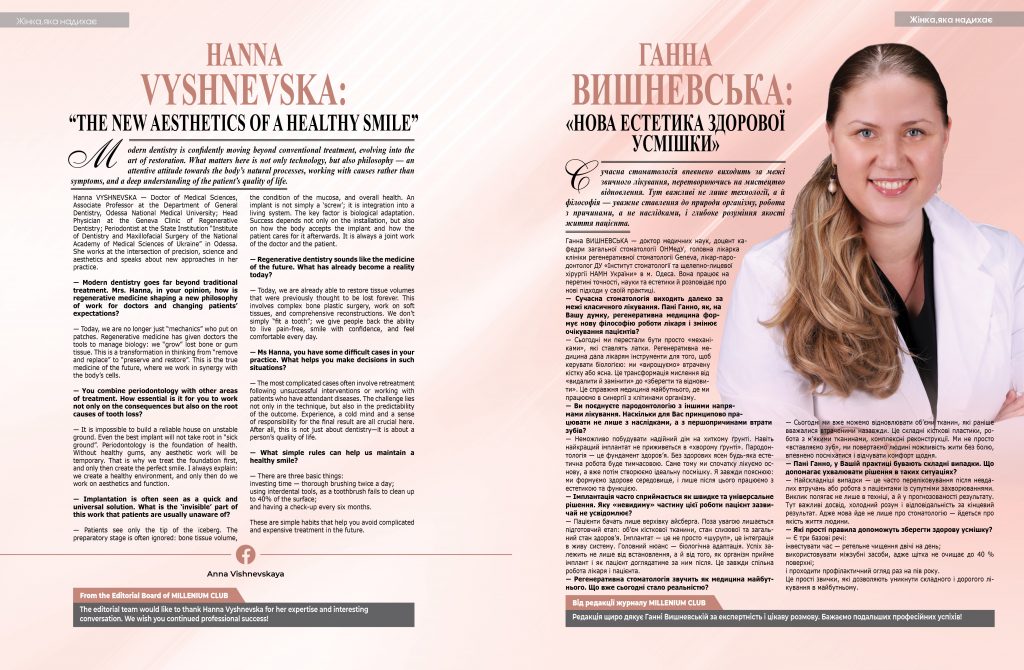
Cучасна стоматологія впевнено виходить за межі звичного лікування, перетворюючись на мистецтво відновлення. Тут важливі не лише технології, а й філософія — уважне ставлення до природи організму, робота з причинами, а не наслідками, і глибоке розуміння якості життя пацієнта.
Ганна ВИШНЕВСЬКА — доктор медичних наук, доцент кафедри загальної стоматології ОНМедУ, головна лікарка клініки регенеративної стоматології Geneva, лікар-пародонтолог ДУ «Інститут стоматології та щелепно-лицевої хірургії НАМН України» в м. Одеса. Вона працює на перетині точності, науки та естетики й розповідає про нові підходи у своїй практиці.
— Сучасна стоматологія виходить далеко за межі класичного лікування. Пані Ганно, як, на Вашу думку, регенеративна медицина формує нову філософію роботи лікаря і змінює очікування пацієнтів?
— Сьогодні ми перестали бути просто «механіками», які ставлять латки. Регенеративна медицина дала лікарям інструменти для того, щоб керувати біологією: ми «вирощуємо» втрачену кістку або ясна. Це трансформація мислення від «видалити й замінити» до «зберегти та відновити». Це справжня медицина майбутнього, де ми працюємо в синергії з клітинами організму.
— Ви поєднуєте пародонтологію з іншими напрямами лікування. Наскільки для Вас принципово працювати не лише з наслідками, а з першопричинами втрати зубів?
— Неможливо побудувати надійний дім на хиткому ґрунті. Навіть найкращий імплантат не приживеться в «хворому ґрунті». Пародонтологія — це фундамент здоров’я. Без здорових ясен будь-яка естетична робота буде тимчасовою. Саме тому ми спочатку лікуємо основу, а вже потім створюємо ідеальну посмішку. Я завжди пояснюю: ми формуємо здорове середовище, і лише після цього працюємо з естетикою та функцією.
— Імплантація часто сприймається як швидке та універсальне рішення. Яку «невидиму» частину цієї роботи пацієнт зазвичай не усвідомлює?
— Пацієнти бачать лише верхівку айсберга. Поза увагою лишається підготовчий етап: об’єм кісткової тканини, стан слизової та загальний стан здоров’я. Імплантат — це не просто «шуруп», це інтеграція в живу систему. Головний нюанс — біологічна адаптація. Успіх залежить не лише від встановлення, а й від того, як організм прийме імплант і як пацієнт доглядатиме за ним після. Це завжди спільна робота лікаря і пацієнта.
— Регенеративна стоматологія звучить як медицина майбутнього. Що вже сьогодні стало реальністю?
— Сьогодні ми вже можемо відновлювати об’єми тканин, які раніше вважалися втраченими назавжди. Це складні кісткові пластики, робота з м’якими тканинами, комплексні реконструкції. Ми не просто «вставляємо зуб», ми повертаємо людині можливість жити без болю, впевнено посміхатися і відчувати комфорт щодня.
— Пані Ганно, у Вашій практиці бувають складні випадки. Що допомагає ухвалювати рішення в таких ситуаціях?
— Найскладніші випадки — це часто переліковування після невдалих втручань або робота з пацієнтами із супутніми захворюваннями. Виклик полягає не лише в техніці, а й у прогнозованості результату. Тут важливі досвід, холодний розум і відповідальність за кінцевий результат. Адже мова йде не лише про стоматологію — йдеться про якість життя людини.
— Які прості правила допоможуть зберегти здорову усмішку?
— Є три базові речі:
інвестувати час — ретельне чищення двічі на день;
використовувати міжзубні засоби, адже щітка не очищає до 40 % поверхні;
і проходити профілактичний огляд раз на пів року.
Це прості звички, які дозволяють уникнути складного і дорогого лікування в майбутньому.
HANNA VYSHNEVSKA: “The New Aesthetics of a Healthy Smile”
Modern dentistry is confidently moving beyond conventional treatment, evolving into the art of restoration. What matters here is not only technology, but also philosophy — an attentive attitude towards the body’s natural processes, working with causes rather than symptoms, and a deep understanding of the patient’s quality of life.
Hanna VYSHNEVSKA — Doctor of Medical Sciences, Associate Professor at the Department of General Dentistry, Odessa National Medical University; Head Physician at the Geneva Clinic of Regenerative Dentistry; Periodontist at the State Institution “Institute of Dentistry and Maxillofacial Surgery of the National Academy of Medical Sciences of Ukraine” in Odessa. She works at the intersection of precision, science and aesthetics and speaks about new approaches in her practice.
— Modern dentistry goes far beyond traditional treatment. Mrs. Hanna, in your opinion, how is regenerative medicine shaping a new philosophy of work for doctors and changing patients’ expectations?
— Today, we are no longer just “mechanics” who put on patches. Regenerative medicine has given doctors the tools to manage biology: we “grow” lost bone or gum tissue. This is a transformation in thinking from “remove and replace” to “preserve and restore”. This is the true medicine of the future, where we work in synergy with the body’s cells.
— You combine periodontology with other areas of treatment. How essential is it for you to work not only on the consequences but also on the root causes of tooth loss?
— It is impossible to build a reliable house on unstable ground. Even the best implant will not take root in “sick ground”. Periodontology is the foundation of health. Without healthy gums, any aesthetic work will be temporary. That is why we treat the foundation first, and only then create the perfect smile. I always explain: we create a healthy environment, and only then do we work on aesthetics and function.
— Implantation is often seen as a quick and universal solution. What is the ‘invisible’ part of this work that patients are usually unaware of?
— Patients see only the tip of the iceberg. The preparatory stage is often ignored: bone tissue volume, the condition of the mucosa, and overall health. An implant is not simply a ‘screw’; it is integration into a living system. The key factor is biological adaptation. Success depends not only on the installation, but also on how the body accepts the implant and how the patient cares for it afterwards. It is always a joint work of the doctor and the patient.
— Regenerative dentistry sounds like the medicine of the future. What has already become a reality today?
— Today, we are already able to restore tissue volumes that were previously thought to be lost forever. This involves complex bone plastic surgery, work on soft tissues, and comprehensive reconstructions. We don’t simply “fit a tooth”; we give people back the ability to live pain-free, smile with confidence, and feel comfortable every day.
— Ms Hanna, you have some difficult cases in your practice. What helps you make decisions in such situations?
— The most complicated cases often involve retreatment following unsuccessful interventions or working with patients who have attendant diseases. The challenge lies not only in the technique, but also in the predictability of the outcome. Experience, a cold mind and a sense of responsibility for the final result are all crucial here. After all, this is not just about dentistry—it is about a person’s quality of life.
— What simple rules can help us maintain a healthy smile?
— There are three basic things:
investing time — thorough brushing twice a day;
using interdental tools, as a toothbrush fails to clean up to 40% of the surface;
and having a check-up every six months.
These are simple habits that help you avoid complicated and expensive treatment in the future.