
Онкохірург із десятиліттями практики, доктор медичних наук Олександр СУХОВЕРША переконаний: сучасна медицина неможлива без психології, довіри та внутрішньої опори лікаря. Він — один із провідних фахівців з онкопульмонології в Україні та голова мультидисциплінарної онкологічної комісії МКЛ № 4 у Дніпрі.
В інтерв’ю для MILLENIUM CLUB пан Олександр розповів про сім’ю, усвідомленість і відповідальність.
— Пане Олександре, як Ви прийшли в медицину і чому обрали саме онкологію?
— Мій батько був хірургом — дуже порядною і чуйною людиною. Я з дитинства бачив, як він працював день і ніч, як допомагав людям. Це сформувало моє ставлення до життя. Я знав, що буду хірургом.
Онкологія з’явилася пізніше — як усвідомлений вибір. Це складна сфера, але тут усе по-чесному: або ти професіонал і відповідаєш за результат, або ні.
— Ви багато років у професії. Чому, попри великий досвід, Ви звернулися до психології і транзакційного аналізу?
— Кожен лікар, особливо онколог і хірург, щодня має величезне психологічне навантаження. Психологія, як і хірургія, — це фах, якому потрібно навчатися.
Кожен пацієнт приходить не лише з діагнозом, а й з болем, страхом, відчаєм. Важливо навчитися правильно це приймати — не переносити на родину, не вигоряти. Для мене транзакційний аналіз — спосіб навести лад у собі: у думках, у почуттях, у внутрішніх станах.
— Як психологія вплинула на Ваше особисте життя і родину?
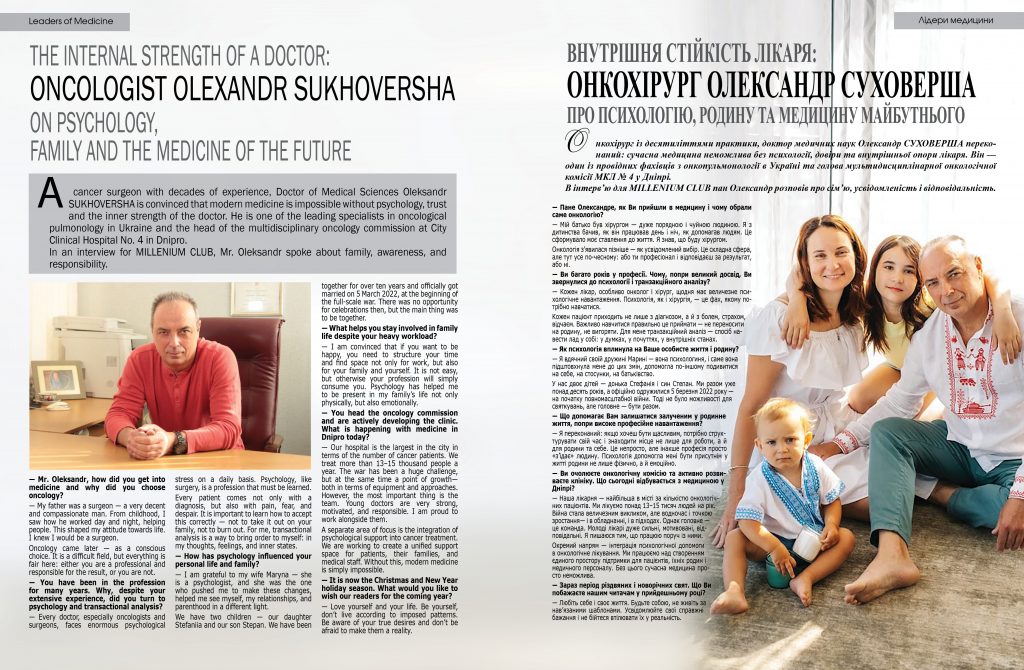
— Я вдячний своїй дружині Марині — вона психологиня, і саме вона підштовхнула мене до цих змін, допомогла по-іншому подивитися на себе, на стосунки, на батьківство.
У нас двоє дітей — донька Стефанія і син Степан. Ми разом уже понад десять років, а офіційно одружилися 5 березня 2022 року — на початку повномасштабної війни. Тоді не було можливості для святкувань, але головне — бути разом.
— Що допомагає Вам залишатися залученим у родинне життя, попри високе професійне навантаження?
— Я переконаний: якщо хочеш бути щасливим, потрібно структурувати свій час і знаходити місце не лише для роботи, а й для родини та себе. Це непросто, але інакше професія просто «з’їдає» людину. Психологія допомогла мені бути присутнім у житті родини не лише фізично, а й емоційно.
— Ви очолюєте онкологічну комісію та активно розвиваєте клініку. Що сьогодні відбувається з медициною у Дніпрі?
— Наша лікарня — найбільша в місті за кількістю онкологічних пацієнтів. Ми лікуємо понад 13–15 тисяч людей на рік. Війна стала величезним викликом, але водночас і точкою зростання— і в обладнанні, і в підходах. Однак головне — це команда. Молоді лікарі дуже сильні, мотивовані, відповідальні. Я пишаюся тим, що працюю поруч із ними.
Окремий напрям — інтеграція психологічної допомоги в онкологічне лікування. Ми працюємо над створенням єдиного простору підтримки для пацієнтів, їхніх родин і медичного персоналу. Без цього сучасна медицина просто неможлива.
— Зараз період різдвяних і новорічних свят. Що Ви побажаєте нашим читачам у прийдешньому році?
— Любіть себе і своє життя. Будьте собою, не живіть за нав’язаними шаблонами. Усвідомлюйте свої справжні бажання і не бійтеся втілювати їх у реальність.
THE INTERNAL STRENGTH OF A DOCTOR: ONCOLOGIST OLEXANDR SUKHOVERSHA ON PSYCHOLOGY, FAMILY AND THE MEDICINE OF THE FUTURE
Аcancer surgeon with decades of experience, Doctor of Medical Sciences Oleksandr SUKHOVERSHA is convinced that modern medicine is impossible without psychology, trust and the inner strength of the doctor. He is one of the leading specialists in oncological pulmonology in Ukraine and the head of the multidisciplinary oncology commission at City Clinical Hospital No. 4 in Dnipro.
In an interview for MILLENIUM CLUB, Mr. Oleksandr spoke about family, awareness, and responsibility.
— Mr. Oleksandr, how did you get into medicine and why did you choose oncology?
— My father was a surgeon — a very decent and compassionate man. From childhood, I saw how he worked day and night, helping people. This shaped my attitude towards life. I knew I would be a surgeon.
Oncology came later — as a conscious choice. It is a difficult field, but everything is fair here: either you are a professional and responsible for the result, or you are not.
— You have been in the profession for many years. Why, despite your extensive experience, did you turn to psychology and transactional analysis?
— Every doctor, especially oncologists and surgeons, faces enormous psychological stress on a daily basis. Psychology, like surgery, is a profession that must be learned.
Every patient comes not only with a diagnosis, but also with pain, fear, and despair. It is important to learn how to accept this correctly — not to take it out on your family, not to burn out. For me, transactional analysis is a way to bring order to myself: in my thoughts, feelings, and inner states.
— How has psychology influenced your personal life and family?
— I am grateful to my wife Maryna — she is a psychologist, and she was the one who pushed me to make these changes, helped me see myself, my relationships, and parenthood in a different light.
We have two children — our daughter Stefaniia and our son Stepan. We have been together for over ten years and officially got married on 5 March 2022, at the beginning of the full-scale war. There was no opportunity for celebrations then, but the main thing was to be together.
— What helps you stay involved in family life despite your heavy workload?
— I am convinced that if you want to be happy, you need to structure your time and find space not only for work, but also for your family and yourself. It is not easy, but otherwise your profession will simply consume you. Psychology has helped me to be present in my family’s life not only physically, but also emotionally.
— You head the oncology commission and are actively developing the clinic. What is happening with medicine in Dnipro today?
— Our hospital is the largest in the city in terms of the number of cancer patients. We treat more than 13–15 thousand people a year. The war has been a huge challenge, but at the same time a point of growth—both in terms of equipment and approaches. However, the most important thing is the team. Young doctors are very strong, motivated, and responsible. I am proud to work alongside them.
A separate area of focus is the integration of psychological support into cancer treatment. We are working to create a unified support space for patients, their families, and medical staff. Without this, modern medicine is simply impossible.
— It is now the Christmas and New Year holiday season. What would you like to wish our readers for the coming year?
— Love yourself and your life. Be yourself, don’t live according to imposed patterns. Be aware of your true desires and don’t be afraid to make them a reality.