
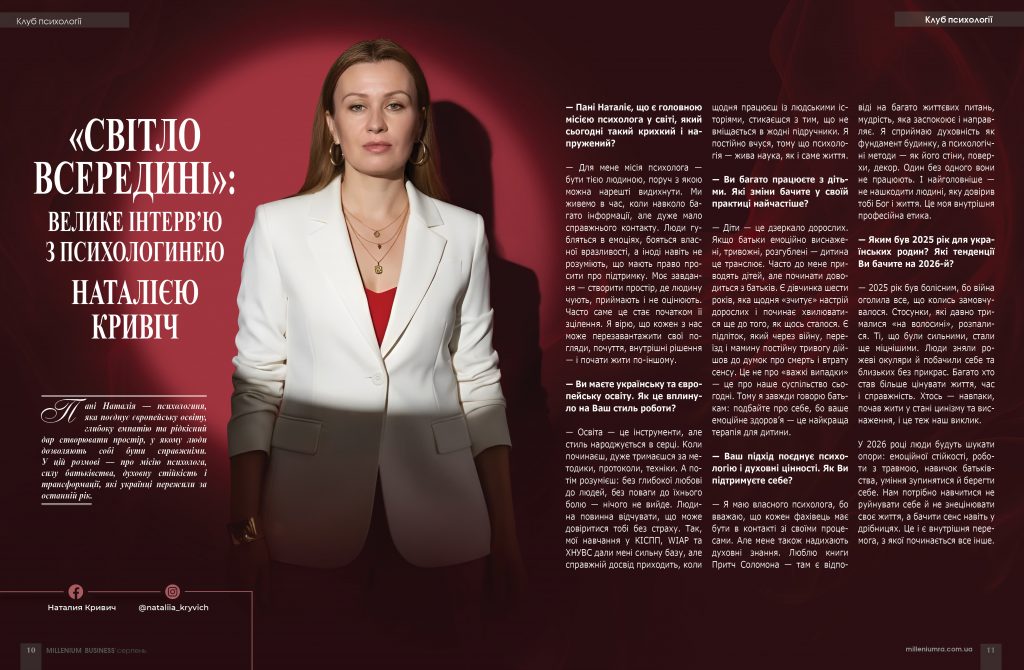
Пані Наталія — психологиня, яка поєднує європейську освіту, глибоку емпатію та рідкісний дар створювати простір, у якому люди дозволяють собі бути справжніми. У цій розмові — про місію психолога, силу батьківства, духовну стійкість і трансформації, які українці пережили за останній рік.
— Пані Наталіє, що є головною місією психолога у світі, який сьогодні такий крихкий і напружений?
— Для мене місія психолога — бути тією людиною, поруч з якою можна нарешті видихнути. Ми живемо в час, коли навколо багато інформації, але дуже мало справжнього контакту. Люди губляться в емоціях, бояться власної вразливості, а іноді навіть не розуміють, що мають право просити про підтримку. Моє завдання — створити простір, де людину чують, приймають і не оцінюють. Часто саме це стає початком її зцілення. Я вірю, що кожен з нас може перезавантажити свої погляди, почуття, внутрішні рішення — і почати жити по-іншому.
— Ви маєте українську та європейську освіту. Як це вплинуло на Ваш стиль роботи?
— Освіта — це інструменти, але стиль народжується в серці. Коли починаєш, дуже тримаєшся за методики, протоколи, техніки. А потім розумієш: без глибокої любові до людей, без поваги до їхнього болю — нічого не вийде. Людина повинна відчувати, що може довіритися тобі без страху. Так, мої навчання у КІСПП, WIAP та ХНУВС дали мені сильну базу, але справжній досвід приходить, коли щодня працюєш із людськими історіями, стикаєшся з тим, що не вміщається в жодні підручники. Я постійно вчуся, тому що психологія — жива наука, як і саме життя.
— Ви багато працюєте з дітьми. Які зміни бачите у своїй практиці найчастіше?
— Діти — це дзеркало дорослих. Якщо батьки емоційно виснажені, тривожні, розгублені — дитина це транслює. Часто до мене приводять дітей, але починати доводиться з батьків. Є дівчинка шести років, яка щодня «зчитує» настрій дорослих і починає хвилюватися ще до того, як щось сталося. Є підліток, який через війну, переїзд і мамину постійну тривогу дійшов до думок про смерть і втрату сенсу. Це не про «важкі випадки» — це про наше суспільство сьогодні. Тому я завжди говорю батькам: подбайте про себе, бо ваше емоційне здоров’я — це найкраща терапія для дитини.
— Ваш підхід поєднує психологію і духовні цінності. Як Ви підтримуєте себе?
— Я маю власного психолога, бо вважаю, що кожен фахівець має бути в контакті зі своїми процесами. Але мене також надихають духовні знання. Люблю книги Притч Соломона — там є відповіді на багато життєвих питань, мудрість, яка заспокоює і направляє. Я сприймаю духовність як фундамент будинку, а психологічні методи — як його стіни, поверхи, декор. Один без одного вони не працюють. І найголовніше — не нашкодити людині, яку довірив тобі Бог і життя. Це моя внутрішня професійна етика.
— Яким був 2025 рік для українських родин? Які тенденції Ви бачите на 2026-й?
— 2025 рік був болісним, бо війна оголила все, що колись замовчувалося. Стосунки, які давно трималися «на волосині», розпалися. Ті, що були сильними, стали ще міцнішими. Люди зняли рожеві окуляри й побачили себе та близьких без прикрас. Багато хто став більше цінувати життя, час і справжність. Хтось — навпаки, почав жити у стані цинізму та виснаження, і це теж наш виклик.
У 2026 році люди будуть шукати опори: емоційної стійкості, роботи з травмою, навичок батьківства, уміння зупинятися й берегти себе. Нам потрібно навчитися не руйнувати себе й не знецінювати своє життя, а бачити сенс навіть у дрібницях. Це і є внутрішня перемога, з якої починається все інше.
“LIGHT INSIDE”: A BIG INTERVIEW WITH PSYCHOLOGIST NATALIIA KRYVICH
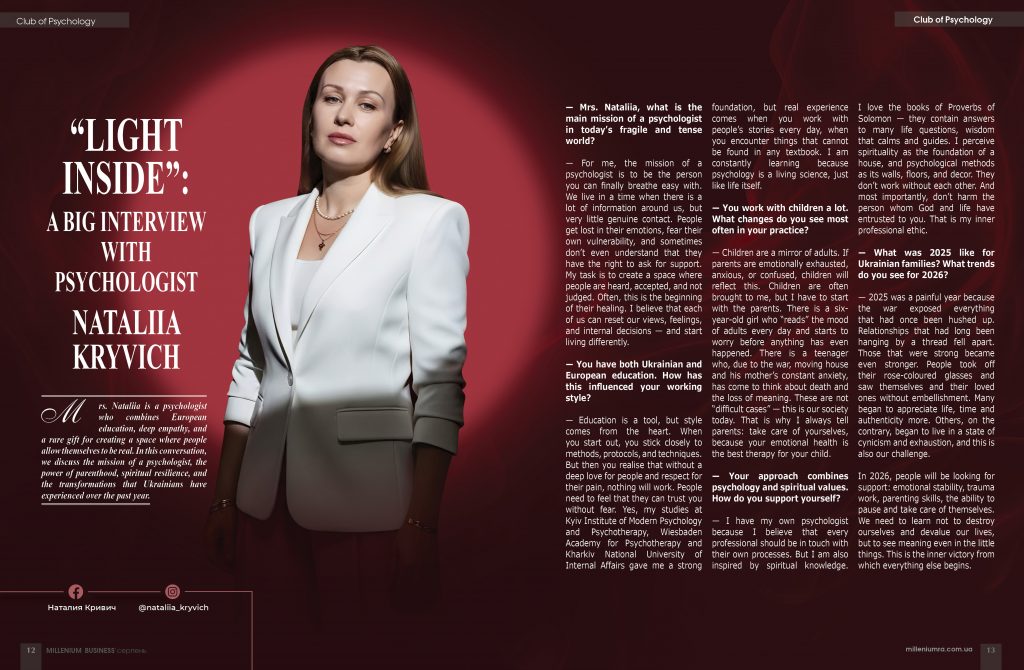
Мrs. Nataliia is a psychologist who combines European education, deep empathy, and a rare gift for creating a space where people allow themselves to be real. In this conversation, we discuss the mission of a psychologist, the power of parenthood, spiritual resilience, and the transformations that Ukrainians have experienced over the past year.
— Mrs. Nataliia, what is the main mission of a psychologist in today’s fragile and tense world?
— For me, the mission of a psychologist is to be the person you can finally breathe easy with. We live in a time when there is a lot of information around us, but very little genuine contact. People get lost in their emotions, fear their own vulnerability, and sometimes don’t even understand that they have the right to ask for support. My task is to create a space where people are heard, accepted, and not judged. Often, this is the beginning of their healing. I believe that each of us can reset our views, feelings, and internal decisions — and start living differently.
— You have both Ukrainian and European education. How has this influenced your working style?
— Education is a tool, but style comes from the heart. When you start out, you stick closely to methods, protocols, and techniques. But then you realise that without a deep love for people and respect for their pain, nothing will work. People need to feel that they can trust you without fear. Yes, my studies at Kyiv Institute of Modern Psychology and Psychotherapy, Wiesbaden Academy for Psychotherapy and Kharkiv National University of Internal Affairs gave me a strong foundation, but real experience comes when you work with people’s stories every day, when you encounter things that cannot be found in any textbook. I am constantly learning because psychology is a living science, just like life itself.
— You work with children a lot. What changes do you see most often in your practice?
— Children are a mirror of adults. If parents are emotionally exhausted, anxious, or confused, children will reflect this. Children are often brought to me, but I have to start with the parents. There is a six-year-old girl who “reads” the mood of adults every day and starts to worry before anything has even happened. There is a teenager who, due to the war, moving house and his mother’s constant anxiety, has come to think about death and the loss of meaning. These are not “difficult cases” — this is our society today. That is why I always tell parents: take care of yourselves, because your emotional health is the best therapy for your child.
— Your approach combines psychology and spiritual values. How do you support yourself?
— I have my own psychologist because I believe that every professional should be in touch with their own processes. But I am also inspired by spiritual knowledge. I love the books of Proverbs of Solomon — they contain answers to many life questions, wisdom that calms and guides. I perceive spirituality as the foundation of a house, and psychological methods as its walls, floors, and decor. They don’t work without each other. And most importantly, don’t harm the person whom God and life have entrusted to you. That is my inner professional ethic.
— What was 2025 like for Ukrainian families? What trends do you see for 2026?
— 2025 was a painful year because the war exposed everything that had once been hushed up. Relationships that had long been hanging by a thread fell apart. Those that were strong became even stronger. People took off their rose-coloured glasses and saw themselves and their loved ones without embellishment. Many began to appreciate life, time and authenticity more. Others, on the contrary, began to live in a state of cynicism and exhaustion, and this is also our challenge.
In 2026, people will be looking for support: emotional stability, trauma work, parenting skills, the ability to pause and take care of themselves. We need to learn not to destroy ourselves and devalue our lives, but to see meaning even in the little things. This is the inner victory from which everything else begins.