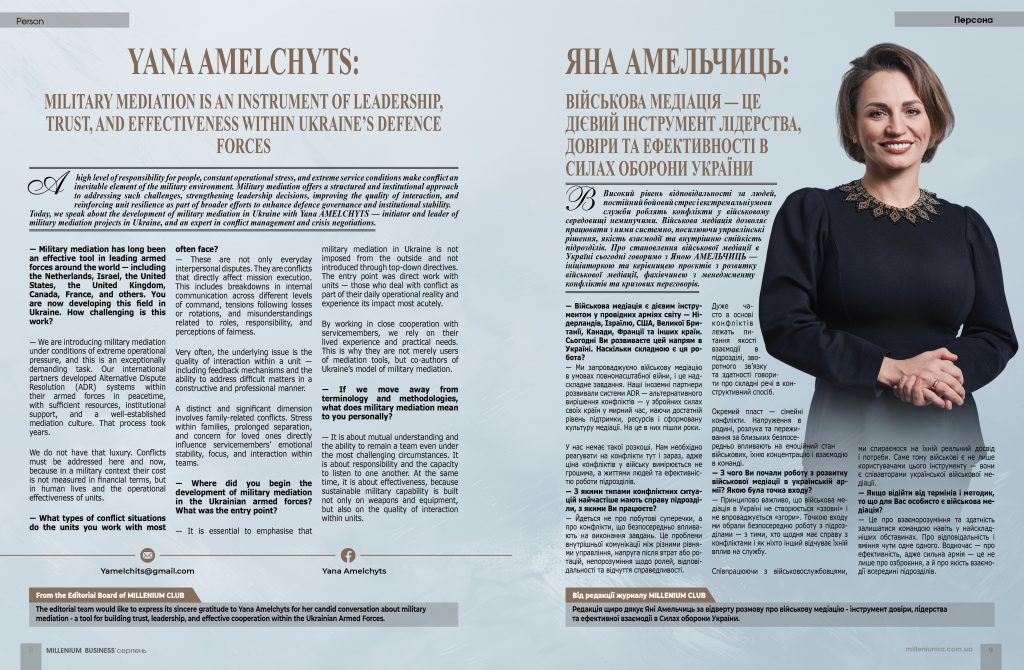
YANA AMELCHYTS: MILITARY MEDIATION IS AN INSTRUMENT OF LEADERSHIP, TRUST, AND EFFECTIVENESS WITHIN UKRAINE’S DEFENCE FORCES
А high level of responsibility for people, constant operational stress, and extreme service conditions make conflict an inevitable element of the military environment. Military mediation offers a structured and institutional approach to addressing such challenges, strengthening leadership decisions, improving the quality of interaction, and reinforcing unit resilience as part of broader efforts to enhance defence governance and institutional stability.
Today, we speak about the development of military mediation in Ukraine with Yana AMELCHYTS — initiator and leader of military mediation projects in Ukraine, and an expert in conflict management and crisis negotiations.
— Military mediation has long been an effective tool in leading armed forces around the world — including the Netherlands, Israel, the United States, the United Kingdom, Canada, France, and others. You are now developing this field in Ukraine. How challenging is this work?
— We are introducing military mediation under conditions of extreme operational pressure, and this is an exceptionally demanding task. Our international partners developed Alternative Dispute Resolution (ADR) systems within their armed forces in peacetime, with sufficient resources, institutional support, and a well-established mediation culture. That process took years.
We do not have that luxury. Conflicts must be addressed here and now, because in a military context their cost is not measured in financial terms, but in human lives and the operational effectiveness of units.
— What types of conflict situations do the units you work with most often face?
— These are not only everyday interpersonal disputes. They are conflicts that directly affect mission execution. This includes breakdowns in internal communication across different levels of command, tensions following losses or rotations, and misunderstandings related to roles, responsibility, and perceptions of fairness.
Very often, the underlying issue is the quality of interaction within a unit — including feedback mechanisms and the ability to address difficult matters in a constructive and professional manner.
A distinct and significant dimension involves family-related conflicts. Stress within families, prolonged separation, and concern for loved ones directly influence servicemembers’ emotional stability, focus, and interaction within teams.
— Where did you begin the development of military mediation in the Ukrainian armed forces? What was the entry point?
— It is essential to emphasise that military mediation in Ukraine is not imposed from the outside and not introduced through top-down directives. The entry point was direct work with units — those who deal with conflict as part of their daily operational reality and experience its impact most acutely.
By working in close cooperation with servicemembers, we rely on their lived experience and practical needs. This is why they are not merely users of mediation tools, but co-authors of Ukraine’s model of military mediation.
— If we move away from terminology and methodologies, what does military mediation mean to you personally?
— It is about mutual understanding and the ability to remain a team even under the most challenging circumstances. It is about responsibility and the capacity to listen to one another. At the same time, it is about effectiveness, because sustainable military capability is built not only on weapons and equipment, but also on the quality of interaction within units.
From the Editorial Board of MILLENIUM CLUB.
The editorial team would like to express its sincere gratitude to Yana Amelchyts for her candid conversation about military mediation – a tool for building trust, leadership, and effective cooperation within the Ukrainian Armed Forces.
ЯНА АМЕЛЬЧИЦЬ: ВІЙСЬКОВА МЕДІАЦІЯ — ЦЕ ДІЄВИЙ ІНСТРУМЕНТ ЛІДЕРСТВА, ДОВІРИ ТА ЕФЕКТИВНОСТІ В СИЛАХ ОБОРОНИ УКРАЇНИ
Високий рівень відповідальності за людей, постійний бойовий стрес і екстремальні умови служби роблять конфлікти у військовому середовищі неминучими. Військова медіація дозволяє працювати з ними системно, посилюючи управлінські рішення, якість взаємодії та внутрішню стійкість підрозділів. Про становлення військової медіації в Україні сьогодні говоримо з Яною АМЕЛЬЧИЦЬ — ініціаторкою та керівницею проєктів з розвитку військової медіації, фахівчинею з менеджменту конфліктів та кризових переговорів.
— Військова медіація є дієвим інструментом у провідних арміях світу — Нідерландів, Ізраїлю, США, Великої Британії, Канади, Франції та інших країн. Сьогодні Ви розвиваєте цей напрям в Україні. Наскільки складною є ця робота?
— Ми запроваджуємо військову медіацію в умовах повномасштабної війни, і це надскладне завдання. Наші іноземні партнери розвивали системи ADR — альтернативного вирішення конфліктів — у збройних силах своїх країн у мирний час, маючи достатній рівень підтримки, ресурсів і сформовану культуру медіації. На це в них пішли роки.
У нас немає такої розкоші. Нам необхідно реагувати на конфлікти тут і зараз, адже ціна конфліктів у війську вимірюється не грошима, а життями людей та ефективністю роботи підрозділів.
— З якими типами конфліктних ситуацій найчастіше мають справу підрозділи, з якими Ви працюєте?
— Йдеться не про побутові суперечки, а про конфлікти, що безпосередньо впливають на виконання завдань. Це проблеми внутрішньої комунікації між різними рівнями управління, напруга після втрат або ротацій, непорозуміння щодо ролей, відповідальності та відчуття справедливості.
Дуже часто в основі конфліктів лежать питання якості взаємодії в підрозділі, зворотного зв’язку та здатності говорити про складні речі в конструктивний спосіб.
Окремий пласт — сімейні конфлікти. Напруження в родині, розлука та переживання за близьких безпосередньо впливають на емоційний стан військових, їхню концентрацію і взаємодію в команді.
— З чого Ви почали роботу з розвитку військової медіації в українській армії? Якою була точка входу?
— Принципово важливо, що військова медіація в Україні не створюється «ззовні» і не впроваджується «згори». Точкою входу ми обрали безпосередню роботу з підрозділами — з тими, хто щодня має справу з конфліктами і як ніхто інший відчуває їхній вплив на службу.
Співпрацюючи з військовослужбовцями, ми спираємося на їхній реальний досвід і потреби. Саме тому військові є не лише користувачами цього інструменту — вони є співавторами української військової медіації.
— Якщо відійти від термінів і методик, то що для Вас особисто є військова медіація?
— Це про взаєморозуміння та здатність залишатися командою навіть у найскладніших обставинах. Про відповідальність і вміння чути одне одного. Водночас — про ефективність, адже сильна армія — це не лише про озброєння, а й про якість взаємодії всередині підрозділів.
Від редакції журналу MILLENIUM CLUB
Редакція щиро дякує Яні Амельчиць за відверту розмову про військову медіацію – інструмент довіри, лідерства та ефективної взаємодії в Силах оборони України.