
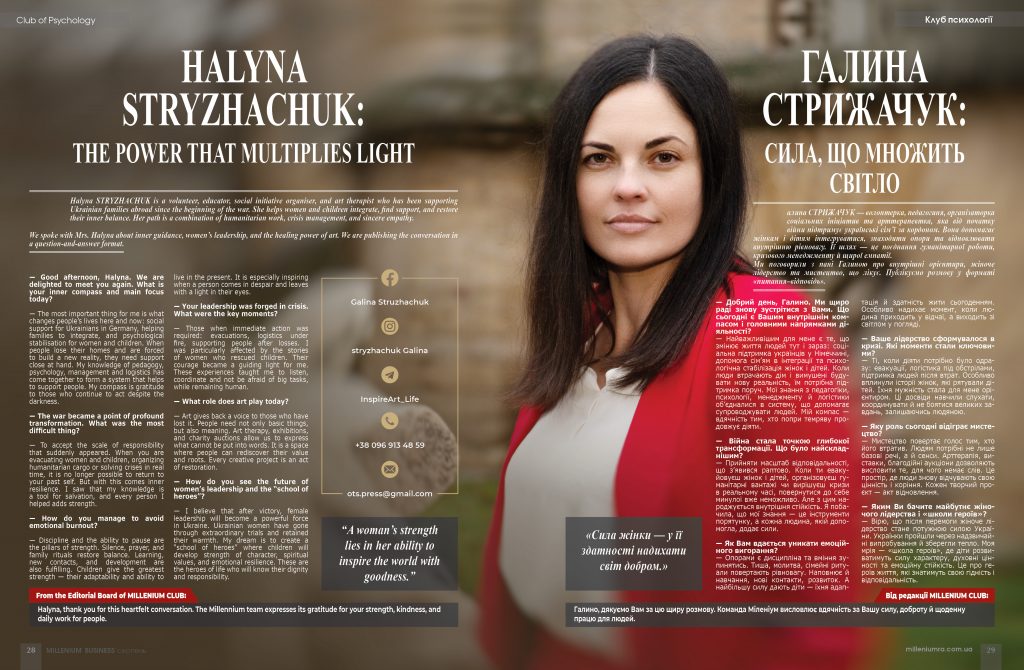
Галина СТРИЖАЧУК — волонтерка, педагогиня, організаторка соціальних ініціатив та арттерапевтка, яка від початку війни підтримує українські сім’ї за кордоном. Вона допомагає жінкам і дітям інтегруватися, знаходити опори та відновлювати внутрішню рівновагу. Її шлях — це поєднання гуманітарної роботи, кризового менеджменту й щирої емпатії.
Ми поговорили з пані Галиною про внутрішні орієнтири, жіноче лідерство та мистецтво, що лікує. Публікуємо розмову у форматі «питання–відповідь».
— Добрий день, Галино. Ми щиро раді знову зустрітися з Вами. Що сьогодні є Вашим внутрішнім компасом і головними напрямками діяльності?
— Найважливішим для мене є те, що змінює життя людей тут і зараз: соціальна підтримка українців у Німеччині, допомога сім’ям в інтеграції та психологічна стабілізація жінок і дітей. Коли люди втрачають дім і вимушені будувати нову реальність, їм потрібна підтримка поруч. Мої знання з педагогіки, психології, менеджменту й логістики об’єдналися в систему, що допомагає супроводжувати людей. Мій компас — вдячність тим, хто попри темряву продовжує діяти.
— Війна стала точкою глибокої трансформації. Що було найскладнішим?
— Прийняти масштаб відповідальності, що з’явився раптово. Коли ти евакуйовуєш жінок і дітей, організовуєш гуманітарні вантажі чи вирішуєш кризи в реальному часі, повернутися до себе минулої вже неможливо. Але з цим народжується внутрішня стійкість. Я побачила, що мої знання — це інструменти порятунку, а кожна людина, якій допомогла, додає сили.
— Як Вам вдається уникати емоційного вигорання?
— Опорами є дисципліна та вміння зупинятись. Тиша, молитва, сімейні ритуали повертають рівновагу. Наповнює й навчання, нові контакти, розвиток. А найбільшу силу дають діти — їхня адаптація й здатність жити сьогоденням. Особливо надихає момент, коли людина приходить у відчаї, а виходить зі світлом у погляді.
— Ваше лідерство сформувалося в кризі. Які моменти стали ключовими?
— Ті, коли діяти потрібно було одразу: евакуації, логістика під обстрілами, підтримка людей після втрат. Особливо вплинули історії жінок, які рятували дітей. Їхня мужність стала для мене орієнтиром. Ці досвіди навчили слухати, координувати й не боятися великих завдань, залишаючись людяною.
— Яку роль сьогодні відіграє мистецтво?
— Мистецтво повертає голос тим, хто його втратив. Людям потрібні не лише базові речі, а й сенси. Арттерапія, виставки, благодійні аукціони дозволяють висловити те, для чого немає слів. Це простір, де люди знову відчувають свою цінність і коріння. Кожен творчий проєкт — акт відновлення.
— Яким Ви бачите майбутнє жіночого лідерства і «школи героїв»?
— Вірю, що після перемоги жіноче лідерство стане потужною силою України. Українки пройшли через надзвичайні випробування й зберегли тепло. Моя мрія — «школа героїв», де діти розвиватимуть силу характеру, духовні цінності та емоційну стійкість. Це про героїв життя, які знатимуть свою гідність і відповідальність.
Галино, дякуємо Вам за цю щиру розмову. Команда Міленіум висловлює вдячність за Вашу силу, доброту й щоденну працю для людей.
HALYNA STRYZHACHUK:
THE POWER THAT MULTIPLIES LIGHT
Halyna STRYZHACHUK is a volunteer, educator, social initiative organiser, and art therapist who has been supporting Ukrainian families abroad since the beginning of the war. She helps women and children integrate, find support, and restore their inner balance. Her path is a combination of humanitarian work, crisis management, and sincere empathy.
We spoke with Mrs. Halyna about inner guidance, women’s leadership, and the healing power of art. We are publishing the conversation in a question-and-answer format.
— Good afternoon, Halyna. We are delighted to meet you again. What is your inner compass and main focus today?
— The most important thing for me is what changes people’s lives here and now: social support for Ukrainians in Germany, helping families to integrate, and psychological stabilisation for women and children. When people lose their homes and are forced to build a new reality, they need support close at hand. My knowledge of pedagogy, psychology, management and logistics has come together to form a system that helps to support people. My compass is gratitude to those who continue to act despite the darkness.
— The war became a point of profound transformation. What was the most difficult thing?
— To accept the scale of responsibility that suddenly appeared. When you are evacuating women and children, organizing humanitarian cargo or solving crises in real time, it is no longer possible to return to your past self. But with this comes inner resilience. I saw that my knowledge is a tool for salvation, and every person I helped adds strength.
— How do you manage to avoid emotional burnout?
— Discipline and the ability to pause are the pillars of strength. Silence, prayer, and family rituals restore balance. Learning, new contacts, and development are also fulfilling. Children give the greatest strength — their adaptability and ability to live in the present. It is especially inspiring when a person comes in despair and leaves with a light in their eyes.
— Your leadership was forged in crisis. What were the key moments?
— Those when immediate action was required: evacuations, logistics under fire, supporting people after losses. I was particularly affected by the stories of women who rescued children. Their courage became a guiding light for me. These experiences taught me to listen, coordinate and not be afraid of big tasks, while remaining human.
— What role does art play today?
— Art gives back a voice to those who have lost it. People need not only basic things, but also meaning. Art therapy, exhibitions, and charity auctions allow us to express what cannot be put into words. It is a space where people can rediscover their value and roots. Every creative project is an act of restoration.
— How do you see the future of women’s leadership and the “school of heroes”?
— I believe that after victory, female leadership will become a powerful force in Ukraine. Ukrainian women have gone through extraordinary trials and retained their warmth. My dream is to create a “school of heroes” where children will develop strength of character, spiritual values, and emotional resilience. These are the heroes of life who will know their dignity and responsibility.
Halyna, thank you for this heartfelt conversation. The Millennium team expresses its gratitude for your strength, kindness, and daily work for people.